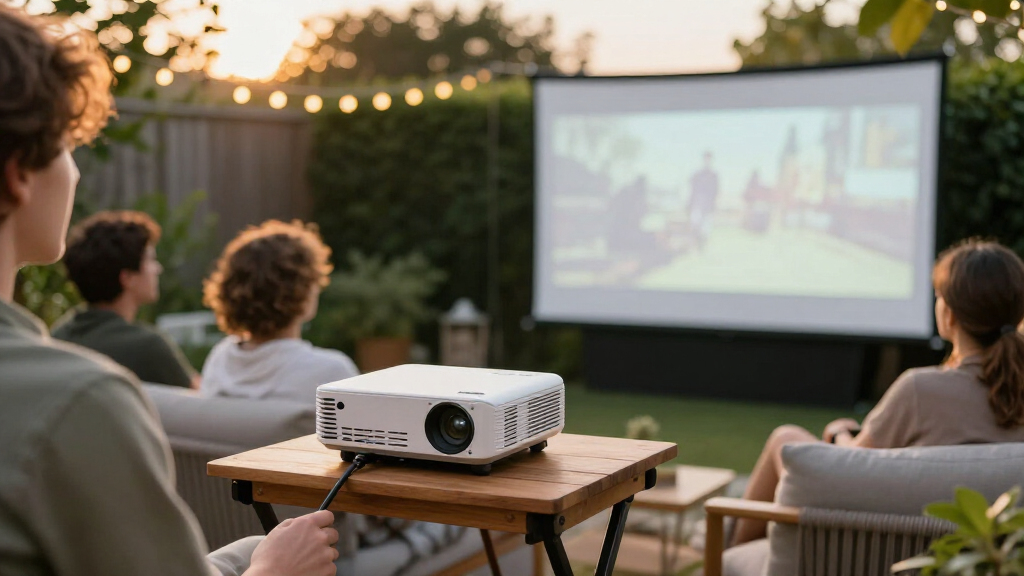
Among these portable mini projectors, I rank the Aurzen Roku TV E1R first for its Roku smart-TV experience, while the XuanPad Portable Smart Projector stands out for native 1080p resolution, autofocus, and a 360-degree stand. The Kodak Ultra Mini takes a different route, prioritizing pocket-sized portability over a full smart-projector feature set. The main tradeoffs are easy streaming versus flexible source connections, and compact size versus image detail and setup convenience. No mini projector can replace a bright-room television, so matching expectations to where and how you watch matters. Read on for the full comparison, buying advice, and picks for different needs.

Get the latest gadgets delivered free with Prime
- Fast, free delivery on millions of items
- Prime Video, Amazon Music and more included
- Member-only deals all year
Complete the kit



Key Takeaways
- Smart TV convenience shapes the leading picks: the Roku-equipped Aurzen E1R and D1R Air offer a more familiar streaming route than models that rely on built-in apps or an external source.
- Native resolution and supported resolution are not interchangeable: the XuanPad and HAPPRUN H1 are listed as native 1080p models, while several others advertise 1080p or 4K support without that phrase establishing native resolution.
- Setup features can matter more than a long feature list: autofocus, electric focus, and adjustable stands can reduce alignment work, but they do not remove the need for a suitable screen position.
- Portability comes in different forms: the Kodak Ultra Mini is aimed at carrying convenience, while rotatable designs such as the Magcubic and 180-degree models emphasize flexible placement.
- Most picks make a specific compromise: smart apps can simplify streaming, but buyer priorities should still include brightness, sound, power needs, and whether the projector can connect to the devices they already use.
| HAPPRUN Roku Smart Mini Projector with WiFi and Bluetooth |  | Best for Built-In Streaming | Display type: LCD | Maximum resolution: HD; specific resolution not stated | Maximum image size: 120 inches | VIEW LATEST PRICE | See Our Full Breakdown |
| TMY V08 Portable Projector with Two-Way Bluetooth and 80-Inch Screen |  | Best Value for a Ready-Made Setup | Native resolution: 1280 × 720 | Maximum display resolution: 1920 × 1080 | Projection size: 32–220 inches | VIEW LATEST PRICE | See Our Full Breakdown |
| Kodak Ultra Mini Portable DLP Projector |  | Best for Pocket-Sized Portability | Display technology: LED DLP | Native resolution: 640 × 360 | Maximum input resolution: 1920 × 1080 | VIEW LATEST PRICE | See Our Full Breakdown |
| Portable Mini Projector with Wi-Fi, Bluetooth, and Built-In Apps |  | Best for Flexible Placement | Native resolution: 1280 × 720 | Maximum display resolution: 3840 × 2160 video playback | Brightness: 500 lm | VIEW LATEST PRICE | See Our Full Breakdown |
| Aurzen Roku TV E1R Smart Portable Mini Projector |  | Best Compact Roku Pick | Native resolution: 1280 × 720 | Maximum display resolution: 1280 × 720 | Brightness: 160 lm | VIEW LATEST PRICE | See Our Full Breakdown |
| AKIYO Mini Projector with WiFi, Bluetooth 5.2, 1080P |  | Best for Pocketable Portability | Native resolution: 1280 x 720 | Maximum resolution: 3840 x 2160 input | Brightness: 200 ANSI lumens | VIEW LATEST PRICE | See Our Full Breakdown |
| YGSKK Mini Projector with Wi-Fi 6, Bluetooth 5.3, Built-In Streaming Apps, and Electric Focus |  | Best for Built-In Streaming and Native 1080p | Native resolution: 1920 x 1080 | Input compatibility: 4K input | Brightness: 300 ANSI lumens | VIEW LATEST PRICE | See Our Full Breakdown |
| Aurzen Roku TV D1R Air Portable Smart Projector |  | Best for Roku Streaming and Simple Setup | Native resolution: 1920 x 1080 | Brightness: 300 ANSI lumens | Power input: USB-C PD, 65W or higher, 20V/3.25A | VIEW LATEST PRICE | See Our Full Breakdown |
| Thunrlge HY300 Portable Smart Mini Projector with Android 11 |  | Best for Ceiling Projection on a Basic Setup | Native resolution: 1280 x 720 | Display type: TFT LCD | Maximum image size: 130 in | VIEW LATEST PRICE | See Our Full Breakdown |
| XuanPad Portable Smart Projector, Native 1080p with 4K Support, Wi-Fi, Bluetooth 5.2, Autofocus, and 360° Stand |  | Best for Flexible Mounting and Image Adjustment | Native resolution: 1920 x 1080 | Maximum display resolution: 3840 x 2160 input | Display type: LCD | VIEW LATEST PRICE | See Our Full Breakdown |
| Magcubic Mini Projector with WiFi 6 and Bluetooth 5.4, Portable 4K Support, 5W Soundbase Speaker, Auto Vertical Keystone, 180° Rotatable Smart Projector for Home and Outdoor |  | Best for Flexible Placement | Weight: 0.88 lb | Native resolution: 1280 × 720 | Brightness: 200 ANSI lumens | VIEW LATEST PRICE | See Our Full Breakdown |
| HOMPOW Mini Projector – 1080P Supported Portable Bluetooth Projector |  | Best for Simple, Quiet Setup | Weight: 0.7 kg | Native resolution: 1280 × 720 | Brightness: 200 lm | VIEW LATEST PRICE | See Our Full Breakdown |
| HAPPRUN H1 Native 1080P Bluetooth Projector (Standard) |  | Best for Native Full HD | Native resolution: 1920 × 1080 | Brightness: 300 ANSI lumens | Contrast ratio: 10000:1 | VIEW LATEST PRICE | See Our Full Breakdown |
| Philoent Mini Projector with Wi-Fi 6, Bluetooth 5.4, and Built-In Apps |  | Best for Built-In Streaming in Small Spaces | Weight: 0.85 lb (387 g) | Native resolution: 1280 × 720 | Maximum display resolution: 1920 × 1080 | VIEW LATEST PRICE | See Our Full Breakdown |
| Wireless Mini Projector with WiFi 6 and Bluetooth, 4K/1080P Support, Portable 180° Rotatable Design, 17″-130″ Screen |  | Best for Broad Placement Flexibility | Resolution: 1920 × 1080 listed; supports 1080p/4K input | Contrast ratio: 1500:1 | Image size: 35–135 inches | VIEW LATEST PRICE | See Our Full Breakdown |
| portable mini projector | Native resolution | Brightness | Connectivity | Weight |
|---|---|---|---|---|
| HAPPRUN Roku Smart Mini Projec | — | — | — | — |
| TMY V08 Portable Projector wit | 1280 × 720 | — | 3.5 mm jack, Bluetooth, HDMI, USB | — |
| Kodak Ultra Mini Portable DLP | 640 × 360 | 35 ANSI lumens | HDMI, USB, MicroSD, 3.5 mm audio | 6.35 oz |
| Portable Mini Projector with W | 1280 × 720 | 500 lm | — | 0.77 lb (0.35 kg) |
| Aurzen Roku TV E1R Smart Porta | 1280 × 720 | 160 lm | — | Under 1 lb |
| AKIYO Mini Projector with WiFi | 1280 x 720 | 200 ANSI lumens | — | 360 g |
| YGSKK Mini Projector with Wi-F | 1920 x 1080 | 300 ANSI lumens | — | — |
| Aurzen Roku TV D1R Air Portabl | 1920 x 1080 | 300 ANSI lumens | Dual-band Wi-Fi, Bluetooth 5.2, HDMI, USB, audio out, USB-C | 1.18 kg (2.60 lb) |
| Thunrlge HY300 Portable Smart | 1280 x 720 | — | Wi-Fi 6, Bluetooth, HDMI, USB | — |
| XuanPad Portable Smart Project | 1920 x 1080 | — | — | 1.89 lb |
| Magcubic Mini Projector with W | 1280 × 720 | 200 ANSI lumens | Wi-Fi 6, Bluetooth 5.4, HDMI, USB | 0.88 lb |
| HOMPOW Mini Projector | 1280 × 720 | 200 lm | HDMI 2.0, USB 2.0, 3.5 mm jack, IR | 0.7 kg |
| HAPPRUN H1 Native 1080P Blueto | 1920 × 1080 | 300 ANSI lumens | HDMI, Bluetooth 5.3, 3.5 mm jack, USB, IR | — |
| Philoent Mini Projector with W | 1280 × 720 | 200 ANSI lumens | Wi-Fi 6, Bluetooth 5.4, HDMI, USB | 0.85 lb (387 g) |
| Wireless Mini Projector with W | — | — | Wi-Fi 6, Bluetooth, DC, AV, USB, 3.5 mm headphone jack | — |
More Details on Our Top Picks
HAPPRUN Roku Smart Mini Projector with WiFi and Bluetooth
I’d pick the HAPPRUN Roku Smart Mini Projector for portable viewing when avoiding a separate streaming stick matters more than having a specified resolution or brightness rating. Roku apps and free live channels are built in, while dual-band Wi-Fi and Bluetooth 5.2 cover streaming and wireless audio. Its stereo speakers with Dolby Audio and several mounting options make it more adaptable than the TMY V08, which includes a foldable screen but may need an external device for some streaming apps. The HAPPRUN can project up to 120 inches and supports HDMI with ARC, though the listing gives no brightness figure and describes its maximum resolution only as HD. I’d favor it for casual, flexible viewing rather than buyers who need detailed picture specifications or a particularly large image.
Pros:- Roku streaming and free live channels are built in
- Dual-band Wi-Fi and Bluetooth 5.2 support wireless connections
- Stereo speakers with Dolby Audio reduce reliance on separate audio gear
- Ceiling, tripod, tabletop, wall, and floor mounting options suit varied setups
Cons:- Maximum resolution is described as HD without a specific resolution
- No brightness specification is provided
- Maximum image size is 120 inches, smaller than the TMY V08’s stated 220-inch ceiling
Best for: Travelers and casual viewers who want Roku apps and live channels built into a portable projector.
Not ideal for: Buyers who need a clearly stated resolution and brightness level to judge picture performance before choosing.
- Display type:LCD
- Maximum resolution:HD; specific resolution not stated
- Maximum image size:120 inches
- Throw distance:3.28–17.43 feet
- Contrast ratio:1800:1
- Wireless connectivity:Dual-band Wi-Fi (2.4G/5G), Bluetooth 5.2
- Ports:HDMI with ARC, USB 2.0, 3.5 mm jack
- Audio:Built-in stereo speakers with Dolby Audio
- Mounting options:Ceiling, tripod, tabletop, wall, or floor
Our verdict“Choose this HAPPRUN if built-in Roku and flexible placement matter more to you than fully specified image performance.”
TMY V08 Portable Projector with Two-Way Bluetooth and 80-Inch Screen
The TMY V08 earns its place for buyers who want a screen included rather than another accessory to source. Its 80-inch foldable screen makes it easier to set up a basic movie space than with the HAPPRUN Roku model, which has built-in streaming but no screen listed. The TMY also accepts a 1080p input and can project images from 32 to 220 inches, but its native resolution is 1280 × 720; accepting a higher-resolution signal does not make the displayed image native 1080p. Two-way Bluetooth offers flexibility for audio playback or an external speaker, while HDMI and USB allow wired sources. I’d choose it for a simple, screen-in-the-box setup, not for viewers who expect apps to work directly or want phone adapters included.
Pros:- Includes an 80-inch foldable projection screen
- Two-way Bluetooth supports audio playback and external speaker pairing
- HDMI and USB accept a range of wired sources
- Projection range spans 32 to 220 inches
Cons:- Native resolution is 1280 × 720 despite support for up to 1920 × 1080 input
- Phone and tablet adapters are not included
- Some streaming apps may require an external streaming device or HDMI connection
Best for: First-time projector buyers who want an included 80-inch screen and plan to connect a laptop, console, or streaming device.
Not ideal for: Viewers who want built-in streaming apps, phone adapters in the box, or native Full HD resolution.
- Native resolution:1280 × 720
- Maximum display resolution:1920 × 1080
- Projection size:32–220 inches
- Projection distance:1.5–6 m
- Aspect ratio:16:9
- Connectivity:3.5 mm jack, Bluetooth, HDMI, USB
- Included screen:80-inch foldable screen
- Lamp lifetime:10,000 hours
Our verdict“Pick the TMY V08 if the included screen and wired-source flexibility matter more than built-in apps or native Full HD.”
Kodak Ultra Mini Portable DLP Projector
At 6.35 ounces and roughly 3.46 inches square, the Kodak Ultra Mini is the clearest pick here for packing light. Its built-in media player and HDMI, USB, and MicroSD connections give it more ways to play content than its size suggests. That convenience comes with a sharp limit: the 640 × 360 native resolution and 35 ANSI lumens suit dim rooms, not bright spaces or detail-focused viewing. The 1 W speaker is useful for a quick clip, but the HAPPRUN Roku projector is a more complete choice for streaming and room audio. Kodak’s maximum image size is 100 inches, yet I’d treat that as a flexibility figure rather than a target for crisp viewing. Its short battery life also favors brief sessions over an outdoor movie night.
Pros:- Very light at 6.35 ounces and small enough for pocket-sized packing
- Built-in media player supports playback without a separate source device
- HDMI, USB, MicroSD, and 3.5 mm audio provide varied connection options
- Listed light-source operating life is 30,000 hours
Cons:- 35 ANSI lumens restrict viewing to dark or dim environments
- Native resolution is only 640 × 360
- Maximum playback time is 1.5 hours
Best for: Travelers, presenters, or occasional viewers who need a genuinely pocketable projector for short sessions in dark rooms.
Not ideal for: Buyers planning long movie nights, viewing in ambient light, or watching content where fine detail matters.
- Display technology:LED DLP
- Native resolution:640 × 360
- Maximum input resolution:1920 × 1080
- Brightness:35 ANSI lumens
- Maximum image size:100 inches
- Connectivity:HDMI, USB, MicroSD, 3.5 mm audio
- Built-in speaker:1 W
- Maximum playback time:1.5 hours
- Weight:6.35 oz
Our verdict“Choose the Kodak when minimum size and weight outrank brightness, resolution, and long-session runtime.”
Portable Mini Projector with Wi-Fi, Bluetooth, and Built-In Apps
This model’s 180° rotation gives it a useful advantage for travel rooms and casual setups where a wall or ceiling is not directly in front of the table. At 0.77 lb, it is also light to carry, and auto focus plus vertical keystone correction can reduce setup adjustments. Compared with the Aurzen Roku E1R, it offers a shorter minimum throw distance of 0.8 feet and a larger stated maximum image size of 200 inches; the Aurzen instead supplies Roku TV and a portable strap. The projector’s 1280 × 720 native resolution remains the limit even though it supports 4K video playback via USB. Its built-in apps and dual-band Wi-Fi simplify source access, but a TV stick is not included if you prefer that route, and the recommended image range is a more modest 40–100 inches.
Pros:- 180° rotation supports wall and ceiling projection
- Lightweight at 0.77 lb for travel or outdoor carrying
- Auto focus and auto vertical keystone correction simplify setup
- Short 0.8-foot minimum throw distance supports close placement
Cons:- Native resolution is 1280 × 720; 4K support refers to video playback, not native display
- TV sticks are not included
- Recommended image size is 40–100 inches, despite a stated maximum of 200 inches
Best for: Travelers and renters who need a lightweight projector that can aim at walls or ceilings from flexible positions.
Not ideal for: Buyers seeking native 4K or Full HD detail, or those who want a specifically named Roku streaming interface.
- Native resolution:1280 × 720
- Maximum display resolution:3840 × 2160 video playback
- Brightness:500 lm
- Image size:30–200 inches; recommended 40–100 inches
- Throw distance:0.8–10 feet
- Throw ratio:0.9:1
- Wireless connectivity:Dual-band Wi-Fi (2.4 GHz and 5 GHz), Bluetooth 5.2
- Weight:0.77 lb (0.35 kg)
- Rotation:180°
Our verdict“Pick this model for flexible aiming and easy setup in small spaces, rather than for native high-resolution projection.”
Aurzen Roku TV E1R Smart Portable Mini Projector
The Aurzen Roku TV E1R pairs a sub-one-pound body with Roku TV, making it a strong fit for buyers who want familiar streaming in a compact package. Its 180° rotating stand, automatic vertical keystone correction, and adjustable focus make it easier to aim in temporary spaces than the TMY V08, which relies on a table or tripod and may need a separate streaming source. The E1R also supports Apple AirPlay and two-way Bluetooth, adding convenient ways to send content or audio. The tradeoff is a 1280 × 720 native resolution and a stated brightness of 160 lm, so I’d keep expectations to modest, controlled-light viewing rather than assume a large image will stay clear in a bright room. Roku activation also requires an account and internet access.
Pros:- Roku TV and popular streaming apps are built in
- Under-one-pound body and portable strap support carrying
- 180° rotating stand and automatic vertical keystone correction aid placement
- Apple AirPlay and two-way Bluetooth add wireless options
Cons:- Native and maximum display resolution are both 1280 × 720
- Listed brightness is 160 lm, limiting confidence for brighter environments
- Activation requires a Roku account and internet connection
Best for: Roku users who want a lightweight projector with a rotating stand for bedrooms, travel, or occasional outdoor viewing.
Not ideal for: Buyers who need native Full HD, strong performance in bright rooms, or activation without a Roku account and internet connection.
- Native resolution:1280 × 720
- Maximum display resolution:1280 × 720
- Brightness:160 lm
- Maximum image size:120 inches
- Maximum throw distance:9.6 feet
- Wireless connectivity:Wi-Fi 2.4 GHz/5 GHz, Bluetooth 5.2
- Ports:HDMI, USB
- Stand rotation:180°
- Weight:Under 1 lb
Our verdict“Choose the Aurzen E1R if compact carrying and built-in Roku matter more than Full HD resolution or bright-room viewing.”
AKIYO Mini Projector with WiFi, Bluetooth 5.2, 1080P
At just 360 grams and under five inches wide, the AKIYO is the easiest pick here to carry between rooms or pack for a trip. Its P2P direct casting can connect a compatible device without a Wi-Fi network, a useful option for presentations or temporary setups. The rotating stand and automatic keystone correction also reduce the fuss of aiming it at a wall. Compared with the YGSKK Mini Projector, though, this model gives up native 1080p sharpness: its panel is 720p, and its 200 ANSI lumens call for a dark room. The stated 4K maximum refers to input compatibility, not native resolution. I’d choose it for compactness and flexible connections, not for bright-room viewing or a large, detailed image.
Pros:- Very light, compact body is easy to carry
- P2P direct casting can work without a Wi-Fi network
- Dual-band Wi-Fi and Bluetooth 5.2 offer wireless connection options
- Rotating stand and automatic keystone correction help with quick positioning
Cons:- Native resolution is 720p, not 1080p
- 200 ANSI lumens suits dark rooms rather than ambient-light viewing
- Bluetooth does not pair with smartphones
Best for: Travelers and occasional users who want a very light projector for dark-room viewing and may need casting without a Wi-Fi network.
Not ideal for: Buyers prioritizing native 1080p detail, brighter viewing, or Bluetooth audio pairing with a smartphone.
- Native resolution:1280 x 720
- Maximum resolution:3840 x 2160 input
- Brightness:200 ANSI lumens
- Weight:360 g
- Dimensions:4.8 x 3.7 x 3.3 in
- Wireless:Dual-band 5 GHz / 2.4 GHz Wi-Fi; Bluetooth 5.2
- Connections:HDMI, USB, 3.5 mm audio jack
- Maximum image size:300 in
Our verdict“Choose the AKIYO if easy packing and network-free casting matter more to you than native 1080p resolution or brightness.”
YGSKK Mini Projector with Wi-Fi 6, Bluetooth 5.3, Built-In Streaming Apps, and Electric Focus
The YGSKK combines native 1080p with built-in streaming apps, so it can serve as a self-contained movie setup without relying on a separate streaming stick. Its remote-controlled electric focus is handy when the projector is placed out of reach, while the 210° rotating base gives it more positioning flexibility than the fixed-angle options. Compared with the 720p Thunrlge HY300, the YGSKK is the clearer choice for buyers who value full-HD detail. Its listed 300 ANSI lumens still point to dim-room use, and Android-phone mirroring requires a program; Bluetooth also does not connect to smartphones. I’d favor it over the AKIYO for a more complete living-room setup, but not if easy phone connectivity or bright-room performance is the priority.
Pros:- Native 1080p resolution provides more detail than the 720p AKIYO and Thunrlge
- Built-in streaming apps reduce the need for a separate playback device
- Electric focus can be adjusted from the remote
- 210° rotating base supports varied projection angles
Cons:- 300 ANSI lumens is best suited to dim or dark viewing
- Android phones require a program for wireless connection
- Bluetooth does not support smartphone connections
Best for: Viewers who want a portable, native-1080p projector with onboard streaming, remote electric focus, and flexible placement.
Not ideal for: People who need a projector for lit rooms or want straightforward Android-phone mirroring and Bluetooth phone pairing.
- Native resolution:1920 x 1080
- Input compatibility:4K input
- Brightness:300 ANSI lumens
- Projection size:50–200 in
- Wireless:Wi-Fi 6; 5 GHz and 2.4 GHz
- Bluetooth:Bluetooth 5.3; supports Bluetooth audio devices
- Focus:Electric focus controlled by remote
- Rotation:210° rotating base
- Audio and apps:Built-in stereo speakers and streaming apps
Our verdict“Pick the YGSKK for native 1080p and onboard streaming in a flexible portable design, provided you’ll use it in a darkened space.”
Aurzen Roku TV D1R Air Portable Smart Projector
The D1R Air stands out for a specific kind of portability: it pairs Roku TV built in with automatic focus and keystone correction, making it a straightforward choice for streaming without a separate stick or much manual alignment. Its gimbal stand helps aim the image, and AirPlay plus HDMI and USB leave room for other sources. Compared with the app-equipped YGSKK Mini Projector, Roku gives this model a familiar streaming interface, while the YGSKK offers a wider rotating base and remote electric focus. The D1R Air’s USB-C power requirement is a real constraint: it needs a compatible 65W-or-higher PD source, so it is not simply a projector to run from any USB battery. With 300 ANSI lumens, it also belongs in dim spaces, and its stated fan noise may matter during quiet scenes.
Pros:- Roku TV is built in for direct streaming
- TOF autofocus and automatic keystone correction simplify setup
- Gimbal stand helps direct the image toward a wall or screen
- AirPlay, HDMI, USB, and audio output support multiple sources
Cons:- Requires a compatible 65W-or-higher USB-C PD power source
- 300 ANSI lumens is better suited to dim or dark rooms
- Fan noise is specified at 29–35 dB at one meter
Best for: Roku users who want a compact projector with automatic image setup, AirPlay mirroring, and compatible USB-C PD power.
Not ideal for: Buyers who need flexible battery or low-wattage USB power, brighter-room viewing, or near-silent operation.
- Native resolution:1920 x 1080
- Brightness:300 ANSI lumens
- Power input:USB-C PD, 65W or higher, 20V/3.25A
- Dimensions:5.35 x 4.33 x 10.12 in
- Weight:1.18 kg (2.60 lb)
- Audio:Dual 5W speakers with Dolby Audio
- Connectivity:Dual-band Wi-Fi, Bluetooth 5.2, HDMI, USB, audio out, USB-C
- Setup:TOF autofocus and automatic keystone correction
- Fan noise:29–35 dB at 1 m
Our verdict“Choose the D1R Air if Roku convenience and automatic setup outweigh the need for flexible power or brighter viewing.”
Thunrlge HY300 Portable Smart Mini Projector with Android 11
The HY300’s defining advantage is its 180° rotation, which makes it easier to aim a small projected image at a ceiling or an awkward wall without repositioning the whole setup. Android 11 and built-in Netflix add a direct streaming route, while automatic keystone correction can help straighten the picture after placement. Against the YGSKK Mini Projector, however, the HY300 is the more basic image option: it has native 720p resolution, a maximum listed image size of 130 inches, and no brightness figure in the supplied specifications. That makes it a more sensible pick for casual viewing at modest sizes than for a large, detail-focused movie screen. The product information also conflicts about Bluetooth version and mentions 4K in the title despite the 720p native panel, so I’d choose it for its rotation and Android setup rather than resolution claims.
Pros:- 180° rotation allows flexible wall and ceiling projection
- Android 11 and built-in Netflix provide direct streaming
- Automatic keystone correction helps align the image
- Wi-Fi 6, Bluetooth, HDMI, and USB support varied connections
Cons:- Native resolution is 1280 x 720, despite the 4K wording in the title
- Brightness is not specified in the provided product data
- Bluetooth version information is inconsistent
Best for: Casual viewers who want a compact projector that can point toward the ceiling and stream directly from Android 11.
Not ideal for: Buyers seeking verified native 1080p, dependable brightness information, or a large high-detail projection.
- Native resolution:1280 x 720
- Display type:TFT LCD
- Maximum image size:130 in
- Throw distance:0.5–3 m
- Operating system:Android 11
- Connectivity:Wi-Fi 6, Bluetooth, HDMI, USB
- Rotation:180°
- Keystone correction:Automatic
- Contrast ratio:1500:1
Our verdict“The HY300 suits casual ceiling or wall viewing if flexible rotation and built-in streaming matter more than full-HD detail.”
XuanPad Portable Smart Projector, Native 1080p with 4K Support, Wi-Fi, Bluetooth 5.2, Autofocus, and 360° Stand
The XuanPad is the most adaptable placement option in this group: its detachable 360° stand supports tabletop, floor, wall, ceiling, or tripod setups, while autofocus and keystone correction cut down on manual alignment. Native 1080p resolution also gives it an image-detail advantage over the 720p AKIYO and Thunrlge models; 4K here refers to supported input, not native display resolution. Built-in apps and wireless mirroring add convenience for indoor or outdoor sessions. Compared with the Aurzen Roku TV D1R Air, the XuanPad offers more mounting flexibility and adjustable zoom, while the Aurzen supplies Roku TV and documented power and brightness details. XuanPad’s main buying uncertainty is that its brightness and speaker performance are not specified, so I would not choose it for a room where image visibility or audio quality needs to be predictable.
Pros:- Native 1080p resolution offers more detail than the 720p AKIYO and Thunrlge
- Detachable 360° stand supports varied mounting and projection positions
- Autofocus, keystone correction, and adjustable zoom ease setup
- Built-in apps and wireless screen mirroring reduce reliance on external sources
Cons:- Brightness is not specified in the supplied product data
- Built-in speaker specifications are not provided
- 4K support is input compatibility, not native 4K resolution
Best for: Buyers who move a native-1080p projector between rooms or projection angles and value a detachable stand, autofocus, and zoom.
Not ideal for: People who need confirmed brightness and speaker specifications, or who want a projector with Roku built in.
- Native resolution:1920 x 1080
- Maximum display resolution:3840 x 2160 input
- Display type:LCD
- Weight:1.89 lb
- Image size:40–200 in
- Zoom:50%–100%
- Wireless and ports:Wi-Fi, Bluetooth 5.2, HDMI, USB, 3.5 mm jack
- Stand:Detachable, 360° rotatable
- Warranty:Two-year product replacement warranty
Our verdict“Choose the XuanPad for versatile mounting and full-HD resolution, but look elsewhere if you need clearly documented brightness or audio performance.”
Magcubic Mini Projector with WiFi 6 and Bluetooth 5.4, Portable 4K Support, 5W Soundbase Speaker, Auto Vertical Keystone, 180° Rotatable Smart Projector for Home and Outdoor
The Magcubic is a strong fit when easy repositioning matters more than a sharp, bright picture. At just 0.88 lb, with a 180° rotating body and tabletop, ceiling, or tripod mounting, it adapts to temporary setups more readily than the HOMPOW, which has a more conventional compact design. Wi-Fi 6, Bluetooth 5.4, HDMI, and USB give you several ways to connect, while the 5W soundbase speaker can handle casual viewing without a separate speaker. Its 200 ANSI lumens suit a dim room or evening outdoors, not daylight or a lit living room. Although it accepts 4K input, its native resolution is 720p, so fine detail will not match the HAPPRUN H1’s native 1080p. Choose it for adaptable placement and wireless convenience, not maximum image clarity.
Pros:- Lightweight 0.88 lb design with 180° rotation and several mounting options
- Wi-Fi 6, Bluetooth 5.4, HDMI, and USB support flexible connections
- Built-in 5W soundbase speaker is useful for casual viewing without extra audio gear
- Accepts input up to 4K and supports H.265 video encoding
Cons:- Native 720p resolution is less detailed than the HAPPRUN H1’s native 1080p
- 200 ANSI lumens are best suited to dim viewing environments
- 4K support refers to input scaling, not native 4K projection
Best for: Travelers and renters who want a very light projector that can point at a wall or ceiling and connect wirelessly.
Not ideal for: Buyers who watch with room lights on or want crisp native Full HD detail; its brightness and 720p panel are limiting.
- Weight:0.88 lb
- Native resolution:1280 × 720
- Brightness:200 ANSI lumens
- Contrast ratio:2000:1
- Connectivity:Wi-Fi 6, Bluetooth 5.4, HDMI, USB
- Image size:80–130 inches
- Throw distance:0.6–2.6 m
- Speaker:5W soundbase speaker
Our verdict“Choose the Magcubic for lightweight, rotating placement and built-in wireless options, but pick a native 1080p model if detail is your priority.”
HOMPOW Mini Projector – 1080P Supported Portable Bluetooth Projector
The HOMPOW makes sense for buyers who want a straightforward portable projector with practical viewing extras rather than smart features. Its 0.7 kg body, 5W speaker, and whisper-quiet operation suit bedrooms and occasional outdoor movie nights, while two-way Bluetooth 5.1 offers more audio flexibility than the HAPPRUN H1’s audio-only Bluetooth connection. A low-blue-light feature and auto-off timer add convenience for family viewing, though neither changes the picture’s limits: brightness is 200 lumens and the panel is native 720p. It supports 1080p input, but that is not the same as native Full HD. Compared with the Magcubic, HOMPOW offers a shorter stated maximum screen size and lacks its 180° rotation; its appeal is a quieter, simple setup, not flexible aiming or a brighter image.
Pros:- Compact 0.7 kg design is easy to move between rooms
- Two-way Bluetooth 5.1 supports flexible audio connections
- Whisper-quiet operation and auto-off timer suit bedroom or family use
- Built-in 5W speaker and HDMI, USB, and 3.5 mm connections
Cons:- Native resolution is 720p despite support for 1080p input
- 200 lumens limit use in rooms with ambient light
- Phone screen mirroring requires a separate adapter
Best for: Families or bedroom viewers seeking a compact, quiet projector with basic wired connections, Bluetooth audio, and an automatic shutoff timer.
Not ideal for: Viewers who need native 1080p sharpness, bright-room performance, or built-in phone mirroring without an adapter.
- Weight:0.7 kg
- Native resolution:1280 × 720
- Brightness:200 lm
- Contrast ratio:10000:1
- Image size:40–120 inches
- Throw distance:3.49–7.26 ft
- Connectivity:HDMI 2.0, USB 2.0, 3.5 mm jack, IR
- Bluetooth:5.1, two-way
- Built-in speaker:5 W
Our verdict“Pick the HOMPOW for a quiet, uncomplicated bedroom or family setup, not for native Full HD detail or bright-room viewing.”
HAPPRUN H1 Native 1080P Bluetooth Projector (Standard)
For buyers who care more about image detail than a featherweight body or built-in streaming, the HAPPRUN H1 is the clearest choice in this group. Its native 1920 × 1080 resolution gives films and games more defined detail than the Magcubic and HOMPOW, both of which use 720p panels. The stated maximum image size of 200 inches also gives it more room to scale up than those smaller-screen options, though the 300 ANSI lumens still point to dim-room viewing rather than daylight use. HDMI, USB, a 3.5 mm jack, and Bluetooth 5.3 audio cover common connections, and its stereo speakers mean sound is available straight away. Unlike the Philoent, it has no listed built-in apps or autofocus, and phone streaming needs an external stick or adapter. Its advantage is straightforward picture resolution, not all-in-one convenience.
Pros:- Native 1920 × 1080 resolution offers more detail than the 720p Magcubic and HOMPOW
- Supports image sizes up to 200 inches
- HDMI, USB, 3.5 mm, and Bluetooth audio provide useful connection choices
- Built-in stereo speakers and included remote allow basic use without extra accessories
Cons:- 300 ANSI lumens are limited for rooms with substantial ambient light
- Phone and tablet streaming requires an external TV stick or HDMI adapter
- Bluetooth handles audio only, with no video casting
Best for: Movie and gaming viewers who want a portable projector with native 1080p and plan to use it in a darkened room.
Not ideal for: Buyers seeking a very lightweight travel projector, built-in streaming apps, automatic focus, or direct phone casting.
- Native resolution:1920 × 1080
- Brightness:300 ANSI lumens
- Contrast ratio:10000:1
- Maximum image size:200 inches
- Throw distance:1.2–7 m
- Connectivity:HDMI, Bluetooth 5.3, 3.5 mm jack, USB, IR
- Mounting:Desktop, tripod, ceiling mount
- Operating life:100,000 hours
Our verdict“Choose the HAPPRUN H1 if native 1080p and a large projected image matter more than built-in apps or the lightest travel-friendly design.”
Philoent Mini Projector with Wi-Fi 6, Bluetooth 5.4, and Built-In Apps
The Philoent is the most convenient pick here for a small room where streaming apps and quick setup matter. Built-in apps over Wi-Fi 6 reduce dependence on a separate streaming stick, while autofocus and automatic vertical keystone correction can save time when you move it between surfaces. Its 0.85 lb weight and 180° rotation make wall or ceiling projection easy, and the 0.8:1 throw ratio helps create a larger image from a closer position than the HAPPRUN H1’s more flexible but longer throw range. The tradeoff is a maximum stated image size of 86 inches and only 200 ANSI lumens, so it is better for intimate, dim-room viewing than big outdoor gatherings. Like the Magcubic, it has a native 720p panel despite accepting higher-resolution content.
Pros:- Built-in apps and Wi-Fi 6 reduce reliance on a separate streaming device
- Autofocus and automatic vertical keystone correction simplify repositioning
- 0.85 lb body rotates up to 180° for flexible wall and ceiling projection
- 0.8:1 throw ratio suits closer placement in smaller spaces
Cons:- Native resolution is 720p, below the HAPPRUN H1’s native 1080p
- 200 ANSI lumens are suited to dim environments
- Maximum image size is 86 inches, smaller than the HAPPRUN H1’s stated 200 inches
Best for: Apartment dwellers and travelers who want built-in streaming, automatic setup aids, and ceiling or wall projection in a compact room.
Not ideal for: Buyers who want a large outdoor screen, bright-room viewing, or native 1080p resolution.
- Weight:0.85 lb (387 g)
- Native resolution:1280 × 720
- Maximum display resolution:1920 × 1080
- Brightness:200 ANSI lumens
- Throw ratio:0.8:1
- Maximum image size:86 inches
- Connectivity:Wi-Fi 6, Bluetooth 5.4, HDMI, USB
- Rotation:Up to 180°
- Noise level:Approximately 25 dB
Our verdict“The Philoent suits small-space viewers who value built-in streaming and easy aiming, but not those prioritizing brightness, screen size, or native Full HD.”
Wireless Mini Projector with WiFi 6 and Bluetooth, 4K/1080P Support, Portable 180° Rotatable Design, 17″-130″ Screen
This wireless mini projector suits buyers who want one compact unit for varied distances and viewing angles. Its 180° swivel bracket supports wall or ceiling projection, while the stated throw range of 0.4–6 m gives more placement latitude than the Philoent’s short-throw-focused setup. Wi-Fi 6, Bluetooth, and a built-in speaker make casual wireless viewing possible, and the listed 1080p resolution is a step up on paper from the 720p Magcubic and HOMPOW. However, the product description says it supports 1080p and 4K input, so buyers should distinguish that support from native 4K capability. It also lists no built-in apps, and protected streaming content may require an external TV stick or Chromecast. The 1500:1 contrast ratio and unspecified brightness make this a flexible-use option, not a clearly brighter alternative.
Pros:- 180° swivel bracket supports wall and ceiling projection
- Wi-Fi 6 and Bluetooth enable wireless device and audio connections
- Listed 1080p resolution is a step above the native 720p Magcubic and HOMPOW
- Wide stated throw distance and image-size ranges allow varied placement
Cons:- 4K is supported input, not confirmed native 4K projection
- HDCP-protected content may need an external TV stick or Chromecast
- Brightness is not specified, making room-light suitability harder to judge
Best for: People who move a projector between rooms or travel with it and want a swivel mount plus wireless connections.
Not ideal for: Viewers who need confirmed native 4K, built-in streaming apps, or dependable playback of protected content directly from a phone.
- Resolution:1920 × 1080 listed; supports 1080p/4K input
- Contrast ratio:1500:1
- Image size:35–135 inches
- Throw distance:0.4–6 m
- Connectivity:Wi-Fi 6, Bluetooth, DC, AV, USB, 3.5 mm headphone jack
- Mount:180° swivel bracket
- Light source:LED
- Lamp life:45,000 hours
Our verdict“Choose this model for a swivel mount and flexible placement, but opt for a clearly specified native-resolution projector if image detail is the deciding factor.”
How We Picked
I compared these 15 portable mini projectors around the decisions that shape everyday use: image-resolution claims, streaming and device connections, setup aids, portability, and built-in sound. I gave extra weight to features that can make a small projector less fussy to use, such as Roku integration, autofocus, electric focus, and adjustable stands. I also distinguished native-resolution claims from supported input formats, since the wording affects what buyers can infer about image detail.
The ranking reflects practical fit, not a single specification. Models with clear streaming paths and useful setup features rank ahead for general use; compact or simpler options rank well for narrower needs, not as universal winners. Product names and listed features provide a basis for comparison, but they do not establish real-world brightness, battery life, or image quality. I would check those details against the exact listing and plan for a darker viewing space, since mini-projector performance depends heavily on room conditions.
Factors to Consider When Choosing Portable Mini Projectors
Before choosing a model, I would decide where the projector will sit and what will feed it. A small chassis can make transport easier, but it does not automatically make setup, streaming, or viewing outdoors simple. These checks can help separate useful portability from features that look appealing on a listing but may not fit your routine.
Choose a Streaming Path That Fits Your Devices
Built-in Roku, Android, and other app platforms can reduce the number of devices and cables you need for streaming. Their usefulness depends on the apps you want, network access, and whether the platform receives updates, so check the current listing rather than assuming every service is available. A projector with wireless connectivity may still need a compatible phone, laptop, streaming stick, or other source for your preferred content. Phone mirroring is not always a reliable substitute for a native app, particularly with protected streaming video. If you already own a streaming device, HDMI compatibility may matter more than an extensive built-in app menu. Choose the simplest source path you expect to use regularly, not the longest feature list.
Read Resolution Claims Carefully
Native resolution describes the projector’s actual display resolution, while a supported-resolution claim can refer to the format of an incoming video signal. Those phrases are not equivalent, and 4K support alone does not mean a compact projector displays a native 4K image. If text, interface details, or fine image texture matter, look for a clearly stated native resolution and verify it in the product specifications. Screen size also affects perceived sharpness: a larger image spreads the available detail across more area. For casual films in a dim room, buyers may care more about convenient setup than maximum pixel detail. Avoid choosing by the largest resolution number in a title without checking what it describes.
Plan for the Room and the Image Size
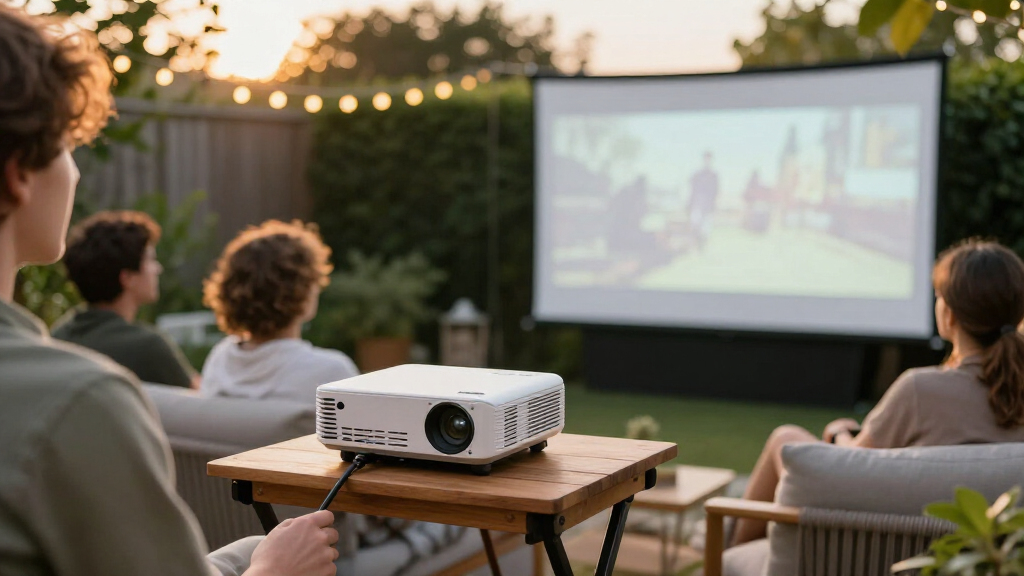
Mini projectors generally suit dim or dark spaces better than rooms with daylight or strong overhead lighting. A large advertised screen size does not guarantee a bright, clear image at that size; image quality depends on the projector, distance, screen, and ambient light. Before buying, check the throw distance and image-size range in the full specifications, then measure the place where you plan to set it up. A blank wall can work for casual viewing, but surface color and texture affect the result. Outdoor use adds another challenge: dusk is usually a more realistic viewing time than early evening with lingering light. If you need daytime viewing, a larger or brighter projector may be a better fit than a pocketable mini model.
Treat Focus and Keystone as Setup Aids, Not Fixes
Autofocus and electric focus can save time when you move a projector between rooms, while keystone correction can help square an image when placement is less than ideal. These tools do not make every angle or surface suitable, and aggressive correction may affect image geometry or clarity. Start by placing the projector as level and centered as possible, then use correction only for the remaining adjustment. A rotatable stand adds placement flexibility, but it still needs a stable surface and suitable projection angle. Buyers who set up once and leave the projector in place may not benefit as much from automated adjustments. Prioritize these features when frequent repositioning is part of your routine.
Check Sound, Power, and Connections as a Set
Built-in speakers make a projector easier to carry and set up, but a compact speaker may not fill a large room or outdoor area with clear sound. Bluetooth can allow a separate speaker connection, though the exact pairing options and audio behavior should be checked in the specifications. Also confirm how the projector receives power: portable size does not necessarily mean it has a built-in battery or can run without an outlet. For a laptop, console, or streaming device, verify that the ports and wireless connections match your equipment. A projector that looks self-contained may still need a power cable, separate speaker, or source device for your intended setup. Thinking through the whole viewing chain prevents portability from turning into extra gear to carry.
Pay for Convenience You Will Use
Features such as Roku, autofocus, and adjustable stands can be worthwhile when they remove steps from regular viewing. They are less valuable if you use a fixed HDMI source, keep the projector in one place, or mostly watch on a larger television. A compact model may be the better travel choice even if it gives up native resolution or integrated streaming. Conversely, a model with more setup tools can suit shared spaces where the projector gets moved often. Check warranty, supported formats, and connection details alongside headline features, since those affect ownership after setup. The best choice is the one whose advantages match your routine rather than the one with the most claims.
Frequently Asked Questions
Can a portable mini projector replace my TV for everyday viewing?
It can handle casual viewing, especially in a dim room, but I would not treat a mini projector as a direct replacement for a television in every setting. Ambient light, screen placement, and the projector’s actual brightness all affect the image, while a TV is usually simpler in a bright room. Consider how often you watch and whether you can darken the space before choosing. A Roku-equipped model may make streaming feel more familiar, but it does not change the room-light limits. If most viewing happens during the day, a TV or a brighter, less portable projector may suit you better.
Does a projector that supports 4K display a native 4K image?
Not necessarily: support for a 4K input format does not by itself mean the projector has a native 4K display. Check the listed native resolution separately from the formats the projector accepts. This distinction matters most if you care about fine detail or plan to project a large image. A smaller image in a dark room may make resolution differences less noticeable for casual viewing, but it does not change the specification. I would treat clear native-resolution information as more useful than a high supported-resolution claim alone.
Do built-in streaming apps mean I can watch without Wi-Fi?
Usually, built-in apps still need an internet connection to stream online content, so the word “built-in” does not mean the projector works offline. Check whether the model supports downloaded content or another offline playback method before relying on it away from home. You can also connect a local source, such as a laptop or compatible media device, if the projector supports it. For travel, confirm both the power requirements and the connection options at your destination. A projector with apps may reduce extra equipment, but it does not remove network needs for online viewing.
Are autofocus and keystone correction enough to avoid careful placement?
No. Autofocus can sharpen the image, and keystone correction can adjust its shape, but neither feature makes a poor position ideal. A projector still needs enough distance for the image size you want, a stable surface, and a reasonably centered angle. Heavy correction may also be less desirable than placing the projector correctly from the start. These features are most useful when the projector gets moved or when the available setup spot is imperfect. For a permanent setup, careful placement can matter more than automated adjustments.
What should I check before taking a mini projector outdoors?
First check whether the projector needs wall power, since portable dimensions do not confirm battery operation. Then consider how you will provide a streaming source, internet access, and sound if the built-in speaker is not adequate for your group. Outdoor viewing is usually easier after daylight fades, because ambient light can wash out a small projector’s image. Bring a suitable flat surface or screen and keep the projector stable and protected from the conditions described by its manufacturer. The Kodak Ultra Mini favors carry-friendly size, while rotatable models offer different placement flexibility; neither feature alone guarantees a complete outdoor setup.
Conclusion
For most buyers, I would start with the Aurzen Roku TV E1R as the best overall choice because Roku makes streaming more direct. The best value depends on your source setup: the HOMPOW Mini Projector is a simpler option to compare if you want a Bluetooth projector without prioritizing a full smart-TV platform. For a best premium-style feature set, I would look at the XuanPad for its stated native 1080p resolution, autofocus, and 360-degree stand, while checking the exact specifications before purchase. Beginners who want a familiar streaming interface can start with either Roku model, with the E1R as my lead pick and the D1R Air as an alternative. For specific needs, choose the Kodak Ultra Mini when carrying size leads, or the Magcubic when a rotatable design and listed soundbase speaker better match your setup. Whichever model you choose, verify brightness, power, and connection details against your viewing space and devices.
Fall Picks
fall essentials
As an affiliate, we earn on qualifying purchases.