
AR glasses aren’t likely to fully replace smartphones anytime soon because of technical limits, high costs, and user experience challenges. They offer hands-free, quick access but still lack the size, power, and affordability needed for everyday use. However, as technology advances and integration improves, hybrid devices may blur the lines between glasses and phones. To get a clearer picture of what the future might hold, keep exploring this evolving digital landscape.
Key Takeaways
- Current AR glasses have limited field of view, processing power, and battery life compared to smartphones, hindering full replacement.
- AR glasses excel in hands-free, real-time data access but lack the versatility, multitasking, and widespread app ecosystems of smartphones.
- Advances in AI, cloud computing, and sensor integration will improve AR glasses but may still complement rather than replace smartphones.
- Security, privacy, and social acceptance challenges must be addressed before AR glasses can fully substitute smartphones.
- Hybrid devices combining AR glasses and smartphones are more likely than outright replacement, enhancing user experience and functionality.
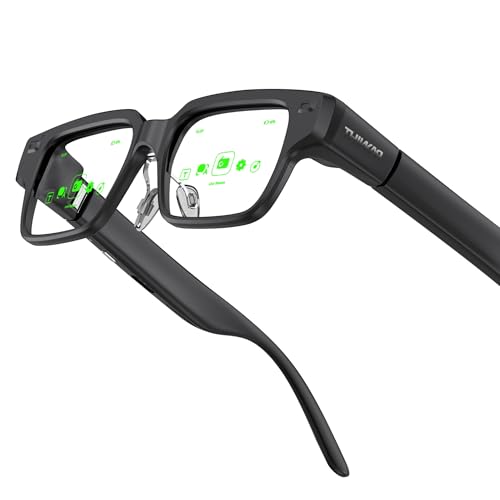
THIИKAЯ AiLens AI Glasses, 37g Smart AR Glasses with Dual Micro-OLED Display, AI Assistant, Translation, Teleprompter for Speeches, Notifications & Music, Bluetooth Pairing via App for Android & iOS
Dual-Lens Waveguide Display Technology: Engineered with an advanced binocular waveguide optical system, these AR smart glasses deliver a…
As an affiliate, we earn on qualifying purchases.
As an affiliate, we earn on qualifying purchases.
Current State of AR Glasses and Smartphone Capabilities
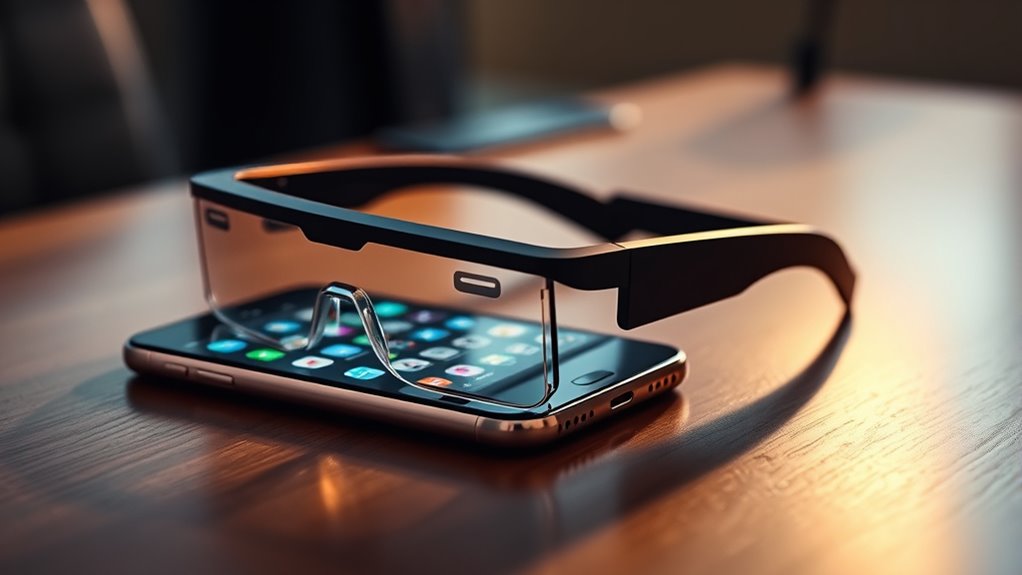
AR glasses have advanced considerably in recent years, offering high-brightness displays with MicroLED and holographic laser projection technologies. These innovations enable clearer visuals and deeper focus, making AR more practical in various settings. Today’s top models feature a field of view between 50° and 70°, which is narrower than smartphone screens that exceed 180°, limiting immersion. Onboard processing power now rivals mid-tier smartphones, supporting real-time overlays and interactions. Battery life averages 4 to 6 hours, less than smartphones’ 10 to 12 hours, restricting extended use. Controls leverage voice, gestures, and eye-tracking, providing hands-free operation. While AR glasses excel in overlaying information and enhancing productivity, they still lack the immersive depth and multitasking capabilities smartphones offer, especially for complex tasks. Processing power has become a crucial factor in determining how well AR glasses can handle demanding applications, even as they currently fall short in multitasking compared to smartphones.

Domars AR Smart Glasses with Display Screen, Built-in HD Camera & Ring Control, AI HUD Privacy Teleprompter Glasses for Speech, 268-Language Offline Translator for Business, Study Abroad and Travel
FLAWLESS PRESENTATIONS WITH INVISIBLE TELEPROMPTER: Step onto any stage or in front of the camera with absolute confidence….
As an affiliate, we earn on qualifying purchases.
As an affiliate, we earn on qualifying purchases.
Technological Differences and Limitations
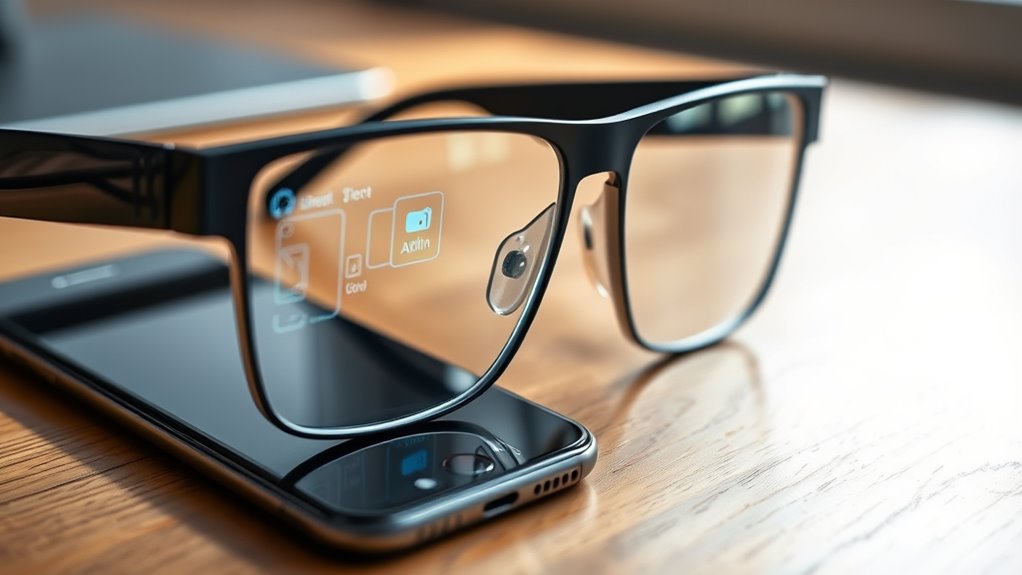
Despite rapid advancements, the technological gaps between AR glasses and smartphones remain significant. You’ll notice that AR glasses still have limited field of view, typically between 50° to 70°, compared to smartphones’ expansive screens over 180°. Battery life is another challenge, with glasses averaging only 4–6 hours, while smartphones last much longer. Processing power in AR glasses now rivals mid-tier phones, but they still struggle with intensive applications, multitasking, and complex navigation. High costs—ranging from $1,000 to $3,000—limit accessibility, and privacy concerns are growing as AR features become more integrated into daily life. Additionally, the contrast ratio of current AR glasses is insufficient for seamless integration with real-world environments, further hindering their adoption. These limitations hinder AR glasses from matching smartphones’ versatility, making it clear that significant technological hurdles still need overcoming before they can replace your device.

XREAL One Pro AR Glasses with X1 Chip, Native 3 DoF, X-Prism Optics, Real 3D, 57°FOV 171" 120Hz FHD Display, XR Glasses for iPhone 17/16, Steam Deck, ROG, Mac, PC, Android & iOS M (IPD 57-66mm)
XREAL's Self-Developed X1 Spatial Computing Chip: Delivers Native 3DoF tracking with ultra-low 3ms M2P latency, ensuring stable visuals…
As an affiliate, we earn on qualifying purchases.
As an affiliate, we earn on qualifying purchases.
User Experience and Interaction Dynamics
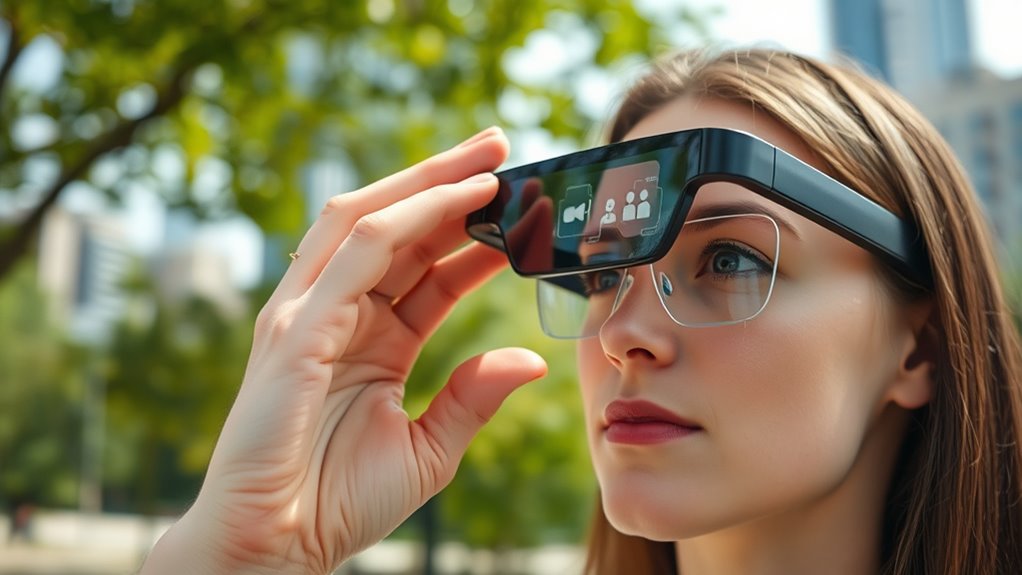
While technological limitations still challenge AR glasses, their user experience and interaction dynamics are evolving rapidly. You can operate them hands-free, which reduces the need to switch between devices, especially in professional settings. Voice and gesture controls are now 30% faster than touch for simple tasks, making interactions more seamless. However, for complex data entry or detailed content creation, smartphones still outperform AR glasses. They excel at providing contextual information overlays, helping you process information faster and with less mental load. Social acceptance is improving, but bulkier models still face stigma. Overall, AR glasses are becoming more intuitive, offering more natural and efficient ways to interact, though they haven’t yet matched the versatility and depth of smartphone interfaces. Additionally, advances in Free Floating technology are enabling virtual interfaces to overlay seamlessly onto real-world environments, enhancing user immersion and interaction flexibility.

XREAL 1S AR/XR Glasses, 500" Virtual Screen Smart Glasses with 52° FOV, Native 3DoF, REAL 3D, Powered by X1 Chip, Supports All USB-C DP Devices Including iPhone 17/16 and Handhelds, like ROG/SteamDeck
Giant Virtual Screen – Immersive Theater Anywhere: Step into a breathtaking virtual screen up to 500 inches, transforming…
As an affiliate, we earn on qualifying purchases.
As an affiliate, we earn on qualifying purchases.
Enterprise Adoption and Use Cases
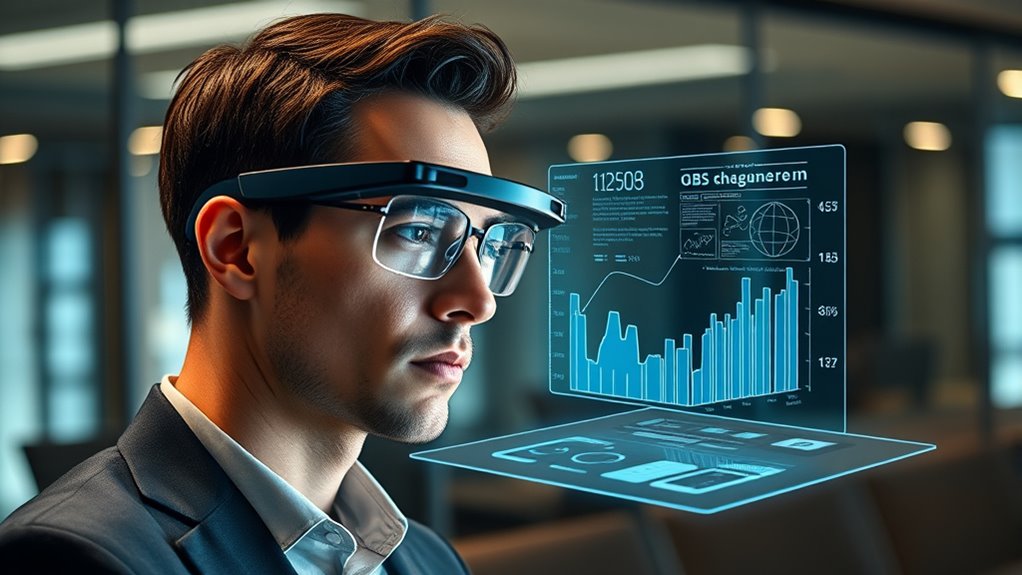
Enterprise adoption of AR glasses is quickly transforming workflows, boosting efficiency and reducing errors in sectors like logistics and healthcare. Remote collaboration becomes seamless as professionals share real-time data and visuals, minimizing delays and miscommunications. As these use cases expand, you’ll see AR glasses become an essential tool for improving productivity and teamwork across industries. Incorporating design principles from the home interior world, such as user-friendly interfaces and ergonomic considerations, will further accelerate their widespread acceptance and use.
Workflow Efficiency Gains
AR glasses are transforming workflow efficiency by enabling workers to access real-time data hands-free and reduce unnecessary device switching. This streamlines tasks, cuts downtime, and improves accuracy. For example, field technicians can view schematics without carrying paper manuals, while warehouse staff get instant inventory updates. These benefits lead to faster decision-making and fewer errors. Additionally, the adoption of net worth insights helps companies allocate resources more effectively.
Remote Collaboration Enhancements
Remote collaboration has become considerably more effective as AR glasses enable workers to connect with colleagues and experts in real time without interrupting their tasks. You can share live visuals, receive immediate guidance, and troubleshoot issues on the spot, saving time and reducing errors. In enterprise settings, AR glasses support secure, encrypted communication, allowing teams to collaborate seamlessly across locations. Field technicians can show experts their work, get instant feedback, and access contextual data overlayed directly into their view. Healthcare professionals use AR glasses for remote consultations, improving diagnostic accuracy. Architects and engineers collaborate on designs remotely, visualizing modifications instantly. With hands-free operation and real-time interaction, AR glasses enhance productivity, accelerate decision-making, and improve overall collaboration, making remote teamwork more natural and efficient. Additionally, the integration of smart technology enables AR glasses to seamlessly connect with other connected devices, further enhancing their functionality in various workflows.
Cost and Accessibility Factors

The high cost of advanced AR glasses remains a significant barrier to widespread adoption, especially when compared to the more affordable and familiar smartphones. Most top-tier AR glasses range from $1,000 to $3,000, making them a hefty investment for everyday users. This price point limits accessibility, particularly in regions where consumers are more price-sensitive. In contrast, smartphones, which offer similar connectivity and basic functions, cost roughly half or less. Additionally, the limited availability and high manufacturing costs of cutting-edge components like MicroLED displays and holographic projectors drive prices higher. For AR glasses to become mainstream, manufacturers need to find ways to reduce costs without sacrificing quality, making them more accessible to a broader audience. Luggage & Bags: How to choose and use the right bag
Privacy and Regulatory Considerations
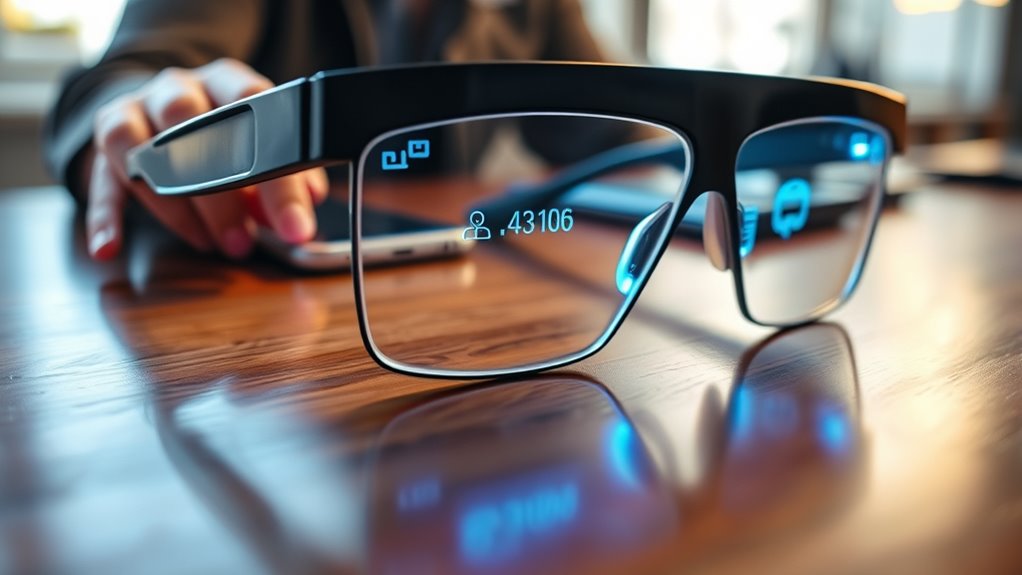
As AR glasses become more widespread, you’ll need to contemplate data security challenges and how your information is protected. Privacy regulations are evolving quickly to keep up with new risks and use cases. Staying compliant will require continuous awareness of these regulatory shifts and how they impact your device’s use. Additionally, understanding the Gold IRA Markets can provide insights into how financial privacy and security are managed within emerging investment opportunities.
Data Security Challenges
Data security remains a significant challenge for AR glasses, especially as they collect and transmit sensitive personal and professional information. You need to consider how data is stored, shared, and protected from cyber threats. Since AR glasses often record audio, video, and biometric data, any breach could expose private details or compromise safety. Additionally, the constant connectivity increases risks of hacking, interception, and unauthorized access. Regulatory frameworks are still evolving, and compliance requires rigorous encryption, secure authentication, and transparent user permissions. You must stay vigilant about data handling practices and ensure your devices meet strict standards. Without robust security measures, widespread adoption may stall, as users and organizations worry about privacy violations and legal liabilities. Moreover, implementing security protocols is essential to mitigate these risks and build user trust.
Privacy Regulation Evolution
With the rapid growth of AR glasses, regulatory frameworks are struggling to keep pace with technological advancements. As these devices collect and transmit vast amounts of personal data, privacy laws are evolving to address new risks. Governments are implementing stricter regulations on data collection, storage, and sharing, pushing companies to prioritize user consent and transparency. You’ll find that regulators demand clearer disclosures about how data is used, especially in public and professional environments. Companies must also comply with cross-border data transfer rules and establish secure encryption standards. Privacy considerations are increasingly influencing device design, prompting manufacturers to build features that protect user identity. As public awareness grows, you’ll see ongoing debates about balancing innovation with privacy rights, shaping the future landscape of AR technology. Additionally, Vetted standards are being developed to ensure consistent privacy protections across different regions and platforms.
The Role of Convergence and Hybrid Devices
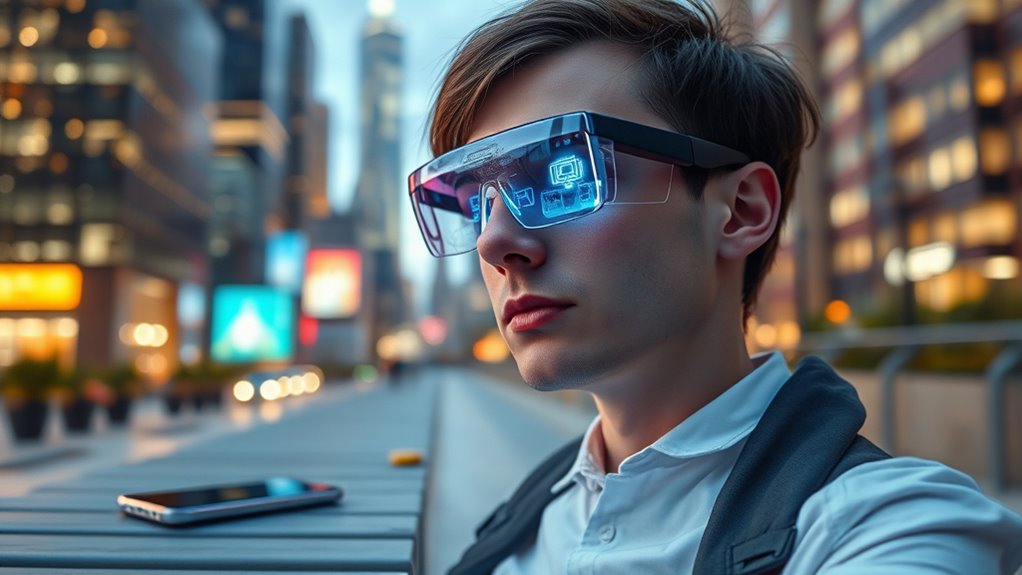
Convergence between AR glasses and smartphones is shaping the future of personal and professional technology by creating hybrid devices that leverage the strengths of both. These hybrid models act as secondary displays, allowing you to access notifications, maps, and real-time data without switching devices. Offloading complex tasks to your smartphone or cloud services, AR glasses handle quick interactions and contextual information overlays efficiently. This synergy reduces device clutter and enhances productivity, especially in work environments like logistics or healthcare. As these devices become more integrated, you’ll find seamless progression between AR and smartphone functionalities, making the experience more intuitive. This merging not only improves user experience but also addresses current limitations, paving the way for more versatile, practical, and adaptive tech solutions. European cloud innovation can further support these hybrid models by providing secure and energy-efficient cloud solutions for data processing and storage.
Future Technological Advancements and Trends

Advancements in artificial intelligence and spatial computing are set to revolutionize AR glasses, making them more intelligent and context-aware than ever before. You’ll see AR glasses that adapt seamlessly to your environment, predicting your needs and providing relevant information instantly. As AI improves, these devices will better understand gestures, eye movements, and voice commands, enabling faster, more natural interactions. Future trends point toward integration with smart sensors, wearable tech, and even contact lenses, creating a seamless digital-physical experience. Cloud computing will offload heavy processing, reducing device size and boosting battery life. These innovations will make AR glasses more practical for daily use across work and leisure, pushing them closer to replacing smartphones as your primary digital interface. Additionally, the development of AI-powered virtual reality in e-learning will enhance interactive experiences, making these devices even more versatile for various applications.
Consumer Perception and Social Acceptance
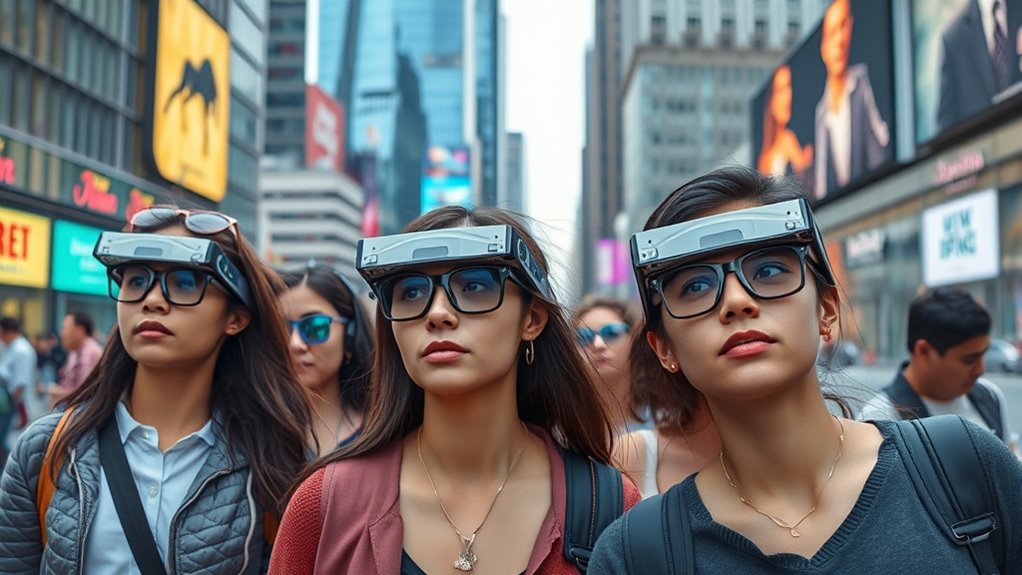
As AR glasses become smarter and more integrated into daily life, how people perceive and accept these devices plays a key role in their future success. You might feel hesitant about wearing bulky or conspicuous models, worried about social judgment or privacy concerns. Over time, however, social acceptance is improving as designs become sleeker and more stylish, making AR glasses less conspicuous. You may also worry about being seen as distracted or disconnected, but many see AR glasses as a way to stay more engaged without constantly pulling out a phone. Trust in privacy protections and the perceived usefulness of AR features influence your acceptance. As societal attitudes shift and technology advances, your comfort level with AR glasses will likely grow, shaping their mainstream adoption. Additionally, design choices play a crucial role in how these devices are perceived socially and practically.
Potential Impact on the Digital Ecosystem
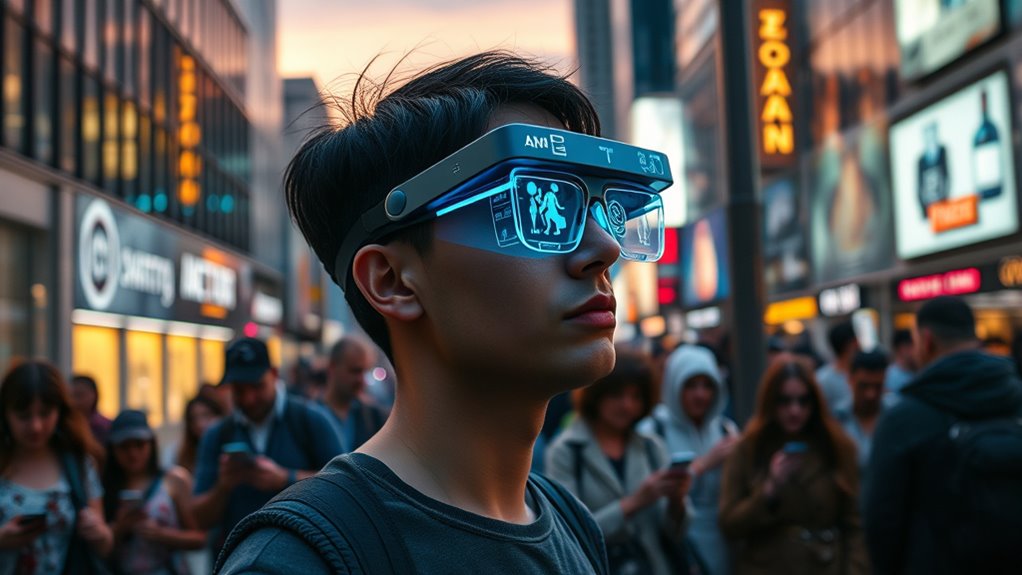
The widespread adoption of AR glasses could profoundly reshape the digital ecosystem by transforming how you access, share, and interact with information. You might experience seamless real-time updates, making you more efficient and connected. Imagine a world where:
- Your digital environment merges with the physical, creating immersive work and social spaces.
- Data becomes instantly accessible, reducing dependency on traditional screens and devices.
- Privacy and security become critical concerns as information flows more freely in shared spaces.
- Cut-through tech clutter will be essential for discerning valuable tools amidst the expanding digital landscape.
This shift could challenge existing platforms, alter social norms, and redefine digital interactions. You’ll need to navigate new privacy landscapes and adapt to more integrated, context-aware experiences. The digital ecosystem will evolve into a more interconnected, dynamic environment—if AR glasses reach widespread adoption.
Frequently Asked Questions
How Will AR Glasses Impact Smartphone Battery Life and Energy Consumption?
AR glasses will likely increase your smartphone’s energy consumption because they often offload processing tasks or sync with your phone to enhance functionality. As AR glasses become more advanced, they’ll use more power, potentially draining your smartphone battery faster. To manage this, you’ll need to optimize device usage, rely on cloud processing, or wait for more energy-efficient designs that balance AR capabilities with battery life.
What ARe the Environmental Implications of Widespread AR Glasses Production?
Widespread AR glasses production could markedly impact the environment. You’ll see increased demand for rare minerals and energy-intensive manufacturing, leading to higher carbon footprints. Electronic waste might rise as devices become obsolete faster. To lessen this, support eco-friendly designs, recycling programs, and manufacturers adopting sustainable practices. By being conscious of your choices, you can help minimize environmental harm while embracing new tech innovations.
Will AR Glasses Become Affordable for Everyday Consumers?
AR glasses will become more affordable for everyday consumers over time. Currently, high-end models cost between $1,000 and $3,000, but as technology advances and production scales up, prices are expected to drop markedly. With 20% annual growth in consumer sales and industry predictions of convergence with smartphones, you’ll likely see more budget-friendly options by the mid-2030s, making AR glasses accessible for everyday use.
How Might AR Glasses Influence Social Interactions and Personal Privacy?
AR glasses will impact your social interactions and privacy by making communication more seamless and immediate, but they also raise privacy concerns. You’ll share moments more effortlessly, yet others might worry about constant surveillance or data collection. As you use AR glasses, be mindful of how much personal information you reveal and how your device captures and shares data, balancing convenience with the need for privacy and respect in social settings.
What ARe the Long-Term Health Effects of Prolonged AR Glasses Use?
Prolonged AR glasses use may cause eye strain, headaches, or fatigue due to extended focus on holographic overlays and small displays. You might experience discomfort from poor ergonomics or limited battery life, leading to frequent breaks. Over time, potential risks include disrupted sleep patterns from blue light exposure and possible impacts on vision health. To stay safe, limit continuous use and make sure proper ergonomics and screen settings are maintained.
Conclusion
So, will AR glasses ever steal your smartphone’s thunder? Maybe someday, if they stop making you look like a character from a sci-fi movie and start feeling as natural as checking your texts. Until then, you might just have to settle for juggling both—one eye on the future, the other on your screen. But hey, at least you’ll look cool pretending to be a cyborg in public, right?