
Ultra Wideband (UWB) is a fast, precise wireless tech that helps your phone locate devices and objects with sub-centimeter accuracy. It enables quick, secure connections, improves device tracking, and enhances augmented reality experiences. UWB also reduces interference and boosts security, making data sharing safer and more efficient. If you want to discover how UWB is transforming your device’s capabilities and your everyday interactions, there’s more to uncover ahead.

Get the latest gadgets delivered free — and shop member deals
- Fast, free delivery on millions of items
- Access to Prime Big Deal Days deals on October 6–7
- Prime Video, Amazon Music and more included
Key Takeaways
- UWB is a radio technology that uses a wide frequency spectrum for precise, short-range data transmission.
- Phones use UWB for accurate device location, secure data sharing, and seamless interactions without complex pairing.
- UWB enhances spatial awareness, enabling augmented reality and virtual object placement in real environments.
- It offers high security and interference resistance, protecting sensitive information and reducing hacking risks.
- UWB operates efficiently with low power, supporting smarter, connected devices and revolutionizing wireless security.

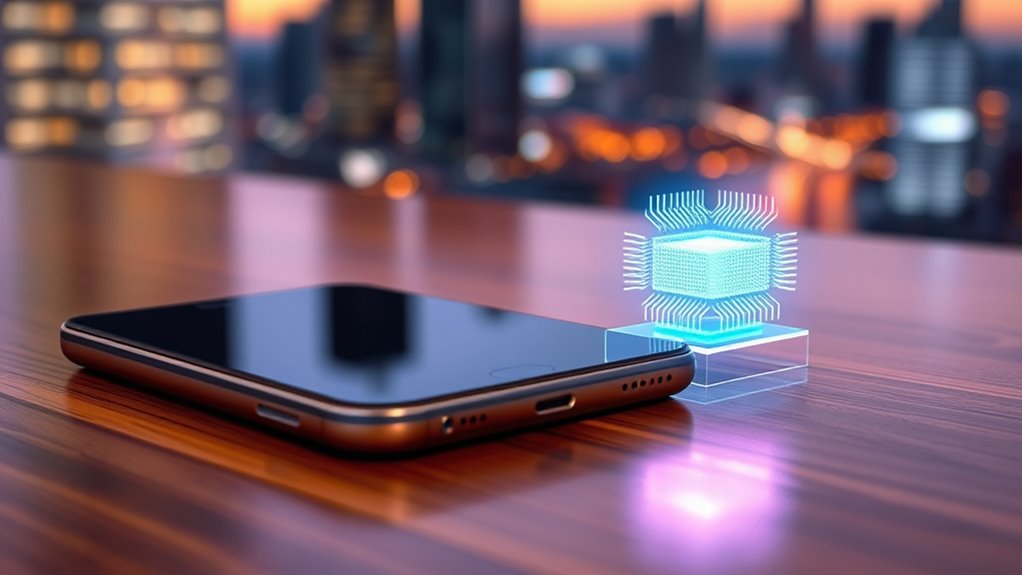
Have you ever wondered how your phone can precisely locate nearby devices or improve data transfer? The answer lies in a technology called UWB, or Ultra Wideband. UWB is a radio technology that uses a very wide frequency spectrum, allowing it to send and receive data over short distances with remarkable accuracy. Unlike traditional Bluetooth or Wi-Fi, UWB offers precise spatial awareness, making it ideal for applications like device tracking, secure data sharing, and augmented reality. When your phone incorporates UWB, it can determine its position relative to other UWB-enabled devices with sub-centimeter accuracy, enabling features like seamless device uncovering, precise device finding, and enhanced file transfer. This level of signal accuracy not only improves user experience but also bolsters wireless security. Because UWB can distinguish between multiple devices in close proximity, it minimizes the risk of data interception or miscommunication, making your wireless interactions more secure and reliable. Its ability to pinpoint devices with high precision means that it’s less susceptible to interference or hacking attempts, ensuring that your sensitive information stays protected.
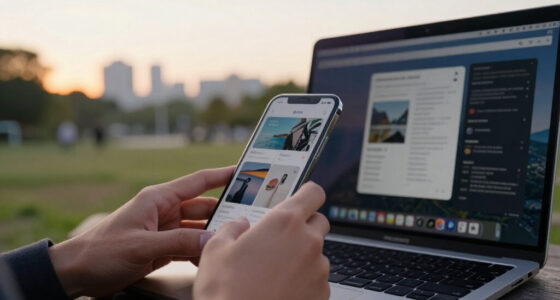
The use of UWB in phones is also transforming how we interact with our environment. For example, with UWB, your phone can understand the exact location of objects or other devices around you, enabling spatial awareness that was previously impossible with older wireless technologies. This capability opens up new possibilities for augmented reality experiences, where virtual objects can be placed precisely within your real-world surroundings. It also enhances device-to-device communication, allowing your phone to establish quick, secure connections with other UWB-enabled gadgets without the need for complex pairing processes. As a result, transferring files or sharing data becomes faster, more secure, and more intuitive. Additionally, UWB’s interference resistance makes it especially suitable for crowded or challenging wireless environments, ensuring consistent performance even amid many competing signals.
Moreover, UWB’s power efficiency means that it can operate continuously without draining your phone’s battery excessively. This, combined with its high signal accuracy, makes it an attractive option for manufacturers looking to integrate advanced features without sacrificing performance or security. As more phones adopt UWB, we’re likely to see a shift toward smarter, more connected devices that can understand their environment more deeply while maintaining robust security standards. Overall, UWB is revolutionizing wireless security and signal accuracy in smartphones, making our digital interactions more precise, secure, and seamless. It’s not just about faster data transfer; it’s about creating a smarter, safer way to connect and navigate our world.
Frequently Asked Questions
Can UWB Be Used for Internet Connectivity?
UWB isn’t typically used for internet connectivity because it’s designed for precise wireless data transfer over short distances, not broad network access. While it provides fast, secure communication, it’s less prone to signal interference than traditional wireless signals. You won’t rely on UWB for streaming or browsing; instead, it’s ideal for device positioning and secure data sharing, complementing your existing Wi-Fi or cellular connections.
Is UWB Safe for Long-Term Health Exposure?
UWB is generally safe for long-term health exposure because current research shows minimal health effects from its radiation safety levels. You don’t need to worry about significant risks, as UWB uses low-power signals that don’t penetrate deeply into the body. Experts continue to monitor its health effects, but based on available data, UWB’s radiation safety measures make it a safe technology for everyday use.
How Accurate Is UWB Compared to Bluetooth or Wi-Fi?
Imagine you’re tracking a misplaced key with UWB. It offers higher precision measurement and better device tracking than Bluetooth or Wi-Fi. UWB can locate objects within centimeters, while Bluetooth and Wi-Fi typically range in meters. This makes UWB ideal for things like secure access or precise indoor navigation. So, if accuracy matters, UWB is the superior choice, providing markedly more precise location data than Bluetooth or Wi-Fi.
Will UWB Technology Affect Phone Battery Life Significantly?
UWB technology may somewhat impact your phone’s battery life due to increased power consumption during active use. However, manufacturers optimize UWB’s power efficiency, so the battery impact remains minimal for most users. You might notice a small drain if you frequently use UWB features, but overall, it shouldn’t considerably affect your phone’s battery life. Modern devices balance UWB’s performance with power management to ensure longevity.
Are All New Smartphones Equipped With UWB?
Not all new smartphones are equipped with UWB, but most high-end models now include it due to increasing UWB adoption trends. You’ll find that many flagship phones offer UWB for enhanced features like precise device tracking and secure data transfer. As UWB becomes more mainstream, smartphone compatibility will expand, making it more common to see this technology in mid-range devices too. Keep an eye on upcoming releases for broader UWB integration.
Conclusion
So, now you know how UWB transforms your phone’s capabilities. It’s not just about faster data; it’s about smarter, more precise interactions. Did you know that UWB can locate objects within just a few centimeters? That’s like having a superpower right in your pocket. As this technology advances, your phone will become even more intuitive and connected. Embrace UWB—it’s shaping the future of how you interact with your world.
Evergreen bestsellers Picks
bestsellers
As an affiliate, we earn on qualifying purchases.