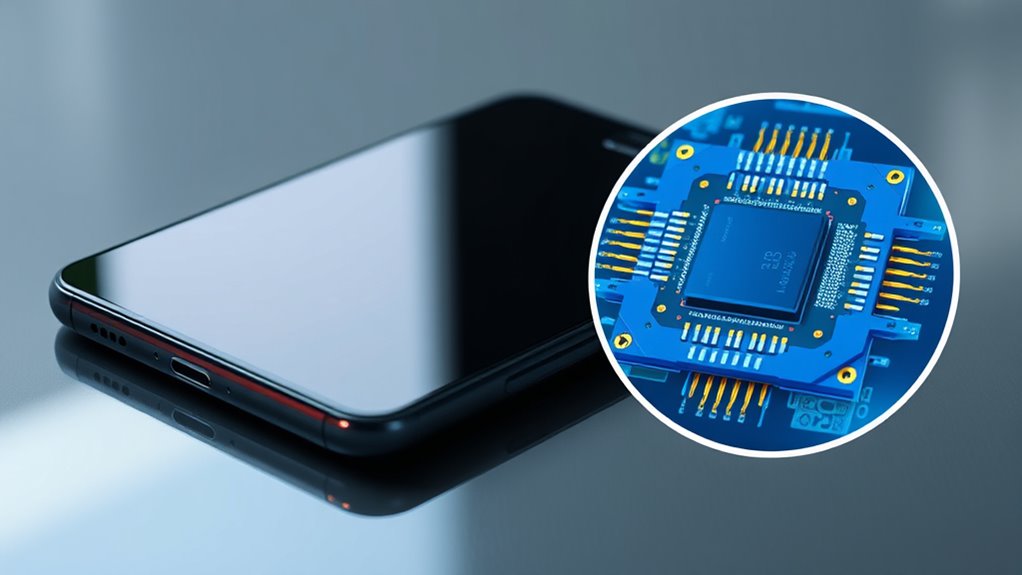

The term “Snapdragon 8 Gen” refers to Qualcomm’s flagship smartphone processor, with “8” indicating its premium status and “Gen” signifying a major yearly update. Each generation improves speed, power efficiency, graphics, and AI capabilities, using advanced ARM architectures and manufacturing processes. These processors power high-end devices for smooth multitasking, gaming, and AI tasks. If you want to understand how these upgrades affect your phone’s performance, there’s more to explore below.
Key Takeaways
- “Snapdragon 8 Gen” indicates a flagship processor series by Qualcomm, with “Gen” representing the latest generation or yearly update.
- It features advanced ARMv9 architecture, a 4nm manufacturing process, and significant performance and efficiency improvements.
- The series includes powerful CPUs, high-performance GPUs, and advanced AI capabilities for flagship device performance.
- Supports high-speed memory, 5G connectivity, and enhanced graphics for smoother multitasking and gaming experiences.
- “Snapdragon 8 Gen” signifies cutting-edge technology designed to deliver flagship-level performance across smartphones.
Understanding the Naming System of Snapdragon Processors

Have you ever wondered what the numbers and names in Snapdragon processors really mean? The “Snapdragon 8 Gen” indicates a new flagship generation from Qualcomm, replacing the older “Snapdragon 8xx” series. The “Gen” number (like Gen 1, Gen 2, or Gen 3) marks each major yearly update, reflecting advancements in architecture, GPU, and features. This naming system helps you easily distinguish between flagship, mid-range, and entry-level chips. Each generation typically introduces significant improvements in performance and efficiency. For example, Snapdragon 8 Gen 1 features a 4nm process, a new ARMv9-A instruction set, and upgraded cores. Understanding this naming convention helps you grasp a processor’s place in the lineup and the level of technology it offers. Additionally, Free Floating techniques in modern processors contribute to enhanced multitasking and power efficiency.
The Architecture Behind Snapdragon 8 Gen Series

The architecture of the Snapdragon 8 Gen series represents a significant leap forward in mobile processing technology. You’ll find a powerful mix of ARMv9-A instruction set and a 4nm manufacturing process, which boosts performance and efficiency. The CPU features a Cortex-X2 prime core at 3.0 GHz, three Cortex-A710 cores at 2.5 GHz, and four Cortex-A510 efficiency cores at 1.8 GHz, delivering about 20% more performance with 30% less power consumption than previous generations. All cores share a 6 MB L3 cache for faster data access. This architecture allows for better multitasking, smoother gaming, and improved battery life. The design emphasizes a balance between raw power and efficiency, setting the foundation for high-end mobile experiences. Advanced manufacturing techniques contribute further to the chip’s energy efficiency and thermal management.
Key Features and Improvements in Snapdragon 8 Gen

What sets the Snapdragon 8 Gen apart are its significant advancements in performance, efficiency, and graphics capabilities. You’ll notice faster processing speeds, thanks to the new ARMv9-A architecture and upgraded cores, which deliver around 20% better CPU performance with improved power efficiency. The integrated Adreno 730 GPU offers 30% higher graphics performance, enabling smoother gaming and richer visuals. Memory support has also improved, allowing up to 24 GB of LPDDR5 RAM at 3200 MHz, with increased bandwidth. Connectivity gets a boost with the Snapdragon X65 5G modem supporting up to 10 Gbps downloads. Additionally, the advanced manufacturing process enhances thermal management and power efficiency, making your device faster, more responsive, and better equipped for demanding applications, all while consuming less power for longer battery life.
GPU and Graphics Capabilities of Snapdragon 8 Gen
Thanks to its integrated Adreno 730 GPU, Snapdragon 8 Gen delivers markedly enhanced graphics performance, making high-end gaming and intensive visual tasks smoother and more immersive. With 512 shading units and a frequency of 818 MHz, it provides up to 1675.3 GFLOPS, outperforming previous generations by 30%. You’ll notice sharper visuals, faster rendering, and more detailed graphics, whether gaming or using demanding apps. The GPU supports Vulkan 1.1, OpenCL 2.0, and DirectX 12.1, ensuring compatibility with advanced graphics features. This means you get exceptional visuals and fluid gameplay on your device. To evoke your excitement, here’s a snapshot of the GPU’s capabilities: graphics performance
| Feature | Specification | Impact |
|---|---|---|
| Shading Units | 512 | Rich, detailed visuals |
| GPU Frequency | 818 MHz | Smooth, fast rendering |
| GFLOPS | 1675.3 GFLOPS | High-performance graphics |
Memory, Connectivity, and Other Technical Specifications

When choosing a smartphone processor, you should consider its memory bandwidth, supported memory types, and connectivity options. These specs directly impact data transfer speeds, network performance, and power efficiency. Understanding these features helps you find a device that balances performance with battery life and connectivity needs. Additionally, system architecture plays a crucial role in determining how efficiently the processor handles various tasks and power consumption.
Memory Bandwidth and Types
Have you ever wondered how much data your smartphone processor can handle at once? Memory bandwidth determines this capability, affecting how quickly your device accesses and processes data. Higher bandwidth means smoother multitasking and better gaming performance. Snapdragon 8 Gen supports LPDDR5 RAM up to 24 GB and a memory frequency of 3200 MHz, with a maximum bandwidth of 51.2 Gbit/s. It uses a 4×16-bit memory bus, allowing rapid data transfer. Different memory types impact speed and power consumption, with LPDDR5 being the fastest and most efficient currently. Here’s a quick comparison:
| Memory Type | Bandwidth (Gbit/s) | Power Efficiency | Typical Use Case | Max Capacity |
|---|---|---|---|---|
| LPDDR5 | 51.2 | High | Flagship Phones | 24 GB |
| LPDDR4X | 34.1 | Moderate | Mid-range Phones | 16 GB |
| LPDDR4 | 25.6 | Lower | Budget Phones | 8 GB |
| DDR4 | 25.6 | Lower | Tablets, Laptops | Varies |
| DDR3 | 17.1 | Lower | Older Devices | Varies |
5G and Wi-Fi Support
Smartphone processors like the Snapdragon 8 Gen series excel in supporting advanced connectivity and memory technologies to deliver fast, reliable performance. You get support for Wi-Fi 6E, which provides higher speeds and lower latency, and Bluetooth 5.2 for improved wireless audio and device pairing. The Snapdragon X65 5G modem enables download speeds up to 10 Gbps and upload speeds of 3 Gbps, ensuring seamless streaming and gaming. With LPDDR5 RAM up to 24 GB and a 4x 16-bit memory bus, your device can handle multitasking and intensive apps smoothly. These features combine to guarantee you experience fast data transfer, excellent wireless connectivity, and efficient memory performance, keeping your device responsive and ready for demanding tasks.
Power Efficiency Features
Enhanced power efficiency in Snapdragon 8 Gen processors guarantees your device runs longer and conserves battery life without sacrificing performance. It supports LPDDR5 RAM up to 24 GB at 3200 MHz, boosting memory bandwidth to 51.2 Gbit/s, which helps reduce energy consumption during data transfers. The integrated Snapdragon X65 5G modem delivers fast connectivity with up to 10 Gbps download speeds and 3 Gbps uploads, maintaining efficiency during heavy usage. FastConnect 6900 supports Wi-Fi 6E and Bluetooth 5.2, optimizing wireless power use. The processors also feature advanced power management techniques, including dynamic core scaling and efficient process node technology. These elements work together to maximize battery life, ensure smooth multitasking, and deliver high-performance experiences without draining your device’s power prematurely. Additionally, adaptive network management helps optimize connectivity based on usage patterns and network conditions to further conserve energy.
Variants and Future Developments in Snapdragon 8 Series

The Snapdragon 8 series continues evolving with new variants like the Gen 5 and Elite, offering significant performance boosts and advanced features. Future releases, such as Snapdragon 8 Gen 6, aim to use cutting-edge manufacturing processes like 2nm TSMC and introduce new CPU and GPU architectures. These developments are designed to deliver flagship-level performance to a broader range of devices while emphasizing AI, efficiency, and thermal management.
Snapdragon 8 Gen Variants
Various Snapdragon 8 Gen variants cater to different segments of flagship and premium smartphones, offering a range of performance and features. The Snapdragon 8 Gen 1 provides a significant upgrade over previous generations, with a new CPU architecture, improved GPU, and enhanced connectivity. The Snapdragon 8 Gen 5 introduces a custom Oryon CPU, boosting performance and efficiency further, while the Snapdragon 8 Elite version offers even higher clock speeds for premium devices. These variants are built on advanced manufacturing processes like TSMC’s 3nm technology, ensuring better power management and performance. As the series evolves, future variants aim to incorporate even more powerful CPUs, efficient GPUs, and cutting-edge AI capabilities, making smartphones faster, smarter, and more capable across all price ranges. Understanding these differences can help consumers make more informed choices when selecting a flagship device.
Future Snapdragon 8 Series
As Qualcomm continues to push the boundaries of mobile processing, the upcoming Snapdragon 8 series is set to introduce significant innovations. You can expect a shift to TSMC’s 2nm process, boosting efficiency and performance further. The new series might feature a redesigned CPU architecture, possibly with a 2+3+3 core setup, balancing power and efficiency. GPU improvements will likely deliver better graphics while managing thermal output, especially in mid-range devices. Qualcomm’s focus on AI, matrix acceleration, and on-device processing will intensify, offering faster and smarter experiences. Variants like the Snapdragon 8 Gen 6 and future Elite models aim to push performance boundaries, bringing flagship capabilities to a broader range of devices. Expect ongoing enhancements that keep your smartphone at the forefront of technology.
How Snapdragon 8 Gen Influences Smartphone Performance

Snapdragon 8 Gen processors substantially boost smartphone performance by delivering faster processing speeds, improved graphics, and enhanced power efficiency. You’ll notice smoother multitasking, quicker app launches, and better overall responsiveness thanks to the new ARMv9-A architecture and the 20% CPU performance increase. The integrated Adreno 730 GPU provides 30% higher graphics performance, making gaming more immersive and graphics-intensive tasks more seamless. Power efficiency improvements mean your device lasts longer between charges. With support for LPDDR5 RAM up to 24 GB and fast 5G connectivity, your smartphone handles demanding tasks effortlessly. Whether gaming, streaming, or multitasking, the Snapdragon 8 Gen ensures your device performs at a flagship level, elevating your smartphone experience with faster, smoother, and more efficient performance.
Frequently Asked Questions
How Does Snapdragon 8 Gen Compare to Previous Snapdragon 8 Series?
You’ll notice Snapdragon 8 Gen processors outperform previous Snapdragon 8 series chips. They offer about 20% better CPU performance, 30% more power efficiency, and enhanced graphics with the Adreno 730 GPU. You’ll also benefit from faster connectivity, support for higher RAM speeds, and advanced features like improved AI and on-device processing. Overall, Snapdragon 8 Gen delivers a significant upgrade in speed, efficiency, and capabilities, making your device more powerful and future-proof.
What Are the Main Differences Between Snapdragon 8 Gen 1 and 8 Gen 5?
Think of the Snapdragon 8 Gen 1 and 8 Gen 5 as two chapters in a story of technological evolution. The main differences are in their cores and manufacturing processes. The Gen 1 uses ARMv9 architecture with a 4nm process, offering a significant boost in performance and efficiency. The Gen 5, however, features a custom Oryon CPU built on a 3nm TSMC process, delivering even higher speeds and power savings, pushing the limits of mobile processing.
Will Snapdragon 8 Gen Processors Be Used in Mid-Range Smartphones?
Yes, Snapdragon 8 Gen processors are expected to be used in mid-range smartphones. Qualcomm’s focus with future Snapdragon 8 Gen chips, like the Snapdragon 8 Gen 6, is to bring flagship-level performance and features to more affordable devices. You’ll likely see these processors in mid-range phones, giving you high-end gaming, faster connectivity, and better AI capabilities without the premium price tag.
How Does the Oryon CPU Architecture Differ From ARM Designs?
They say, “the proof is in the pudding,” and the Oryon CPU architecture differs from ARM designs by offering a custom layout tailored for Snapdragon’s flagship chips. You’ll find it emphasizes higher performance and efficiency, with core configurations optimized for both speed and power management. Unlike standard ARM designs, Oryon is built specifically for Snapdragon, allowing Qualcomm to push boundaries and deliver better AI, gaming, and multitasking experiences in your device.
What Future Features Are Expected in Snapdragon 8 Gen 6?
You can expect the Snapdragon 8 Gen 6 to feature a TSMC 2nm process, boosting efficiency and performance. It might adopt a 2+3+3-core CPU setup, improving power management. The GPU could be slightly toned down for better thermal control, but still deliver flagship performance. Focus on AI, matrix acceleration, and on-device processing will continue, enhancing features like gaming, photography, and connectivity, making your device faster and smarter.
Conclusion
By understanding what “Snapdragon 8 Gen” means, you can picture the powerhouse inside your phone—like a tiny, lightning-fast engine fueling every swipe, tap, and photo. It’s the difference between a sluggish ride and a smooth, adrenaline-pumping race. As technology advances, you’ll feel the boost in every game, stream, and selfie. So, next time you pick up your device, know that behind the scenes, Snapdragon is working tirelessly to keep you connected and entertained.