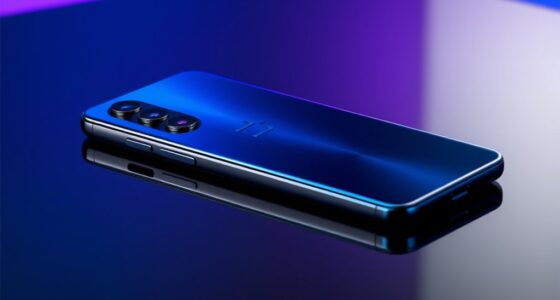
5G offers faster speeds, lower latency, and smarter connectivity, making it a worthwhile upgrade if you want smoother streaming, quicker downloads, and real-time responses for gaming or AR. While coverage is still expanding and not everywhere supports it yet, the advantages in performance and efficiency are clear. If you’re curious about how 5G compares to 4G and whether it suits your needs, exploring these details can help you decide if it’s time to switch.
Key Takeaways
- 5G offers faster speeds, lower latency, and better capacity, especially in urban areas, compared to 4G.
- Coverage for 5G is still expanding, with limited availability in rural and mmWave zones.
- Upgrading depends on device compatibility and specific needs; basic tasks may not require 5G yet.
- 5G’s energy efficiency benefits vary based on network mode and usage patterns.
- Future applications like AR, IoT, and smart cities will greatly benefit from full 5G adoption.
How Do Speed and Data Rates Differ Between 5G and 4G?

How do the speed and data rates of 5G compare to those of 4G? You’ll find that 5G dramatically outpaces 4G in both peak and real-world speeds. In lab conditions, 5G can reach up to 10–20 Gbps, while 4G tops out around 1 Gbps. In everyday use, 5G averages between 300 Mbps and 1 Gbps, compared to 4G’s typical 25–100 Mbps. This means 5G is up to 10 times faster in urban environments. Additionally, mmWave 5G offers multi-gigabit speeds, though coverage is limited, while low-band 5G provides modest improvements but better coverage. Overall, you’ll notice faster downloads, smoother streaming, and quicker data transfers with 5G, making it a significant upgrade over 4G’s capabilities.
What Are the Latency Advantages of 5G Over 4G?

While 5G’s faster speeds are impressive, its real advantage lies in latency reduction. With 5G, you experience markedly lower delay, making real-time applications more responsive. 5G latency averages between 1 and 10 milliseconds, compared to 20 to 50 milliseconds for 4G. This reduction means smoother gaming, quicker video calls, and instant data transfer. To understand the impact:
| Feature | 4G Latency | 5G Latency |
|---|---|---|
| Typical Range | 20–50 ms | 1–10 ms |
| Real-Time Use | Slight delay | Nearly instantaneous |
| Application Impact | Less suitable for gaming | Perfect for AR/VR |
Lower latency transforms how you interact with tech, enabling near real-time experiences. Enhanced network infrastructure further optimizes 5G performance, making these benefits more accessible.
How Do Spectrum and Bandwidth Impact Performance?

Spectrum and bandwidth are key factors that directly influence the performance of 5G networks. Wider bandwidths allow more data to flow through each channel, increasing your download and upload speeds. With 5G, channels can reach several hundred MHz, compared to 4G’s typical 20 MHz, enabling faster data transfer. The use of low-, mid-, and high-band frequencies means 5G can balance speed and coverage, with mmWave providing ultra-fast speeds over short distances, while low-band offers broader coverage with modest gains. This flexibility lets your network adapt to different environments and user demands. Additionally, innovative European cloud servers leverage energy-efficient technologies to optimize network performance and sustainability. Ultimately, larger bandwidths and spectrum choices translate into higher throughput, reduced congestion, and a more reliable experience, especially in densely populated areas.
In What Ways Does Network Capacity and Efficiency Vary?

You’ll notice that 5G offers markedly greater network capacity, letting more devices connect without slowing down. It also uses technologies like massive MIMO and beamforming to boost efficiency and reduce energy consumption. As a result, 5G handles crowded environments better and supports smarter, more connected systems. Additionally, the adoption of high refresh rates in 5G networks contributes to smoother data transmission and improved user experiences.
Enhanced Network Capacity
5G substantially enhances network capacity by supporting more simultaneous connections within the same coverage area. This means you can connect more devices without experiencing slowdowns or dropped signals, even in crowded places like stadiums or city centers. Technologies like massive MIMO and beamforming optimize how signals are directed, increasing spectral efficiency and overall throughput. Wide bandwidths, especially in the mmWave spectrum, allow for higher data rates and reduce network congestion. As a result, your streaming, gaming, and browsing stay smooth even during peak usage times. Compared to 4G, 5G handles dense environments better, ensuring reliable service for large groups of users. Additionally, network optimization techniques improve how the infrastructure manages traffic, further enhancing overall network performance. Overall, this improved capacity supports your growing data needs while maintaining high performance across various scenarios.
Energy-Efficient Connectivity
As network capacity and efficiency improve with 5G, devices also become more energy-efficient. This is because 5G uses advanced technologies like massive MIMO and beamforming, which direct signals precisely where needed, reducing power waste. The flexible spectrum and wider channels mean data can be transmitted faster and more efficiently, lowering the energy required per bit. Additionally, 5G’s lower latency means devices spend less time transmitting and waiting for responses, conserving battery life. In dense urban environments, 5G handles more connections without draining power, unlike 4G, which struggles with congestion. Overall, 5G’s optimized network design helps your devices use less energy while maintaining high performance, making it a smarter, greener choice for connectivity. Filter maintenance techniques and smart network management further enhance energy savings in 5G networks.
How Reliable and Widespread Is Coverage for Both Generations?

While 4G has established extensive and reliable coverage over the past decade, 5G is still expanding its reach across various regions. In urban areas, 5G coverage is growing rapidly, supported by new infrastructure like small cells and repeaters. However, outside cities and in rural locations, 5G remains limited, especially for mmWave frequencies, which offer blazing speeds but short-range coverage. Low-band 5G provides broader coverage similar to 4G but with modest speed improvements. Indoor coverage is improving as carriers deploy more small cells, but reliability can vary. In contrast, 4G’s network is more mature, offering consistent, widespread service across urban and rural areas. For now, 4G remains the more dependable choice if consistent coverage is your priority. Additionally, the global outage experienced by Microsoft underscores the importance of reliable infrastructure for digital connectivity.
What Are the Practical Use Cases for 5G Compared to 4G?

Have you considered how the faster speeds and lower latency of 5G open up new possibilities beyond what 4G offers? With 5G, you can enjoy ultra-high-definition streaming, seamless virtual reality experiences, and real-time gaming without lag. It’s ideal for smart cities, where connected sensors improve traffic flow and public safety. In healthcare, 5G enables remote surgeries and instant data sharing between devices. For industrial automation, it supports robotics and predictive maintenance with minimal delay. Smart homes benefit from instant device responses and enhanced security. Unlike 4G, which mainly handles browsing, social media, and HD videos, 5G powers advanced applications requiring rapid data transfer and near-instant communication. These use cases demonstrate how 5G transforms everyday life and industry, offering capabilities 4G simply can’t match.
Is 5G More Energy-Efficient for Devices?

5G is designed to be more energy-efficient for connected devices, helping extend battery life and reduce power consumption. It achieves this through advanced tech like massive MIMO and beamforming, which optimize signal delivery and minimize waste. However, some high-speed modes, like mmWave, can drain batteries faster due to higher power demands. To illustrate, consider the table below:
| 5G Mode | Power Usage | Typical Use Case |
|---|---|---|
| Low-band | Lower | Extended battery life, basic tasks |
| Mid-band | Moderate | Streaming, browsing |
| mmWave | Higher | Data-heavy activities |
While 5G offers energy benefits, the actual impact depends on how you use it and the network mode. Efficient use can help preserve your device’s battery. Additionally, understanding Free Floating technology can help users optimize their device settings for better energy efficiency.
Should You Upgrade to 5G Now or Wait?

Deciding whether to upgrade to 5G now depends on your current needs and device compatibility. If you use your phone mainly for browsing, social media, and streaming HD videos, sticking with 4G might be enough for now. However, if you want faster speeds, lower latency, and access to future technologies like AR or IoT, upgrading could be worthwhile. Keep in mind, 5G coverage is still expanding, especially outside urban areas, and not all devices support 5G yet. If your phone is compatible and you’re excited about the latest features or need better performance for gaming or video calls, upgrading now makes sense. But if you’re satisfied with your current service, waiting until 5G coverage and device options improve could save you money and frustration. 5G adoption is gradually increasing, so staying informed about new developments can help you decide the right timing.
Frequently Asked Questions
How Does 5G Impact Battery Life of Connected Devices?
5G can drain your device’s battery faster because it requires more power to handle higher speeds and complex signals like beamforming and massive MIMO. When you use 5G, especially in areas with weak coverage or when accessing mmWave bands, your device works harder, consuming more energy. To extend battery life, you might want to switch to 4G when high speed isn’t necessary or enable power-saving modes on your device.
Will 5G Improve Indoor Coverage Compared to 4G?
Coincidentally, 5G improves indoor coverage, but not uniformly. Low-band 5G offers wider coverage similar to 4G, making indoor reception better in many cases. However, mmWave 5G, despite its speed, struggles indoors due to its short range. As technology advances, indoor performance is getting better with small cells and repeaters. Overall, expect improved indoor coverage, especially with low-band 5G, but it won’t replace the reliability of 4G everywhere yet.
Is 5G More Secure Than 4G Networks?
Yes, 5G is generally more secure than 4G networks because it incorporates advanced encryption, improved authentication, and newer security protocols. These enhancements help protect your data from cyber threats and unauthorized access better than 4G. However, as with any technology, vulnerabilities can still exist. Staying vigilant by updating your devices and using strong passwords is essential to maximize your security in both 4G and 5G networks.
Can 5G Support Emerging Technologies Like Autonomous Vehicles?
You bet 5G can support emerging technologies like autonomous vehicles. With ultra-low latency, high speeds, and massive bandwidth, it’s built to handle real-time data exchange essential for self-driving cars. The network’s ability to process traffic information instantly and support IoT devices makes it a game-changer. While coverage is still growing, 5G’s capabilities are strong enough to keep autonomous vehicles safe, connected, and ready for the future.
How Long Will 4G Networks Remain Relevant After 5G Rollout?
4G networks will stay relevant for several years even after 5G rolls out. You’ll still rely on 4G for basic browsing, social media, and streaming, especially in rural or indoor areas where 5G coverage isn’t widespread yet. Plus, 4G’s proven reliability and affordability make it a good choice for lighter data users. As 5G expands, 4G will complement it, ensuring you stay connected everywhere without immediate need to upgrade.
Conclusion
So, is 5G worth it yet? Think of 4G as a steady stream and 5G as a rushing river—faster, more efficient, but still finding its full flow. If you crave lightning-fast downloads, lower latency, and future-proofing, upgrading now puts you at the forefront of this digital tide. However, if your current network suits your needs, patience might let 5G’s promise unfold like a sunrise, brighter with each passing day.