
TL;DR

Get the latest gadgets delivered free with Prime
- Fast, free delivery on millions of items
- Prime Video, Amazon Music and more included
- Member-only deals all year
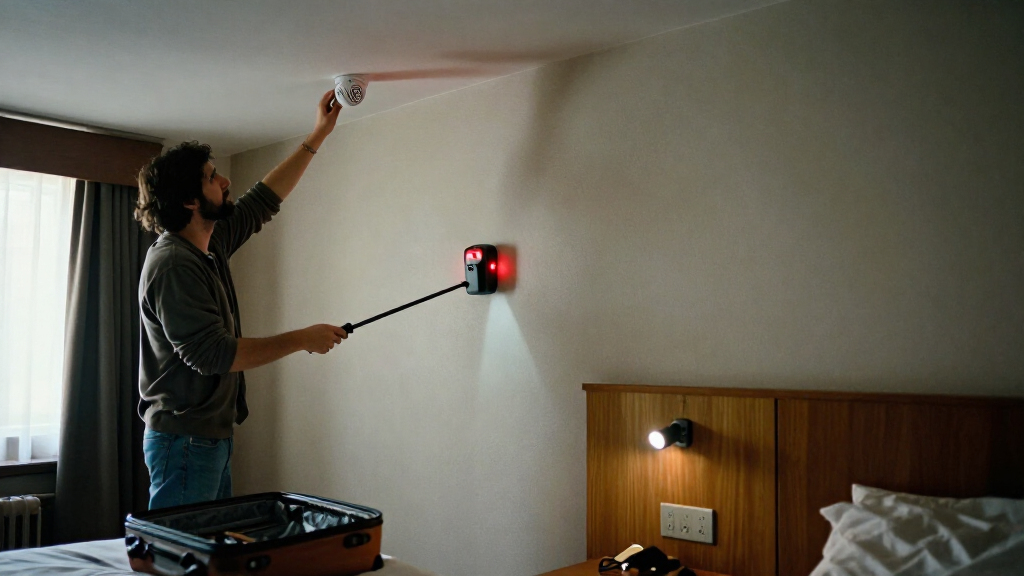
Researchers presented ESauron, a proof-of-concept system that detects and locates hidden cameras by sensing electromagnetic emissions from their memory activity after a scene change. In tests involving 50 camera products, the team reported 100% detection accuracy after four stimuli and a range exceeding 20 meters, including with blockages; those results describe the study’s experimental setup, not a validated consumer product.
Researchers presenting at USENIX Security 2024 reported a proof-of-concept system that detects and locates hidden cameras by sensing electromagnetic emissions associated with video processing. Called ESauron, the prototype was tested on 50 camera products; the authors report 100% detection accuracy after four scene-change stimuli and a detection range of more than 20 meters in some tests, including when obstacles were present.
The system’s premise is that cameras must process captured images—such as by encoding or compressing video—before sending or storing them. According to the researchers, this work creates changes in electrical activity in the device’s memory circuitry. Those changes produce electromagnetic radiation (EMR) that ESauron is designed to sense. A change in the camera’s view can trigger a burst of video processing, giving the system a signal to look for.
To provoke that response, the prototype intentionally stimulates changes in the visual scene, then measures and distinguishes the resulting emissions. The authors say their approach can cover wireless, wired and offline cameras, and can estimate where a detected device is located. Their paper describes the work as a proof of concept and reports results from experiments with 50 products.
The reported headline figures are specific to those experiments: the researchers say all tested spy cameras were detected with 100% accuracy after four stimuli, the range exceeded 20 meters even in the presence of blockages, and the devices were accurately located. The source material does not give enough detail to treat those figures as general performance guarantees across different camera models, surroundings or detection conditions.
ESauron explores a detection route that does not depend on a camera broadcasting over Wi-Fi or another wireless connection. That matters because a wired camera or a device recording locally may not offer a network signal for conventional scanning to find. Instead, the proposal looks for side effects of image processing, which the authors say may be present across several camera types.
If the approach can be made reliable outside controlled experiments, it could give security professionals another way to investigate suspected surveillance devices, including ones that are not transmitting data wirelessly. The reported range could also reduce the need to inspect every object at close range. But the paper describes a research prototype, not a ready-to-use detector. Its results do not establish how well it would distinguish cameras from other sources of emissions in ordinary buildings, or how easily users could operate it.
As an affiliate, we earn on qualifying purchases.
How Scene Changes Reveal Processing
The research is based on a chain of activity inside a camera: a sensor captures a scene, the device processes the resulting images, and the data is transferred to a receiver or storage medium. The researchers focus on memory operations during processing. They describe memory-clock activity and switching voltage regulators as sources of fluctuating currents, which in turn produce emissions that can be measured.
ESauron uses a deliberate scene change as a trigger because a sudden change in the view can increase video-processing work, including encoding. The system then searches for a responsive EMR pattern. The authors say they developed techniques to sense and distinguish those emissions, determine whether a camera is present, and pinpoint its location. The paper’s contribution is the reported combination of stimulus, emission sensing and localization, rather than a claim that every electronic camera can already be found under all conditions.
“The first proof-of-concept system that can detect diverse forms of spy cameras (i.e., wireless, wired and offline devices) and quickly pinpoint their locations.”
— ESauron research team, in the USENIX Security 2024 paper
long-range electromagnetic spy camera detector
As an affiliate, we earn on qualifying purchases.
As an affiliate, we earn on qualifying purchases.
Performance Beyond the Test Setup
The supplied report does not specify how the 50 products were selected, how many examples of each camera type were tested, or the full conditions behind the accuracy and range measurements. It also does not establish whether performance would remain the same amid interference from other electronics, varying room layouts, or cameras operating with different settings and workloads.
It remains unclear how ESauron would separate camera-related emissions from other electronic activity in a typical space, what equipment or expertise a practical version would require, and whether the method could produce false positives or miss devices in real-world use. The source describes a proof-of-concept prototype; it does not report a commercial product, independent replication, or deployment results.
As an affiliate, we earn on qualifying purchases.
Further Testing and Practical Deployment
The next step is broader evaluation beyond the reported experiments: testing more device models and environments, documenting how obstacles and competing emissions affect results, and measuring both false detections and missed cameras. Such work would help establish whether the reported range and accuracy can be reproduced under ordinary conditions.
The USENIX page makes the research paper available as part of the conference’s open-access proceedings. The material provided does not announce a release schedule, product launch, or specific follow-up study. Until further results are available, ESauron is best understood as a research demonstration of a possible detection technique, rather than a consumer-ready solution.
camera detection and localization system
As an affiliate, we earn on qualifying purchases.
As an affiliate, we earn on qualifying purchases.
Key Questions
What is ESauron?
ESauron is a research prototype designed to detect and locate hidden cameras by sensing electromagnetic emissions associated with image processing inside the devices.
How does the system try to detect a camera?
It deliberately causes a change in the camera’s view, then looks for emissions the researchers associate with the increased memory activity involved in processing that change.
How far away did the researchers say it could detect cameras?
The paper reports a detection range of more than 20 meters, including in tests involving blockages. That is a reported experimental result, not a guarantee for other settings.
Does ESauron work on every hidden camera?
The authors report tests on 50 camera products and say the prototype detected all spy cameras in those experiments after four stimuli. The results do not establish performance across every camera or environment.
Can consumers use ESauron now?
The source describes a proof-of-concept prototype and does not announce a consumer product or release. Its suitability for everyday use remains unclear.
Source: hn
Columbus Day / Indigenous Peoples' Day Picks
long weekend sales
As an affiliate, we earn on qualifying purchases.