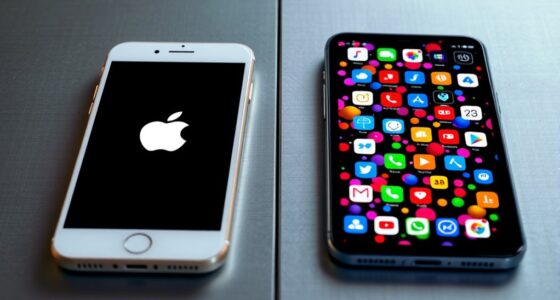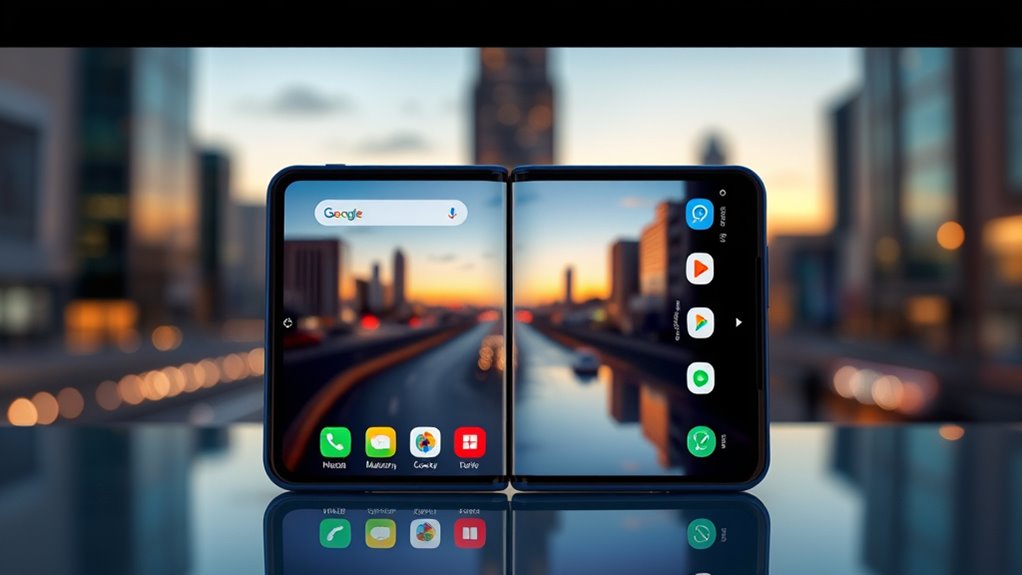

By 2026, most major brands will likely offer foldable smartphones, thanks to rapid tech advances and intense market competition. Companies are investing heavily in innovation, making foldables more durable, cheaper, and user-friendly. As a result, foldable phones will shift from premium features to mainstream devices across diverse brands. If you want to understand how design improvements and industry trends are shaping this future, there’s much more to explore.
Key Takeaways
- Rapid innovation and competition are driving widespread adoption of foldable phones across brands.
- Technological advancements are improving durability and reducing costs, making foldables more accessible.
- Market trends indicate foldables will transition from premium to mainstream devices by 2026.
- Major brands are investing heavily in R&D to incorporate foldables into diverse product lines.
- By 2026, foldable technology is expected to be a standard feature across most mobile brands.

As foldable phones continue to evolve, many wonder if they’ll become a standard feature across all brands by 2026. The rapid development of foldable technology is driven by design innovation, which pushes manufacturers to create sleeker, more durable, and user-friendly devices. You’ll notice that companies are experimenting with different hinge mechanisms, screen materials, and form factors to stand out in a crowded market. This push for innovation isn’t just about aesthetics; it’s about enhancing functionality and offering new ways to interact with your device. From ultra-thin foldable displays to seamless multi-tasking features, brands are investing heavily in R&D to perfect these gadgets. As a result, the design of foldable phones is becoming more refined, with reduced creases and increased durability, making them more appealing to a broader audience. The ongoing technology development in foldable displays is also a crucial factor in making these devices more reliable and attractive to consumers.
Market competition plays a pivotal role in accelerating this evolution. With tech giants like Samsung, Huawei, and Xiaomi racing to outdo each other, you can expect a rapid influx of new models with improved foldable designs. This competition drives innovation not only in hardware but also in software optimization, ensuring these devices are practical for everyday use. Each brand aims to capture a larger share of the market by offering features that appeal to different segments—whether it’s a compact foldable for portability or a larger, tablet-like device for productivity. This fierce rivalry pushes companies to reduce costs, improve quality, and introduce unique features that set their products apart.
The relentless market competition also means that you’re likely to see more affordable foldable options from various brands, making these devices accessible to a wider audience. As the technology matures, economies of scale will lower production costs, allowing brands to offer foldable phones at competitive prices. In turn, this will encourage more consumers to adopt foldables, normalizing their presence in the smartphone landscape. By 2026, it’s plausible that foldable phones won’t just be a premium niche but a standard feature across a broad spectrum of brands and models. The combination of ongoing design innovation and escalating market competition is shaping a future where foldables become a common, expected part of your mobile experience.

Google Pixel Fold – Unlocked Android 5G Smartphone with Telephoto Lens and Ultrawide Lens – Foldable Display – 24-Hour Battery – Obsidian – 256 GB
The first foldable phone engineered by Google, Pixel Fold has all the power of the Google Tensor G2…
As an affiliate, we earn on qualifying purchases.
As an affiliate, we earn on qualifying purchases.
Frequently Asked Questions
How Durable Are Foldable Screens Over Time?
Foldable screens have improved substantially, but durability concerns still exist. Over time, repeated folding can cause wear and tear, affecting screen longevity. You might notice creases or reduced responsiveness after extensive use. While manufacturers are working on stronger materials, it’s wise to handle foldables gently and avoid excessive folding to maximize their lifespan. Overall, with proper care, foldable screens can last several years, but they aren’t as durable as traditional displays yet.
What Are the Environmental Impacts of Foldable Phones?
Foldable phones pose environmental challenges due to recycling difficulties and material sustainability concerns. You might find that their complex design makes recycling more difficult, leading to higher e-waste. Additionally, the materials used, like flexible plastics and specialized metals, often aren’t sustainably sourced or easily recyclable. This increases the environmental footprint, urging brands to focus on eco-friendly materials and improved recycling methods to reduce their impact.
Will Foldable Technology Increase Phone Repair Costs?
Think of foldable phones as a complex puzzle, and you’re the solver. They’ll likely increase repair costs due to delicate hinges and flexible screens, making repairs more intricate. This impacts the cost implications for users and challenges the repair industry, which must adapt to new technology. So, expect higher repair costs initially, but as tech improves, costs may stabilize, balancing innovation with affordability.
Are Foldable Phones Suitable for Enterprise Use?
Foldable phones are suitable for enterprise use because their flexible displays enhance user ergonomics, allowing for more comfortable and adaptable workflows. You can easily switch between a compact device and a larger screen for presentations or multitasking. Plus, the durability of modern foldables continues to improve, making them a practical choice for enterprise environments that require both portability and functionality.
How Will Foldable Devices Influence Other Tech Categories?
You’re hitting the nail on the head—foldable devices will revolutionize other tech categories by pushing flexible displays and user interface adaptation to new heights. As you embrace this change, expect laptops, tablets, and even wearable tech to become more versatile, lightweight, and interactive. This shift will break down barriers, making tech more intuitive and personalized, turning the industry on its head and opening up endless possibilities for innovation.
![Vizvera for Samsung Galaxy Z Fold 7 Case RFID Wallet with Cards Holder [Hinge Cover] [Camera Cover] Shockproof Silicone Protective Phone Case for Z Fold 7 2025-Black](https://m.media-amazon.com/images/I/41wIyp-VSML._SL500_.jpg)
Vizvera for Samsung Galaxy Z Fold 7 Case RFID Wallet with Cards Holder [Hinge Cover] [Camera Cover] Shockproof Silicone Protective Phone Case for Z Fold 7 2025-Black
Compatibility for Z Fold 7 Case: This Newest Upgrade Wallet Case is designed for Samsung Galaxy Z Fold…
As an affiliate, we earn on qualifying purchases.
As an affiliate, we earn on qualifying purchases.
Conclusion
By 2026, it’s clear that foldable phones are poised to become mainstream. As brands race to perfect these devices, you’ll find yourself on the cusp of a tech revolution. Don’t be left in the dust—embrace the change and keep an eye on the horizon. The foldable revolution isn’t just a passing trend; it’s the tip of the iceberg, and soon, everyone will be riding the wave.
![TOCOL for Samsung Galaxy Z Fold 7 Screen Protector [9H Hardness] [Military Grade Shatterproof] HD Tempered Glass 2 Pack](https://m.media-amazon.com/images/I/51Cx+JLGhHL._SL500_.jpg)
TOCOL for Samsung Galaxy Z Fold 7 Screen Protector [9H Hardness] [Military Grade Shatterproof] HD Tempered Glass 2 Pack
【Revolutionary Innovative Auto Installation】It features innovative automatic positioning, dust removal, and adsorption technology, making the installation a breeze…
As an affiliate, we earn on qualifying purchases.
As an affiliate, we earn on qualifying purchases.

Klearlook 4 in 1 Adjustable Phone Stand – 360 Rotation Handsfree Viewing, Foldable Travel Essentials, Accessory for Flight/Home/Office – Green
Flexible Angle Adjustable: The upper holder is rotatable that allows you to adjust the angle (290-degree) and direction…
As an affiliate, we earn on qualifying purchases.
As an affiliate, we earn on qualifying purchases.