

This checklist is for anyone planning a laptop upgrade in 2026, whether you’re adding memory or storage, improving desk setup, or checking whether a replacement battery is the right next step. Use the listed product names as starting points, then confirm every detail against your exact laptop model.

Get the latest gadgets delivered free with Prime
- Fast, free delivery on millions of items
- Prime Video, Amazon Music and more included
- Member-only deals all year
The sections follow common upgrade categories: RAM, storage, cooling, docking, monitors, and batteries. Each one explains what to check before choosing a product, with extra attention to fit and compatibility—details that can vary between laptops and accessories.
Start with the upgrade that addresses your main need. Look up your laptop’s specifications and ports, compare them with the product’s documentation, and check what installation requires. If a key detail is unclear, verify it before buying or ask the laptop maker or a qualified repair professional.
Laptop RAM Kits
More memory can be a useful upgrade when your laptop’s current configuration is limiting the way you use it. The pick here is named “Laptop Computer, 15.6 Inch Windows 11 Pro Gaming Laptop with 16GB RAM,” which describes a laptop configuration rather than clearly identifying a standalone RAM kit. Treat it as a reference point, not a confirmed module, and verify the actual item before purchasing.
A common mistake is assuming that any kit with a matching capacity will work. Laptop memory must match the machine’s supported memory type, module format, capacity limits, and configuration. Some laptops have memory that cannot be replaced, while others have a mix of soldered memory and accessible slots. Check the exact model’s service information and determine whether installation is supported. Also consider whether opening the case affects warranty or requires tools and experience.
Before choosing, confirm whether the listing is for a complete computer or memory modules, and check the number and specifications of the modules included. Compare those details with your laptop’s existing memory and manufacturer guidance. Model-specific compatibility is the deciding factor; the product name alone does not establish that it fits another laptop.
What to look for:
- Verify the listing is for RAM modules, not a laptop.
- Match the memory type and module format to your exact model.
- Check the laptop’s maximum supported capacity and available slots.
- Confirm whether memory is soldered or replaceable.
- Review installation requirements and warranty guidance.
Laptop Computer, 15.6 Inch Windows 11 Pro Gaming Laptop with 16GB RAM, 512GB SSD

This gaming laptop features a 15.6-inch Full HD IPS display, an Intel Core i7-7600U processor, 16GB RAM, and a 512GB SSD, providing high performance for work, gaming, and entertainment. It comes pre-loaded with Windows 11 Pro and Office 365, with a backlit keyboard and portable design for mobility.
Pros:
- High-performance Intel Core i7 processor
- Bright 15.6-inch Full HD display with low blue light technology
- Large 16GB RAM and fast 512GB SSD for smooth multitasking
- Portable design weighing only 3.5 lbs
Cons:
- Battery life may be limited to around 6 hours
- Older generation processor (7th Gen) compared to newer models
- Integrated graphics may not handle high-end gaming
Best for: Shoppers verifying a memory upgrade against their laptop’s service specifications
Not ideal for: Anyone seeking a clearly identified standalone RAM kit from this product name alone
Bottom line: Confirm the item is actually a compatible RAM kit for your exact laptop before buying.
NVMe SSDs
The listed pick is the “Micron 9300 Max 6.4TB NVMe U.2 Enterprise Solid State Drive.” Its name identifies a U.2 enterprise drive, so don’t assume it is a direct replacement for a typical laptop SSD. This slot matters because storage upgrades depend on both the laptop’s supported interface and the physical space available. Connector and form factor need to match before capacity becomes relevant.
A frequent buying mistake is treating “NVMe” as enough information to establish compatibility. Check the laptop’s manual or service documentation for supported drive types, connector, dimensions, and any capacity or installation requirements. Compare those details with the complete drive specifications. Also check whether the machine has a suitable bay or connection and whether fitting the drive requires an adapter or other hardware; don’t assume such parts are included.
Plan the installation as well as the purchase. Find out how to transfer or reinstall your operating system and files, and confirm whether the laptop can be opened safely. If the documentation does not show support for a U.2 drive, choose storage specified for your laptop instead. The product name gives a clear U.2 compatibility cue, but it cannot confirm fit for an unspecified laptop.
What to look for:
- Check whether your laptop supports U.2 drives specifically.
- Match the drive’s connector and physical dimensions to the laptop.
- Verify supported capacity and installation requirements in the manual.
- Confirm whether required adapters or mounting parts are included.
- Plan data transfer or operating-system installation before replacing storage.
Micron 9300 Max 6.4TB NVMe U.2 Enterprise Solid State Drive

The Micron 9300 Max is a 6.4TB enterprise NVMe SSD in a 2.5-inch U.2 form factor, designed for performance-critical cloud and datacenter workloads. It delivers industry-leading sequential write performance with the lowest write latency on the market, consistently reading and writing over 3.5 GB/s of sequential data.
Pros:
- Industry-leading sequential write performance with lowest write latency on the market
- High 6.4TB capacity for enterprise storage needs
- Consistent throughput over 3.5 GB/s
- Efficient performance with more IOPS per watt
Cons:
- Enterprise-grade drive that may be overkill for consumer use
- Requires U.2 interface compatibility, limiting desktop use
Best for: Shoppers whose laptop documentation specifically confirms support for this drive type
Not ideal for: Laptop owners whose storage requirements or connectors are still unknown
Bottom line: Buy this drive only after confirming your laptop supports its U.2 connection and fit.
Laptop Cooling Pads
The “Razer Laptop Cooling Pad with Adaptive Fan Control” is the cooling accessory listed for this checklist. A cooling pad can be worth considering when you want an external base for your laptop, but the product name alone does not establish which laptop sizes, connections, or control features are supported. Check the maker’s documentation for your specific model and the pad’s requirements.
A common mistake is choosing a pad based only on its appearance or assuming that it works with every laptop. Confirm the supported size range and how the pad is powered and connected. If its adaptive controls require software or a particular connection, check that those requirements match your laptop and operating system. Also consider where the laptop’s air intakes and exhaust vents are located, and whether the pad’s layout leaves them unobstructed.
Think through day-to-day use before ordering: where the laptop will sit, whether the pad can stay connected, and whether its controls are convenient for your setup. Review included cables and any setup instructions rather than assuming the necessary accessories are in the box. Fit and airflow are practical checks, while the product name’s adaptive-fan wording should be confirmed against the documented feature set.
What to look for:
- Check the supported laptop size range.
- Confirm power, connection, and any software requirements.
- Compare the pad layout with your laptop’s vent locations.
- Review the documented fan-control features and setup instructions.
- Check which cables or accessories are included.
Razer Laptop Cooling Pad with Adaptive Fan Control
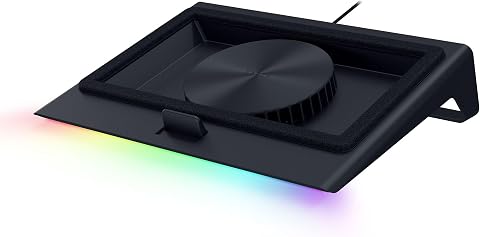
This laptop cooling pad automatically adjusts fan speed based on system temperature and uses an airtight pressure chamber to direct airflow. It fits most 14–18-inch laptops and includes customizable fan curves, Chroma RGB lighting, remappable controls, and a three-port USB-A hub.
Pros:
- Automatically adjusts fan speed based on laptop temperature
- Airtight chamber and foam seals help direct cool air
- Fits a range of 14–18-inch laptops
- Includes three USB-A ports and customizable fan controls
Cons:
- Custom fan curves and remappable controls require Razer Synapse
- Razer HyperBoost performance features are for compatible Blade laptops
Best for: Shoppers confirming size, vent placement, and control requirements before choosing a cooling pad
Not ideal for: Anyone who cannot verify the pad’s supported models and connection needs
Bottom line: Confirm fit, airflow clearance, and documented control requirements for your laptop.
USB-C Laptop Docks
The dock pick is “Anker Prime Docking Station, 14-in-1 Laptop Docking Station Dual Monit.” The name suggests a multiport dock and mentions dual monitors, but it does not give the complete specifications. A dock can help organize a desk setup, yet the laptop’s USB-C port must support the functions you plan to use. Port capability matters as much as the connector’s shape.
A common mistake is assuming that every USB-C port can drive displays or deliver power in the same way. Check your laptop documentation for display output, charging support, and any relevant connection standards. Then compare it with the dock’s full port list and requirements. For dual displays, verify the supported display combinations and resolutions for your exact laptop and operating system. Confirm whether the dock includes a power supply and the cables you need.
List your intended devices before buying: displays, storage, network, audio, and other peripherals. Match each one to a documented dock port, and check whether connecting them at the same time changes what is supported. The truncated product name is not enough to confirm its specifications. Verify the complete model details and laptop compatibility before relying on it for a particular workstation setup.
What to look for:
- Confirm your USB-C port supports the functions you need.
- Check the full dock port list and supported display combinations.
- Verify dual-display support for your laptop and operating system.
- Check whether power supply and required cables are included.
- Match every planned peripheral to an available, supported port.
Anker Prime Docking Station, 14-in-1 Laptop Docking Station Dual Monitor
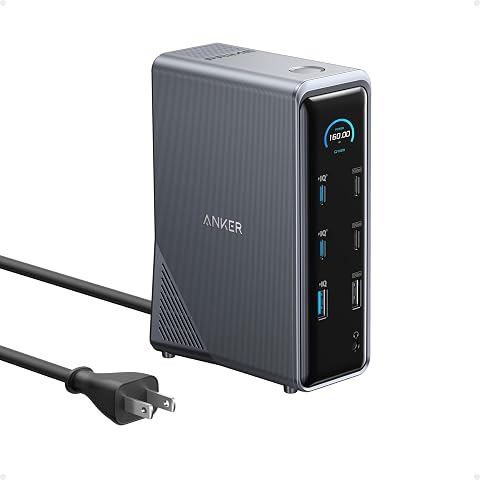
The Anker Prime Docking Station offers 14-in-1 connectivity, supporting dual 4K displays, fast data transfer, and charging for multiple devices simultaneously. It features a powerful 160W output and versatile ports, compatible with various laptops and operating systems.
Pros:
- Supports dual 4K displays with clear visuals
- High power output for charging multiple devices simultaneously
- Versatile port options for data transfer and connectivity
- Compatible with various operating systems and laptops
Cons:
- Does not support monitors with 5120×1440 resolution
- MacOS displays are mirrored, not extended
- Not compatible with Linux
Best for: Shoppers checking a multi-device desk setup against their laptop’s port capabilities
Not ideal for: Anyone relying on the truncated product name as a full specification
Bottom line: Verify the complete dock specifications and your laptop’s display and charging support.
External Monitors
The listed display is the “Acer Predator X32 31.5-Inch Curved 4K QD-OLED 240Hz Gaming Monitor.” Its name provides several specifications to compare with your laptop and workspace, including a 31.5-inch curved screen and 4K resolution. Before choosing, confirm that your laptop can connect to the monitor at the settings you want. Connection support affects what the completed setup can deliver.
A common mistake is focusing on the monitor’s listed features without checking the laptop’s display output, supported resolution, and refresh-rate capabilities. Look up the laptop’s specifications and compare them with the monitor’s complete input and mode information. Check which cable or connection is required, whether it is included, and whether your intended configuration is supported through a dock or adapter. Don’t assume that connecting through a dock will preserve every display mode.
Measure the available desk space and viewing distance, and check that the curved 31.5-inch format suits the intended position. Consider how the monitor will be placed and connected in your setup, including whether the laptop can sit where its ports remain accessible. The product name is a useful specification checklist, but confirm the full details and laptop compatibility before ordering.
What to look for:
- Check laptop output support for the intended resolution and refresh rate.
- Review the monitor’s complete input and connection specifications.
- Confirm cable, adapter, or dock requirements and what is included.
- Measure desk space and consider viewing distance for a 31.5-inch curved screen.
- Verify the planned connection supports your chosen display settings.
Acer Predator X32 31.5-Inch Curved 4K QD-OLED 240Hz Gaming Monitor

The Acer Predator X32 is a 31.5-inch curved 4K UHD QD-OLED gaming monitor with a 240Hz refresh rate and 0.03ms response time. It supports DisplayHDR True Black 400, AMD FreeSync Premium, and ergonomic tilt, swivel, and height adjustments.
Pros:
- Sharp 4K UHD QD-OLED picture with 99% DCI-P3 color gamut
- 240Hz refresh rate and 0.03ms response time
- Curved screen and adjustable stand support immersive, comfortable gaming
- Includes AMD FreeSync Premium, USB-C, and a built-in KVM switch
Cons:
- Large 31.5-inch size requires substantial desk space
- The provided product data contains no customer review details
Best for: Shoppers whose laptop and connection setup support the display modes they want
Not ideal for: Anyone who has not checked laptop output or desk fit
Bottom line: Match the laptop’s supported output and your available space to the monitor’s specifications.
Laptop Replacement Batteries
A battery replacement should begin with your laptop’s exact model and the battery part information, not a generic fit assumption. Laptop batteries can differ between models, including models that look similar. This slot matters because choosing the wrong replacement can leave you with a part that does not fit or connect as required. Identify the exact battery using the laptop maker’s documentation or support resources.
A common mistake is searching by laptop brand or screen size alone. Find the full model number and, where available, the battery part number printed on the original battery or listed in service documentation. Check the manufacturer’s replacement guidance and confirm whether the battery is intended for user replacement. Some models require careful disassembly; if the procedure is unclear or you are not comfortable with it, consult an authorized service provider or qualified repair professional.
Before ordering, compare the replacement’s part number and documented compatibility with your laptop, and review installation instructions. Don’t rely on a marketplace title that names a broad laptop family without confirming the specific models. Check how the old battery should be handled and follow local disposal guidance. Part-number confirmation and safe installation planning are the practical steps that make this advice useful.
What to look for:
- Record the complete laptop model number.
- Confirm the original battery part number from the battery or service documentation.
- Check manufacturer guidance on user replacement and installation.
- Match the replacement’s documented compatibility to the exact laptop model.
- Follow the maker’s instructions and local guidance for old battery disposal.
For a budget-first upgrade order, start by identifying the one limitation you want to address, then check your laptop’s specifications before shopping. Compare compatibility and installation needs across the relevant category, and prioritize the option that solves that need with the fewest additional parts. Check the fit first so you can avoid buying accessories your laptop cannot use.
Use each product name as a prompt to verify its full specifications, then make your choice with confidence. If a detail is missing, the laptop maker’s manual or support team can help you confirm it. A little preparation makes it easier to choose an upgrade that fits your machine and your plans.