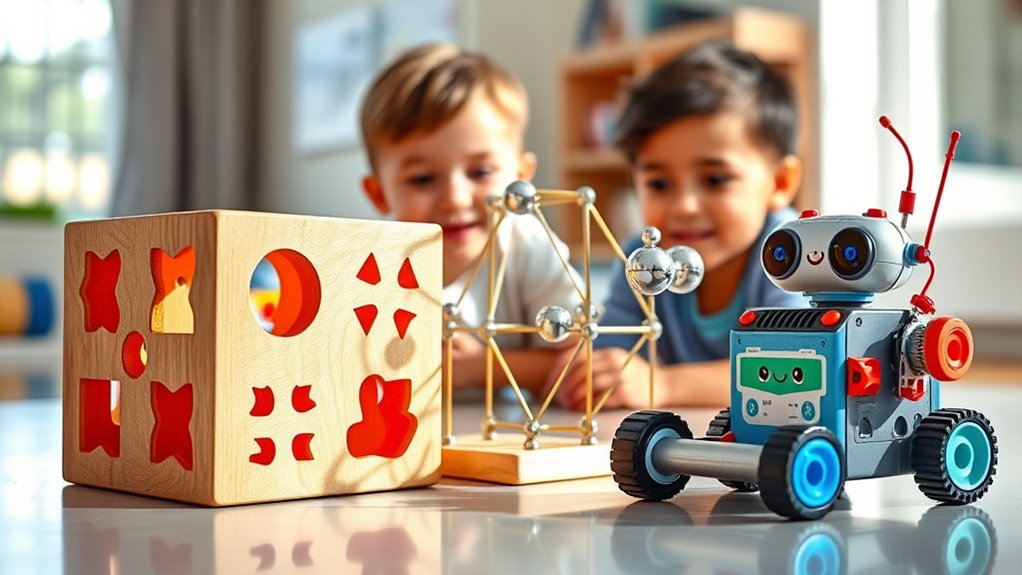

I recommend the FlySky 9-in-3 Take Apart Toys for hands-on building fun, Coodoo Magnetic Tiles for creative spatial play, and the Boley Microscope Kit to explore the natural world. These toys are safe, engaging, and age-appropriate, helping toddlers develop fine motor skills, problem-solving, and curiosity. They also support imaginative play and learning through versatile features. Keep going to discover how to choose the best STEM toys that grow with your child’s interests.
Listen free for 30 days with Audible
Thousands of audiobooks and originals — cancel anytime.
As an affiliate, we earn on qualifying purchases.
Key Takeaways
- Choose age-appropriate toys with large, safe parts that support fine motor skills and simple problem-solving for toddlers.
- Opt for colorful, visually appealing designs that stimulate curiosity and engagement during early learning stages.
- Prioritize durable, non-toxic materials and safety certifications to ensure long-lasting, safe play experiences.
- Select versatile toys that can be combined or modified for continued learning and creative exploration.
- Incorporate easy-to-store options with organized compartments to promote independence and tidy play habits.

9 in 3 Take Apart Toy Construction Truck Electric Drill STEM
- Complete Construction Set: Includes 3 truck bases, manual, screwdriver, drill, and storage box
- Build Multiple Vehicles: Create forklifts, excavators, bulldozers, and mixers
- Educational STEM Toy: Encourages DIY assembly and enhances motor skills
As an affiliate, we earn on qualifying purchases.
9-in-3 STEM Toy Set for 4-7 Year Old Boys
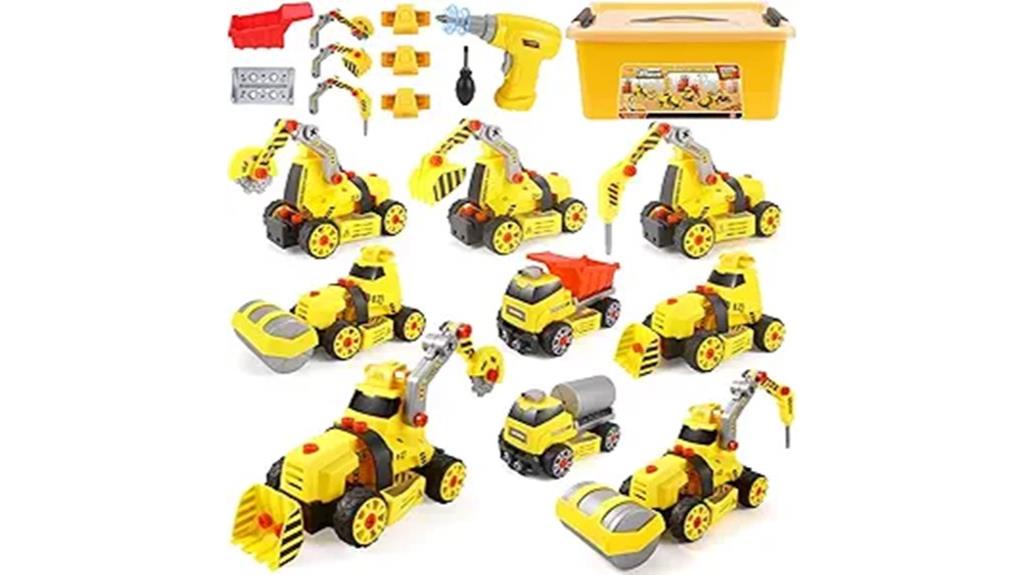
If you’re looking for a STEM toy set that’s perfect for boys aged 4 to 7, the FlySky 9-in-3 Take Apart Toys is an excellent choice. This set includes three construction trucks—forklifts, excavators, and bulldozers—plus an electric drill, screwdriver, and user manual. The storage box makes organization easy, and kids can quickly rebuild trucks into different vehicles, boosting creativity. The electric drill simplifies assembly, encouraging hands-on learning. Designed for early learners, it helps improve fine motor skills, hand-eye coordination, and logical thinking. This versatile set makes a fun, educational gift that inspires curiosity about engineering and construction.
Best For: children aged 4 to 7 who enjoy hands-on, educational STEM toys that promote creativity and motor skill development.
Pros:
- Encourages DIY assembly and problem-solving skills through realistic construction trucks.
- Enhances fine motor skills and hand-eye coordination with easy-to-use electric drill and screwdriver.
- Comes with a storage box for organized play and portability, making it ideal for both home and classroom use.
Cons:
- Batteries for the electric drill are not included, requiring an additional purchase.
- The set may be more suitable for children at the lower end of the age range due to small parts.
- The electric drill may require adult supervision during assembly for younger children.

Coodoo Magnetic Tiles Kids Toys STEM Magnet Toy for Toddler Magnetic Blocks Building Preschool Learning Sensory Montessori Toys for 3+ Year Old Boys and Girls, Safe Creativity Toddler Kids Toy 40PCS
- Starter Set with 40 Tiles: Includes 40 colorful magnetic tiles for beginners
- Compatible with Leading Brands: Standard 3-inch base size fits other brands
- Encourages STEM and Creativity: Supports pattern recognition and problem-solving skills
As an affiliate, we earn on qualifying purchases.
Coodoo Magnetic Tiles Kids Toys (40PCS)

Coodoo Magnetic Tiles Kids Toys (40PCS) is an excellent choice for parents and educators looking to foster STEM skills in young children, especially those aged 3 and up. This set includes 40 colorful, magnetic tiles in various shapes, perfect for small hands to grasp and build with. The tiles are compatible with other brands, allowing for expanded creativity. Made from food-grade ABS plastic, they’re safe, durable, and feature rounded edges to prevent injuries. The open-ended design encourages imaginative play, pattern recognition, and spatial reasoning. Plus, the portable carrying bag makes it easy to enjoy learning and building anywhere—at home, school, or on the go.
Best For: parents, teachers, and caregivers seeking a safe, educational, and versatile toy to promote STEM learning and creativity in children aged 3 and above.
Pros:
- Encourages STEM development through building, pattern recognition, and spatial reasoning.
- Made from food-grade, durable ABS plastic with rounded edges for safety.
- Compatible with other brands and comes with a portable carrying bag for easy on-the-go play.
Cons:
- Limited to 40 pieces, which may restrict larger or more complex constructions.
- May require additional sets for expanded creative options.
- Some children might need supervision to ensure safe handling of magnetic tiles.
Boley Microscope Kit for Kids with Butterfly Toys
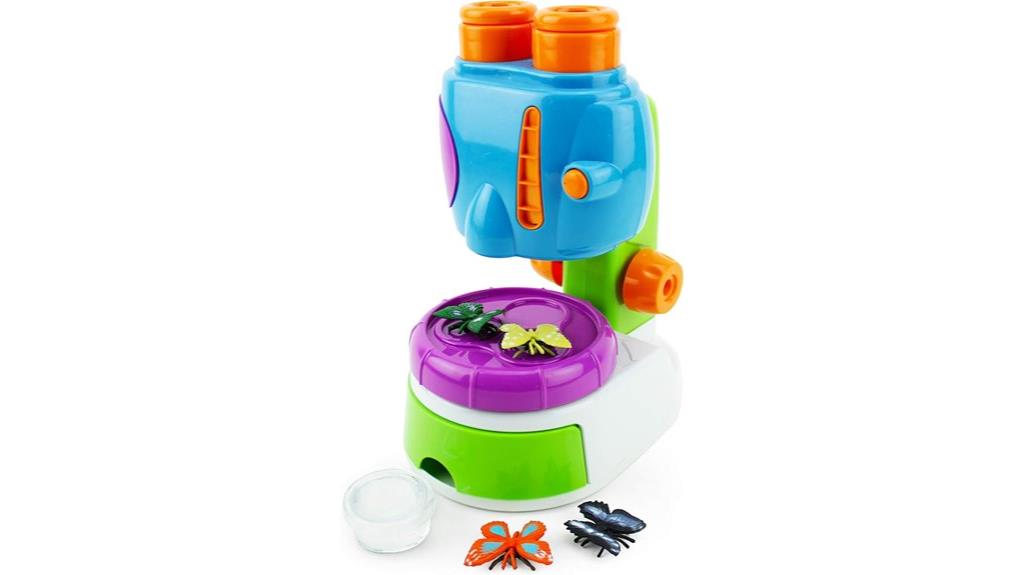
The Boley Microscope Kit for Kids with Butterfly Toys is an excellent choice for parents seeking an engaging STEM toy that introduces preschoolers to scientific exploration. This colorful kit features a kid-friendly microscope, magnifying glasses, a rotating tray, four toy butterflies, and a specimen container, encouraging hands-on discovery. With a side button to illuminate specimens, it sparks curiosity about the natural world. Designed for children aged 3 and up, it emphasizes safety with non-toxic materials and has received high praise, including a 4.5-star rating. It’s a fun, educational way to nurture early scientific skills and curiosity in young learners.
Best For: Young children aged 3 and up who are curious about science and enjoy hands-on learning with safe, educational toys.
Pros:
- Engages preschoolers with real scientific exploration through magnification and specimen examination
- Includes colorful, child-friendly design with non-toxic materials ensuring safety and durability
- Promotes STEM learning and curiosity in a fun, interactive way suitable for early learners
Cons:
- May have limited magnification compared to more advanced microscopes for older children or hobbyists
- The toy butterflies are not real specimens, which might reduce the authenticity for some educational purposes
- Requires adult supervision for younger children to ensure proper handling and safety during exploration
Factors to Consider When Choosing STEM Toys for Toddlers
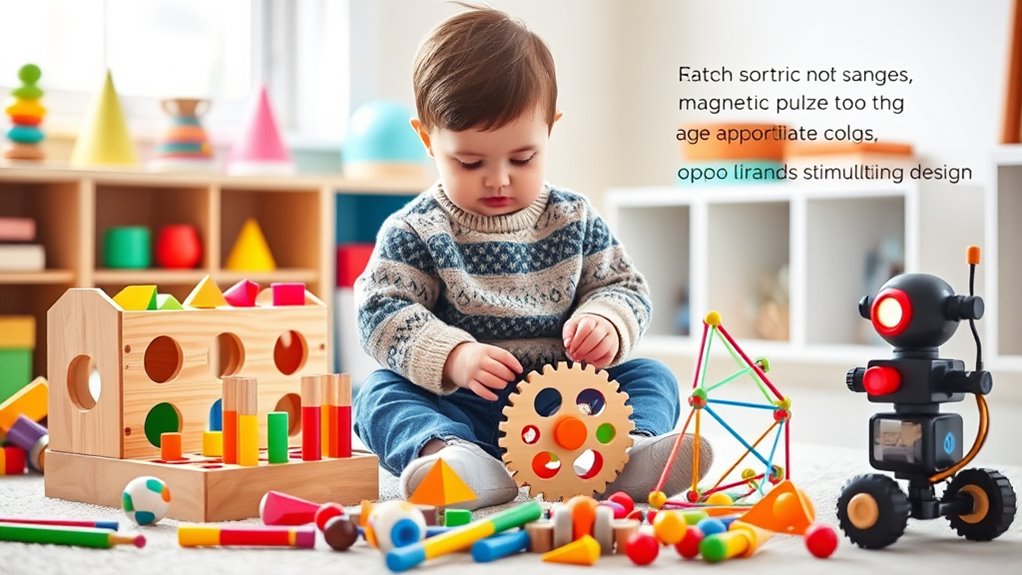
When selecting STEM toys for toddlers, I always check if they are age-appropriate and meet safety standards to guarantee my child’s well-being. I also consider the educational value and how well the toy encourages play and learning together. Finally, I look for durability and versatility to get the most lasting benefit from the toy.
Age Appropriateness
Choosing the right STEM toy for a toddler begins with paying close attention to age labeling. This helps guarantee the toy matches their developmental stage and abilities. For children aged 1-3, I look for toys with large, easy-to-handle parts to prevent choking risks and make play safe. It’s also important to select toys that offer the right level of challenge—ones that engage their current skills without causing frustration. I always check for safety certifications and non-toxic materials, since toddlers tend to put things in their mouths. Ultimately, I choose toys that promote foundational skills like fine motor control and simple problem-solving, laying the groundwork for future learning. Age-appropriate toys help make play both safe and enriching.
Safety Standards
Ensuring a STEM toy meets strict safety standards is essential for protecting toddlers during play. I always check for certifications like ASTM F963 or EN71, which confirm the toy is made from non-toxic materials and manufactured safely. Look for clear age labels and warnings to avoid choking hazards or injuries. I prefer toys with smooth edges, sealed magnets, and sturdy construction to prevent cuts, breakage, or ingestion risks. It’s also important that materials like food-grade plastics or non-toxic paints are used, especially since toddlers tend to mouth toys. Reputable safety certifications from trusted organizations give me peace of mind, ensuring the toy complies with international safety regulations. Prioritizing these standards helps keep playtime safe and enjoyable for my little one.
Educational Value
Ever wonder what makes a STEM toy truly educational for toddlers? It’s about more than just fun; it’s how the toy promotes early critical thinking and problem-solving through age-appropriate activities. Toys that introduce core concepts in science, technology, engineering, and math in an engaging way boost learning from the start. Hands-on experimentation and exploration are key—they help toddlers grasp basic scientific principles while fostering curiosity. An educational STEM toy should also support creativity and cognitive development, aligning with developmental milestones. Incorporating sensory play and open-ended building options encourages exploration and helps strengthen neural connections. When choosing a STEM toy, look for one that balances learning and fun, igniting a child’s natural curiosity while promoting foundational skills that serve as a base for future learning.
Play Flexibility
When selecting STEM toys for toddlers, considering play flexibility can make a big difference in how long and how effectively a child engages with the toy. Toys with versatile components and open-ended designs encourage kids to invent new uses and explore different ways to play. This promotes creativity and keeps their interest alive over time. Flexible STEM toys also support various skill levels, allowing children to gradually develop more complex understanding as they grow. The ability to modify or combine parts enhances problem-solving skills and encourages independent thinking. Plus, play flexibility ensures that the toy remains relevant and engaging through different developmental stages. Overall, choosing toys with adaptable features helps foster a love for learning while keeping play fresh and exciting.
Durability Factors
Choosing durable STEM toys for toddlers requires attention to the materials and construction quality, as these determine how well the toy withstands active play. I look for toys made from high-quality, non-toxic materials like food-grade ABS plastic, which resist breaking and are safe for little hands. Reinforced magnetic connections and sealed parts prevent breakage, ensuring long-lasting use. Smooth edges and rounded corners are essential to avoid injuries and preserve the toy’s integrity over time. Toys with sturdy construction, such as reinforced joints or impact-resistant components, can handle drops and rough handling common with toddlers. Additionally, I ensure they’re properly tested and certified to meet safety standards, giving me confidence that durability and safety go hand in hand for extended, worry-free play.
Storage Convenience
Since toddlers are naturally curious and active, selecting STEM toys with convenient storage options can make a big difference in keeping play areas organized. Look for toys that include built-in storage to keep small parts from getting lost, which also makes cleanup easier. Durable, portable containers or boxes are ideal for quick transport and safe storage. Modular or stackable designs help maximize space and allow flexible organization, especially in tight areas. Make sure the storage solutions are age-appropriate, with secure lids or compartments to prevent spills or accidental openings. Clear labeling or designated sections can help both children and parents quickly find and put away parts, promoting independence and tidiness during playtime. Efficient storage encourages ongoing engagement and reduces clutter.
Visual Appeal
Bright, colorful designs instantly capture toddlers’ attention and encourage them to explore STEM toys. Vibrant colors and engaging patterns stimulate visual exploration, helping young children differentiate shapes and objects. Clear, high-contrast shapes make it easier for toddlers to recognize and understand new structures, supporting their development. Toys with appealing themes, like construction or animals, spark curiosity and motivate children to interact more deeply. Well-designed visual elements also make complex concepts more accessible, turning learning into an enjoyable experience. When a toy’s appearance is attractive, children are more likely to stay engaged and participate actively in STEM activities. Overall, thoughtful visual appeal not only draws toddlers in but also enhances their understanding and love for learning through play.
Frequently Asked Questions
How Do STEM Toys Support Emotional Development in Toddlers?
STEM toys support emotional development in toddlers by encouraging curiosity and confidence as they explore and solve problems. I’ve noticed that when kids succeed with these toys, they feel proud and more willing to try new things. They also learn patience and persistence when faced with challenges. These toys help build resilience and self-esteem, fostering emotional growth alongside cognitive skills, which is essential during their early years.
Are There STEM Toys Suitable for Children With Special Educational Needs?
Did you know that 15% of children worldwide have some form of developmental disability? I believe there are plenty of STEM toys designed specifically for children with special educational needs. These toys often feature sensory elements, simple mechanics, and adjustable difficulty levels, making learning accessible and enjoyable. I always recommend choosing toys that match the child’s individual abilities and interests, ensuring they feel supported and empowered to explore STEM concepts.
What Safety Features Should I Look for in Toddler STEM Toys?
When choosing toddler STEM toys, I focus on safety features like smooth edges, non-toxic materials, and sturdy construction to prevent choking hazards. I also look for toys that meet safety standards and have secure battery compartments that require tools to open. Additionally, I prefer toys with age-appropriate labels and parts that are too large to swallow, ensuring my child’s safety as they explore and learn through play.
How Can Parents Encourage Creativity With STEM Toys?
Encouraging creativity with STEM toys is like opening a treasure chest of imagination. I suggest you set up open-ended activities and let your child explore freely, asking questions and experimenting without fear of failure. Join in their play, offer gentle guidance, and praise their ideas. This nurturing environment acts as a catalyst, turning simple toys into powerful tools that inspire curiosity, problem-solving, and endless creative adventures.
At What Age Should Children Start Using More Complex STEM Kits?
I believe children can start exploring more complex STEM kits around ages 4 to 6, depending on their individual development. At this stage, they usually have better fine motor skills and understanding of basic concepts, making it easier and more enjoyable for them to engage with advanced projects. I always recommend parents choose age-appropriate kits to guarantee their kids stay safe and excited to learn.
Conclusion
Finding the right STEM toys for toddlers can feel overwhelming, but remember, a little patience goes a long way. By choosing toys that spark curiosity and promote learning through play, you’re planting seeds that will grow into a love for discovery. Don’t put all your eggs in one basket—try a variety of options to see what clicks. With the right tools, you’ll help your little one thrive and turn their early interests into lifelong passions.
College move-in / dorm season Picks
dorm essentials
As an affiliate, we earn on qualifying purchases.