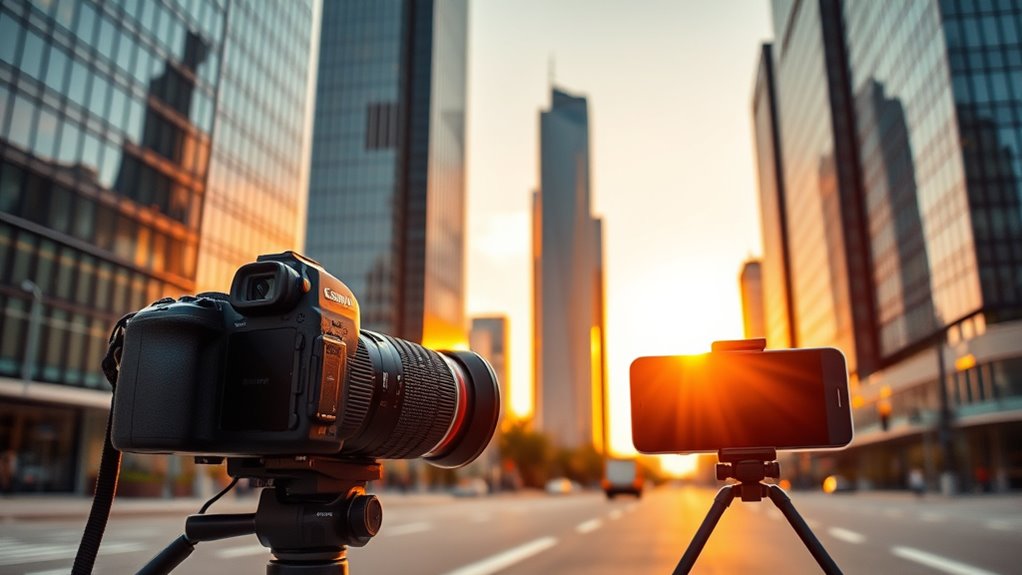

Smartphone cameras have come a long way and can handle many professional needs, thanks to advanced optics, multiple lenses, and powerful editing tools. They’re convenient, produce high-quality images in many situations, and suit quick projects. However, for critical professional work that requires superior low-light performance, extensive zoom, or precise control, DSLRs still hold an edge. To discover which option best fits your goals, explore the differences and latest innovations further.

Get the latest gadgets delivered free — and shop member deals
- Fast, free delivery on millions of items
- Access to Prime Big Deal Days deals on October 6–7
- Prime Video, Amazon Music and more included
Key Takeaways
- Smartphone cameras offer advanced optics and editing tools, enabling high-quality images suitable for many professional needs.
- Smaller sensors limit performance in low-light conditions and reduce detail compared to DSLRs.
- Limited optical zoom and manual controls restrict creative flexibility for specialized or high-precision photography.
- Continuous technological improvements are narrowing the gap between smartphones and DSLRs for casual and some professional use.
- DSLRs still outperform smartphones in sensor size, low-light performance, and versatility for demanding professional photography.
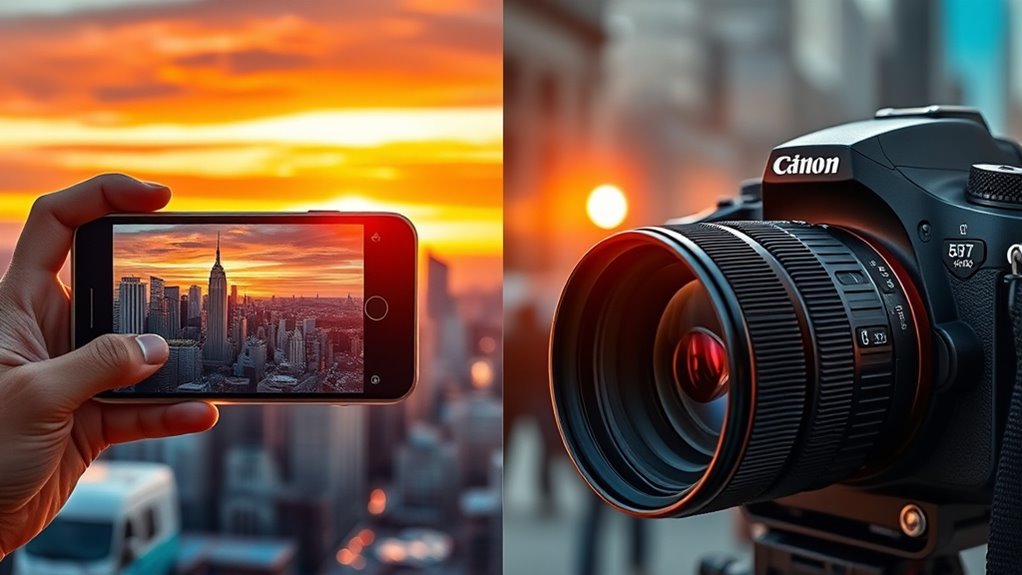
In recent years, smartphone cameras have made incredible advancements, challenging the dominance of traditional DSLRs for everyday photography. You might think that smartphones can’t match the quality and versatility of professional cameras, but modern smartphones have closed that gap considerably. One of the key factors is lens quality. Smartphone manufacturers now equip their devices with multiple lenses—wide-angle, telephoto, macro—that deliver impressive image clarity and detail. These lenses are designed with advanced optics and coatings that reduce distortions and glare, ensuring sharp, vibrant photos even in challenging lighting conditions. As a result, you can capture high-resolution images with excellent color accuracy without carrying bulky equipment.
Smartphone lenses now deliver sharp, vibrant images with advanced optics, rivaling traditional cameras for everyday photography.
Beyond lens quality, editing capabilities on smartphones have become remarkably sophisticated. Today’s devices come with built-in editing tools that allow you to tweak exposure, contrast, sharpness, and color balance right after capturing a photo. Many apps also offer advanced features like noise reduction, HDR, and portrait mode effects with artificial intelligence enhancements. This means you can produce professional-looking images directly on your phone, often eliminating the need for extensive post-processing on a computer. The convenience of instant editing streamlines your workflow and makes it easier to share high-quality images quickly.
However, while smartphone cameras excel in these areas, they still face limitations compared to DSLRs, especially when it comes to sensor size and optical zoom. DSLR sensors are much larger, capturing more light and detail, which translates into better performance in low-light conditions and when shooting fast-moving subjects. The larger sensors also allow for a greater depth of field control, giving you more creative freedom with focus and background blur. But for everyday photography or casual professional work, these distinctions are less noticeable, thanks to smartphone improvements. Additionally, advancements in sensor technology continue to improve low-light performance and image quality, narrowing the gap further.
If you’re considering whether a smartphone can replace a DSLR for professional use, think about your specific needs. For quick, on-the-go shoots, smartphones offer convenience, excellent lens options, and powerful editing tools that can produce images rivaling those from a DSLR. They’re perfect for capturing moments rapidly and sharing instantly. On the other hand, if your work demands high precision, exceptional low-light performance, or extensive manual control, a DSLR still holds advantages. Nonetheless, the gap between the two continues to narrow, making smartphones a viable, versatile tool for many professional scenarios.
professional smartphone camera lenses
As an affiliate, we earn on qualifying purchases.
As an affiliate, we earn on qualifying purchases.
Frequently Asked Questions
Can Smartphone Cameras Match Professional DSLR Image Quality?
Smartphone cameras can’t match professional DSLR image quality yet. DSLRs have larger sensor sizes, capturing more light and detail, which enhances image quality. They also offer lens versatility, allowing you to switch for different scenarios, from wide landscapes to detailed portraits. While smartphones excel for quick shots and convenience, they still fall short of the depth, dynamic range, and customization that professional DSLRs provide for high-quality photography.
Are Smartphone Cameras Suitable for High-End Commercial Photography?
Smartphone cameras are increasingly suitable for high-end commercial photography, thanks to sensor advancements that improve image quality and low-light performance. You also benefit from app integrations that offer manual controls and editing tools, giving you more creative flexibility. While they may not replace DSLRs for every professional project, modern smartphones can handle many high-end commercial tasks effectively, especially when portability and quick turnaround are priorities.
How Do Smartphone Cameras Perform in Low-Light or Challenging Conditions?
Smartphone cameras struggle in low-light or challenging conditions, but recent models improve with night photography features and enhanced dynamic range. You can capture better images in dim environments by using night mode and adjusting settings, yet they still fall short of DSLR performance in extreme low-light situations. For professional results, especially in challenging conditions, DSLRs remain superior due to their larger sensors and advanced optics.
Can Smartphone Cameras Handle Professional Video Production Needs?
You realize that smartphone cameras can handle professional video production thanks to sensor stabilization and lens versatility, but only in certain scenarios. While they excel in quick, on-the-go shoots, they may struggle with complex lighting or high-end editing. It’s a coincidence that their compact design offers convenience, yet limits creative control. Ultimately, if you prioritize portability and ease, smartphones can be a solid tool; for advanced projects, DSLRs still lead.
What Are the Limitations of Smartphone Cameras Compared to DSLRS?
Smartphone cameras have limitations compared to DSLRs, mainly due to sensor size and zoom capabilities. You’ll find that smartphone sensors are smaller, which affects image quality, especially in low light. Their zoom capabilities are usually digital or limited, leading to loss of detail. DSLRs, with larger sensors and optical zoom, deliver superior image quality, better depth, and flexibility, making them more suitable for professional photography.
DSLR camera for low light photography
As an affiliate, we earn on qualifying purchases.
As an affiliate, we earn on qualifying purchases.
Conclusion
While smartphone cameras have come a long way, they’re still like a Swiss Army knife—versatile but not always the right tool for every job. DSLRs remain the heavyweight champs, offering unmatched control and image quality. For professionals, it’s not about replacing but knowing when to pick up the right tool. So, unless your smartphone has a built-in magic wand, keep your DSLR handy—because some shots demand the precision only a dedicated camera can provide.
As an affiliate, we earn on qualifying purchases.
telephoto macro lens for smartphones
As an affiliate, we earn on qualifying purchases.
As an affiliate, we earn on qualifying purchases.
Evergreen bestsellers Picks
bestsellers
As an affiliate, we earn on qualifying purchases.