
TL;DR

Get the latest gadgets delivered free with Prime
- Fast, free delivery on millions of items
- Prime Video, Amazon Music and more included
- Member-only deals all year
IdeaClyst is a local-first AI-powered war room that helps founders validate ideas quickly by simulating a structured debate among AI advisors. It reduces costly market mistakes and builds confidence in decision-making, all without leaving your laptop.
Ever sit on an idea, feeling the weight of uncertainty, and wish you had a team of advisors to tell you the truth? That’s exactly what IdeaClyst offers—a digital war room where your ideas get tested, challenged, and refined before you commit months or dollars.
In a world where building the wrong thing can cost over $150,000 in six months, having a tool that compresses research, highlights risks, and builds your conviction matters more than ever. This isn’t just a fancy app; it’s a strategic partner you keep on your own machine, keeping your raw ideas safe and your decisions sharp.
A war room for your next idea
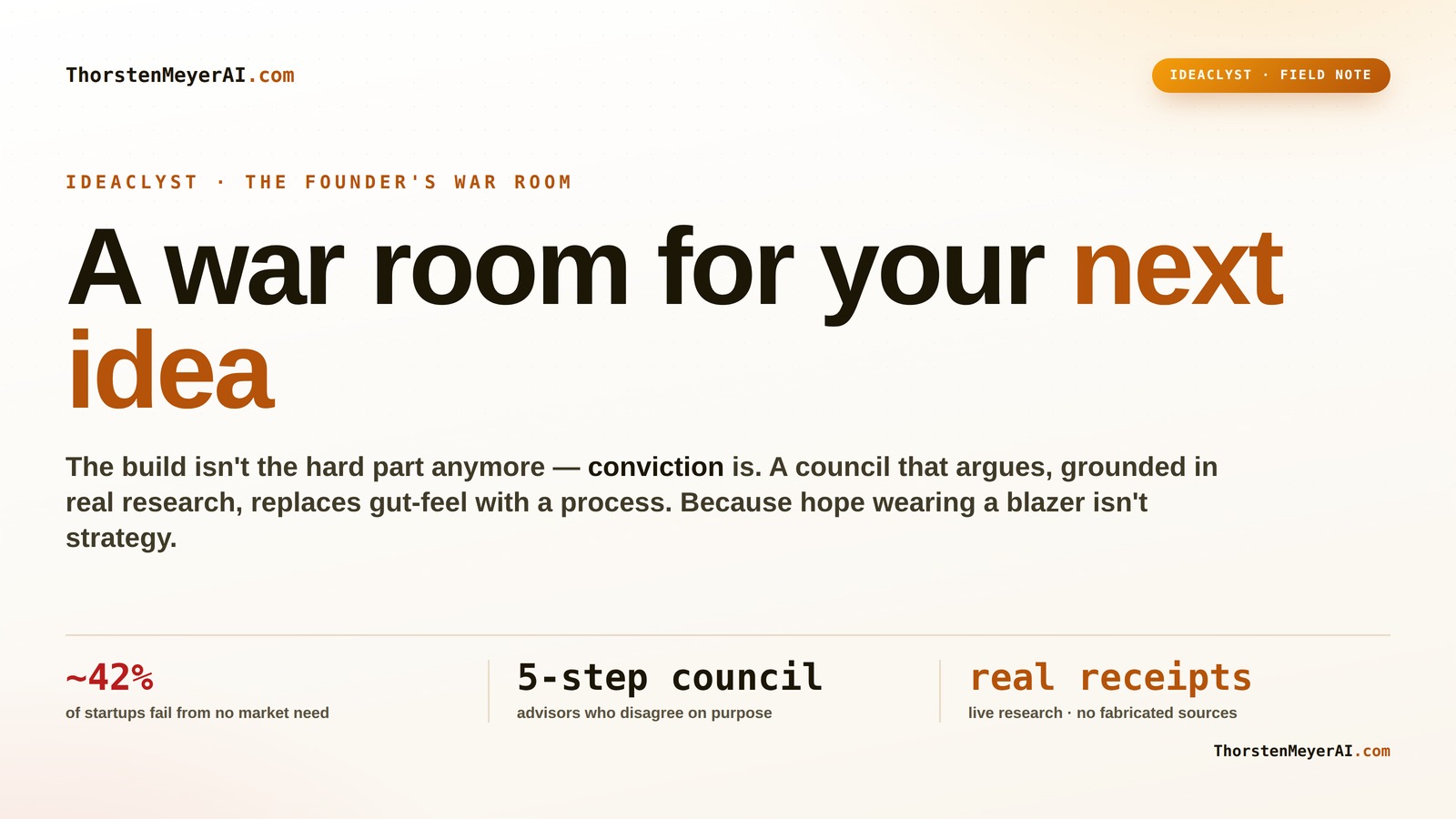
The build isn’t the hard part anymore — conviction is. Knowing which idea deserves the next six months, and being able to defend it. Most founders answer with gut feel and optimistic math. That’s hope wearing a blazer. IdeaClyst replaces it with a process.
The most expensive decision is what to build
The single most valuable thing a tool can do is talk you out of the wrong six months. The numbers make the case better than any pitch.
Three tools in one — on your own machine
Strip away the framing and IdeaClyst is three things at once, all running locally with nothing leaving your laptop.
An AI council
Pressure-tests an idea you bring it — advisors who argue on purpose.
A discovery engine
Finds ideas you didn’t know to look for by hunting real demand signals.
A founder’s workspace
Carries winners from “interesting” all the way to “ready to build.”
Advisors who disagree on purpose
Not one confident, agreeable answer — a structured five-step deliberation where models play different roles and turn on their own work. The disagreement is the feature.
The five-step deliberation
A council that leads with the bad news surfaces the objections you’d otherwise find the expensive way, on month five.
Product strategy
Who’s it for, what’s the wedge, why now, what’s the business model.
Technical architecture
What would it actually take to build — and where’s the risk.
Critique pass
The council turns on its own work. Where’s the hand-waving? What kills this?
Second, independent critique
A different voice, a different angle — so blind spots don’t survive.
Final synthesis
Everything into one coherent founder packet: strategy, architecture, validation, plan.
When IdeaClyst cites a source, it actually fetched it
The hard departure from “ask an AI what it thinks of my startup.” It runs in a strict, real-data-only mode — if it can’t gather genuine evidence, it says so plainly rather than inventing a plausible paragraph.
Confidence with receipts
No fabricated statistics, no imaginary competitors, no made-up citations. The packet survives a skeptical co-founder or a sharp investor because the reasoning has receipts.
Market research first
Scouts the landscape before the council reasons about anything.
Competitor read
Real positioning, pricing signals, feature claims — differentiation vs. reality.
Validation with links
Not “talk to customers” — concrete signals & sources you can click.
From the blank page to build-ready
Evaluation is half the problem; the blank page is the other half. And a plan is worthless if it dies in a tab you never reopen.
Bring a space, not an idea
“AI for accountants,” “tools for indie game studios” — plus your goal and real capacity. It hunts demand signals across HN, Reddit, Product Hunt, GitHub, pricing pages.
- An honest market read — leads with the bad news when a space is hard
- An opportunity map — high pain, thin competition
- Ranked candidates — wedge, who pays, effort, risk, confidence
- each with KILL CRITERIA — when to walk away
A home and a forward path
Every promising idea gets carried forward, with every artifact in plain files on your disk.
- Validation tooling — sprint board, interview list, evidence browser
- Founder profile — a personal-fit lens; same discovery, different advice
- Build workspaces — funnel, personas, landing draft, version history
- “Build this idea” → a PRD + task queue, ready for a coding agent
Key Takeaways
- IdeaClyst turns your laptop into a private, structured war room, enabling rigorous idea validation without data leaks or cloud dependencies.
- Its AI council stages a five-step debate—covering strategy, tech, critique, and synthesis—exposing weaknesses early and saving costly mistakes.
- Grounded in live web research, IdeaClyst provides evidence-based insights, not vague vibes, boosting confidence and decision quality.
- The final founder packet is a clear, version-controlled Markdown document—your strategic blueprint ready to share or refine anytime.
- Perfect for solo founders, early-stage startups, or teams needing fast, private validation without the overhead of traditional research.
As an affiliate, we earn on qualifying purchases.
Why a War Room Changes How You Launch Ideas
A war room isn’t just a fancy term; it’s a dedicated space—physical or digital—where teams focus intensely on strategy, obstacles, and opportunities. For founders, it’s the difference between flying blind and flying with a clear, well-tested plan.
Imagine having a place where you can lay out your idea, see it challenged from every angle, and walk away with a better plan—without the noise of endless meetings or vague gut feelings. That’s what a war room does. IdeaClyst takes this concept digital, turning your laptop into a battlefield of ideas, debates, and decisions.
As an affiliate, we earn on qualifying purchases.
How IdeaClyst’s AI Council Acts Like a Devil’s Advocate
IdeaClyst’s core feature is its AI council—five models playing different roles to pressure-test your idea. Instead of one cheerleader, you get a debate. One model questions your target market, another assesses technical risks, while others critique your assumptions, just as a seasoned advisor would.
By simulating this structured disagreement, IdeaClyst encourages founders to confront their ideas from multiple perspectives, revealing blind spots and potential flaws that might otherwise be overlooked. This process helps avoid overconfidence and promotes more nuanced decision-making. The tradeoff, however, is that while this debate can surface many issues, it might also lead to analysis paralysis if not managed carefully. Founders need to interpret the AI’s critiques thoughtfully, balancing skepticism with optimism to develop a robust plan.
According to [1], structured disagreement like this exposes flaws early, saving founders from costly mistakes down the line.
As an affiliate, we earn on qualifying purchases.
Why Grounding Ideas in Real Research Matters
Most AI tools give you vague, confidence-boosting answers—’market is growing,’ ‘there’s fragmentation.’ But according to founders need facts, not vibes. IdeaClyst anchors its debates in live web research, pulling in fresh data as the conversation unfolds.
This grounding in real-time data is crucial because it shifts validation from subjective opinion to evidence-based reasoning. When founders rely on live research, they can more accurately assess market size, competitive dynamics, and emerging trends. This reduces the risk of making decisions based on outdated or biased information. However, integrating live data also introduces tradeoffs—such as increased complexity and potential information overload. Founders must learn to sift through the data efficiently to extract actionable insights. The benefit is a significantly higher confidence level that their ideas are aligned with current market realities, making their validation process more credible and less prone to hype.
This approach cuts through the noise, giving you evidence-backed insights that help you defend your idea with real data, not just intuition.
As an affiliate, we earn on qualifying purchases.
What an IdeaClyst Founder Packet Looks Like — And Why It Matters
After the council debate, IdeaClyst compiles a clear, structured founder packet—think of it as your idea’s battle report. It includes strategy, architecture, critiques, validation tests, and a final plan—all in Markdown files you own and control.
This packet serves as a living document that consolidates insights, critiques, and validation steps, providing a comprehensive overview of your idea’s strengths and weaknesses. Its structure encourages systematic thinking—breaking down complex ideas into manageable components—and facilitates iterative refinement. For instance, if you start with a concept for a new drone delivery service, the final packet will clearly identify target markets, potential technical hurdles, and specific validation experiments. This clarity helps you communicate your plan to stakeholders and makes it easier to track progress over time. Moreover, having everything in plain text files allows you to version-control your ideas, revisit previous iterations, and adapt your strategy as new data or insights emerge. This transparency and flexibility are vital for navigating the uncertainties of startup development, enabling founders to make informed adjustments without losing sight of their core vision.
Having everything in plain text files means you can version control, edit, and review your ideas anytime. No endless cloud subscriptions, no data leaks—just your raw, valuable thoughts on your own machine.
How to Use IdeaClyst Effectively in Your Startup Journey
- Start with a clear idea. Write a one-sentence pitch or a paragraph—nothing fancy.
- Run it through IdeaClyst’s council. Let the models debate, critique, and challenge every assumption.
- Review the final founder packet. Identify weak spots and plan your next steps.
- Use the validation plan as your roadmap—test your idea with real customers, then update the packet.
- Keep iterating. Every new insight refines your plan and boosts your confidence.
This process turns gut feelings into data-backed confidence, saving time and money.
Local-First, Private, Open Source — Why It Matters for Founders
Most AI tools rely on cloud servers, risking data leaks and privacy concerns. IdeaClyst is different. It runs entirely on your machine, keeping your raw ideas private and secure. Plus, it’s open source under the MIT license, meaning you control your data and can customize the tool.
Imagine working on a sensitive healthcare app or a new hardware startup. Your ideas stay exactly where they belong—on your own disk, not floating in someone else’s cloud.
This local-first approach isn’t just about privacy. It’s about freedom, control, and peace of mind.
Who’s Going to Love IdeaClyst? The Perfect Fit for Founders Who…
Are you a founder tired of vague advice and expensive research? Do you want a tool that’s fast, private, and deeply integrated into your decision-making? If so, IdeaClyst is your new best friend.
It’s ideal for early-stage startups, solo founders, product teams, or anyone who needs to validate an idea quickly without sacrificing privacy. Think of it as your strategic war room, on your terms.
Plus, with its open-source nature, it’s perfect for those who love customizing their toolkit or want to avoid vendor lock-in.
The Bottom Line: Build Confidence Before You Build
IdeaClyst isn’t just a tool; it’s a mental model for founders. It turns guesswork into a structured, debate-driven process. You get a clear plan, backed by evidence, to fight the uncertainty that keeps founders awake at night.
Imagine closing your laptop after a session, knowing your idea has been rigorously challenged and refined. That’s the power of a digital war room—less hope, more strategy.
Next time you face a big decision, remember: the smartest founders don’t guess. They debate, validate, and prepare. Make IdeaClyst your secret weapon.
Frequently Asked Questions
What exactly is IdeaClyst and how does it work?
IdeaClyst is a local-first AI-powered war room that stages structured debates among AI models to pressure-test your ideas. It grounds its critique in live web research and compiles a comprehensive plan in plain text files you own, making validation faster and safer.How is a digital war room different from a traditional meeting space?
A digital war room like IdeaClyst is accessible from your laptop, runs entirely offline, and is designed for focused, structured debates. Unlike physical spaces, it keeps your ideas private, version-controlled, and ready for quick iteration—perfect for the modern founder.What kind of founders should use IdeaClyst?
Ideal users are solo founders, early-stage startups, or product teams who want fast, private validation. It’s especially valuable if you’re handling sensitive ideas or want a structured way to challenge assumptions without relying on vague AI vibes.Can I customize IdeaClyst or adapt it to my needs?
Yes. Because it’s open source under the MIT license, you can modify its code, integrate new research sources, or tailor the council roles to fit your unique process—giving you full control over your strategic war room.Does IdeaClyst replace customer interviews or real-world testing?
Not exactly. It accelerates the research and validation phase, helping you identify risks early. But real customer conversations and market tests are still essential. Think of it as a prep tool that makes your actual testing more focused and effective.Conclusion
In a landscape filled with hype and guesswork, a digital war room like IdeaClyst offers clarity, confidence, and control. It’s more than a tool—it’s your strategic edge in a noisy world.
Don’t guess your next move. Debate it, validate it, and own it. Your best idea deserves the full battlefield treatment—on your own terms.
Halloween Picks
halloween
As an affiliate, we earn on qualifying purchases.