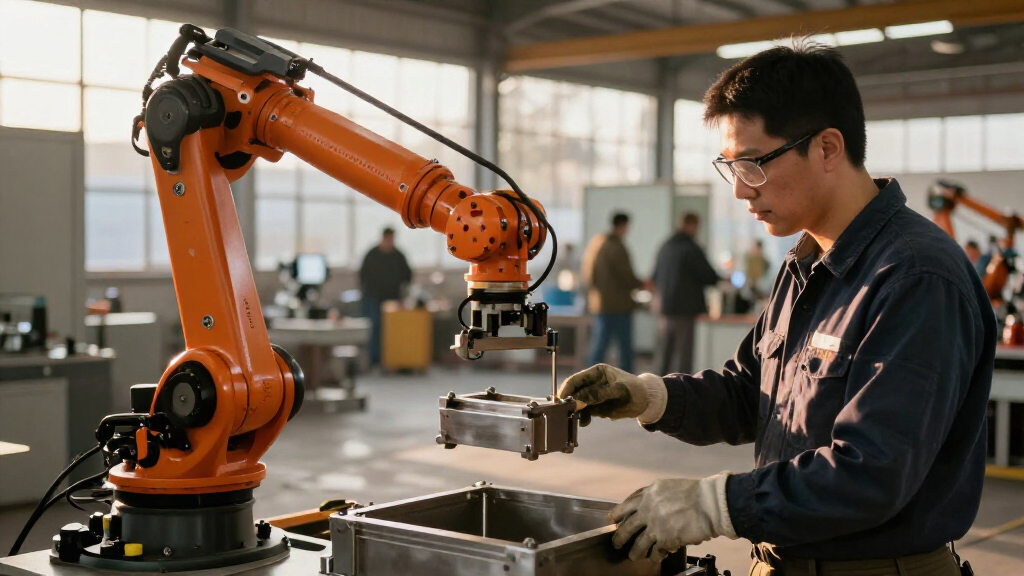

🔍 Read the full analysis: Why Is ByteDance Hiring For Its Push To Bring Robots Into Factories? on ThorstenMeyerAI.com

Get the latest gadgets delivered free with Prime
- Fast, free delivery on millions of items
- Prime Video, Amazon Music and more included
- Member-only deals all year
TL;DR
A South China Morning Post headline reports that ByteDance is recruiting for work aimed at moving its robots from laboratory research toward factory use. The available details do not identify the roles, hiring numbers, facilities, tasks or schedule, and do not confirm a factory trial or deployment.
ByteDance is hiring for work intended to bring its robots from laboratory research closer to factory use, according to a South China Morning Post headline. The reported recruitment points to an effort to develop practical industrial applications, but the details available do not say how many people the company seeks, what roles are open, or whether any robots are already being tested or used in a factory.
The headline describes a hiring push tied to moving ByteDance’s robots from the lab toward the factory floor. However, the available reporting contains no specifics about job titles, team locations, budgets or hiring totals. It also does not identify a robot model, a production task or a facility where the systems might be deployed.
That limits what can be concluded about the project’s stage. Recruiting can indicate that a company is assigning people to engineering or operational work, but it does not establish that a system is ready for industrial use. The details provided do not confirm a factory pilot, deployment date or production results, and there is no attributed ByteDance statement explaining the plan.
The report’s central news is therefore the apparent direction of the work, rather than a demonstrated operational milestone: ByteDance is hiring in connection with a move toward factory robotics. Whether the recruitment supports early development, preparation for a trial, or a broader program remains unspecified.
The Hiring Signal and Its Limits
Factory work would test robotics beyond controlled research settings. Industrial systems are expected to carry out assigned tasks safely and consistently amid the conditions of an operating workplace. A move toward that use could bring ByteDance’s robotics research closer to commercial application, but the headline provides no performance data with which to judge the systems’ readiness.
For people following automation and employment, the distinction between hiring and deployment matters. Recruiting may add engineering, testing or operations capacity, yet it does not show that robots have taken on factory tasks or changed staffing at a facility. Without identified roles or sites, the likely scope and practical consequences of the effort are unknown.
The most useful indicator of progress would be verifiable information about a factory trial: where it took place, what task the robots performed and whether they did so reliably. Until such details are available, the recruitment is best read as a signal of intent, not evidence that ByteDance has completed the lab-to-factory step.
Products Worth Considering

DJI Osmo Pocket 3 Vlogging Camera with 1-Inch CMOS Sensor and 4K Video

Logitech MX Brio Ultra HD 4K Webcam, Graphite

DJI Osmo Pocket 3 Creator Combo Vlogging Camera with 1 CMOS & 4K/120fps
As an affiliate, we earn on qualifying purchases.
From Robotics Research to Factory Floors
Moving a robot from a laboratory into an industrial setting generally involves more than showing that it can perform a task under controlled conditions. Developers may need to adapt hardware and software, test performance in the intended workplace, and evaluate safety and reliability. These are general requirements of industrial use; the available report does not say which of them ByteDance is addressing.
The headline connects the company’s hiring to a move from research toward factory applications, but gives no account of earlier milestones. It does not state how long ByteDance has worked on the robots, what capabilities they have demonstrated, or what industrial tasks the company has in mind. The current development stage is not established, so it is not possible to place the reported recruitment on a firm timeline from research to deployment.
Nor does the information identify a factory owned by ByteDance or a partner site. The phrase “factory floor” describes the intended direction in the headline; it should not be taken as confirmation that robots are already operating in production.
Open Questions on Roles and Trials
Key facts remain unreported: the number of openings, the roles and teams involved, the intended applications, and the locations of the work. There is no stated budget, named factory, robot model, trial date or deployment schedule in the available details.
It is also unclear whether the recruitment supports early-stage research, preparations for a pilot, or a larger industrial program. No evidence is provided that ByteDance’s robots have completed a factory trial or met production requirements. The absence of those details does not show that the effort is stalled; it means its scale, readiness and progress cannot yet be assessed from the reported information.
Evidence That Would Clarify Progress
Further clarity would come from ByteDance describing the positions it is filling, the robot capabilities involved and the industrial tasks it wants to address. A named factory, trial timetable or account of a completed test would help distinguish development planning from actual deployment.
For now, no next milestone or public schedule is specified. Readers should look for company comment, job descriptions and verifiable trial details before drawing conclusions about timing or operational results. The confirmed takeaway remains limited: ByteDance is reportedly hiring for work aimed at bringing robots closer to factory use, while the scale and outcomes are still unknown.
Key Questions
What is ByteDance reportedly hiring for?
A South China Morning Post headline says ByteDance is hiring for work intended to move its robots from laboratory research toward factory use. It does not provide specific job titles or team details.
Are ByteDance’s robots already working in factories?
The available details do not confirm a factory trial or deployment. They describe an intended direction, not evidence that robots are already operating in production.
How many people is ByteDance hiring?
No hiring figure is provided. The number of openings, roles and locations involved remains unspecified.
When could the robots reach a factory floor?
No trial date, launch schedule or deployment timeline is stated, so it is not possible to say when factory use might begin.
Primary source: ByteDance Seed · via ThorstenMeyerAI.com