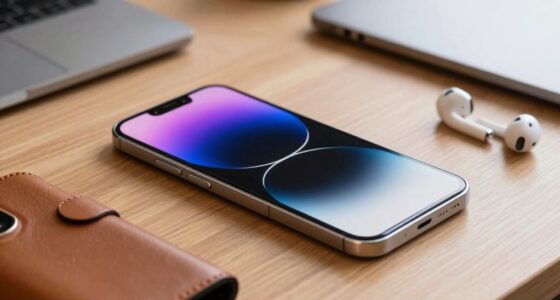
You might wonder why your sleek phone can’t have a huge battery. The main reason is that physical size constraints limit how large the battery can be in such a slim device. Larger batteries take up more space, making phones thicker and less stylish. While advanced charging tech helps, it can’t entirely solve the size-capacity challenge. To understand how manufacturers balance these factors and what future solutions could be, keep exploring further.

Get the latest gadgets delivered free — and shop member deals
- Fast, free delivery on millions of items
- Access to Prime Big Deal Days deals on October 6–7
- Prime Video, Amazon Music and more included
Key Takeaways
- Larger batteries require more internal space, conflicting with slim device design constraints.
- Increasing battery size adds bulk and thickness, reducing the phone’s sleekness.
- Slim phones have limited room for bigger batteries, impacting overall battery capacity.
- Advanced charging technologies help mitigate size issues but don’t eliminate the size-capacity trade-off.
- Physical and engineering limitations prevent extremely large batteries in ultra-slim smartphones.

When choosing a smartphone, you often face a trade-off between battery life and device thickness. If you want a slim phone, you might have to accept shorter battery life, while larger batteries tend to make the device bulkier. Manufacturers have to balance these factors carefully. Advances like wireless charging and fast charging help mitigate some of the inconvenience, but they don’t eliminate the core issue: bigger batteries require more space, which conflicts with the desire for sleekness. Wireless charging, for example, allows you to avoid bulky ports and cables, but it still needs a larger battery capacity to keep you going through the day. Fast charging, on the other hand, lets you juice up your phone quickly, reducing the need for a massive battery, but it doesn’t change the physical size constraints.
Slim phones often sacrifice battery capacity, relying on fast charging to keep up.
The core challenge is that batteries are inherently large compared to other components. Lithium-ion batteries, which most smartphones use, need space not just for the cells but also for safety buffers and thermal management. When you opt for a slim design, manufacturers are forced to make compromises: either reduce battery capacity or find innovative ways to pack more power into less space. This is why many high-end phones with slim profiles often have smaller batteries, relying on fast charging to compensate for shorter daily use. Fast charging can replenish your battery in minutes, making it more convenient to power through your day without carrying a bulky device.
Furthermore, the desire for a lightweight, thin phone often limits how large the battery can be. Thinner phones tend to have less internal space for batteries, which directly impacts how long you can use your device before needing a recharge. Even with advancements like wireless charging, the size constraint remains because a larger battery means a thicker device. Manufacturers are continually experimenting with new materials and battery chemistries to push the boundaries, but fundamental physics still play a role. As a result, phones with the slimmest profiles generally have smaller batteries, which makes fast charging a vital feature for users who want quick top-ups. Innovative battery technologies are being developed to address these size and capacity limitations, but widespread adoption is still evolving.
Ultimately, the reality is that you can’t have it all: a super-slim phone with an enormous battery that lasts days. The trade-off between battery capacity and thickness is a balancing act driven by physical limitations and consumer expectations. Features like wireless charging and fast charging help you get the most out of your device, but they don’t eliminate the inherent size constraints. So, when you’re choosing your next phone, understand that a thinner design will likely mean shorter battery life or reliance on rapid charging to keep you connected.
ultra slim smartphone with large battery
As an affiliate, we earn on qualifying purchases.
As an affiliate, we earn on qualifying purchases.
Frequently Asked Questions
How Does Battery Chemistry Influence Size and Capacity?
Your phone’s battery chemistry, especially with solid state batteries, directly impacts its size and capacity. Solid state batteries offer higher energy density, meaning they store more power in a smaller space. This allows for slimmer designs without sacrificing battery life. Since they use different materials than traditional lithium-ion batteries, they can be more compact and safer, enabling manufacturers to create phones that are both slim and long-lasting.
Can Future Technology Solve the Battery-Thinness Dilemma?
Future technology could definitely solve the battery-thinness dilemma. Advances like wireless charging and energy harvesting might allow your phone to stay slim while maintaining a larger battery capacity. You might not need bulky batteries anymore, as these innovations could continuously replenish power without adding thickness. While challenges remain, ongoing research suggests that your next slim phone could deliver impressive battery life without sacrificing sleek design.
Are There Alternative Power Sources for Slim Phones?
Yes, there are alternative power sources for slim phones. You can use solar power, which harnesses sunlight to recharge your device, or kinetic energy, converting your movements into usable energy. These options help reduce reliance on traditional batteries, making phones slimmer without sacrificing power. While they’re still developing, integrating solar panels or kinetic energy systems could soon offer practical, eco-friendly ways to keep your phone charged on the go.
How Does User Behavior Impact Battery Size Requirements?
User behavior shapes your battery needs like a tailor molds fabric. Heavy usage patterns, like streaming, gaming, or constant messaging, demand larger batteries to keep your phone alive longer. On the other hand, light users can get by with smaller batteries, allowing phones to stay slim. Your habits directly influence battery size requirements, making your choices and routines key factors in how your device is designed and performs throughout the day.
What Role Does Fast Charging Play in Battery Design?
Fast charging influences battery design by requiring larger capacities and improved thermal management to handle quick power influx. You benefit from shorter charging times, but manufacturers must incorporate advanced thermal management to prevent overheating. Wireless charging also plays a role by enabling convenient, cable-free refueling, yet it demands optimized battery and device architecture to guarantee safety and efficiency during rapid charge sessions, balancing performance with device longevity.
fast charging power banks for smartphones
As an affiliate, we earn on qualifying purchases.
As an affiliate, we earn on qualifying purchases.
Conclusion
So, as you weigh your options, remember that pushing for both huge batteries and sleek designs isn’t just a matter of choice—it’s a battle of physics and engineering limits. Will future innovations finally bridge this gap? Or will compromises remain unavoidable? The truth is, the next breakthrough might be just around the corner, but for now, your phone’s slim profile might come at the cost of its staying power. The real question is, how much are you willing to sacrifice?
wireless charging compatible phones
As an affiliate, we earn on qualifying purchases.
As an affiliate, we earn on qualifying purchases.
high capacity thin phone batteries
As an affiliate, we earn on qualifying purchases.
As an affiliate, we earn on qualifying purchases.
Evergreen bestsellers Picks
bestsellers
As an affiliate, we earn on qualifying purchases.