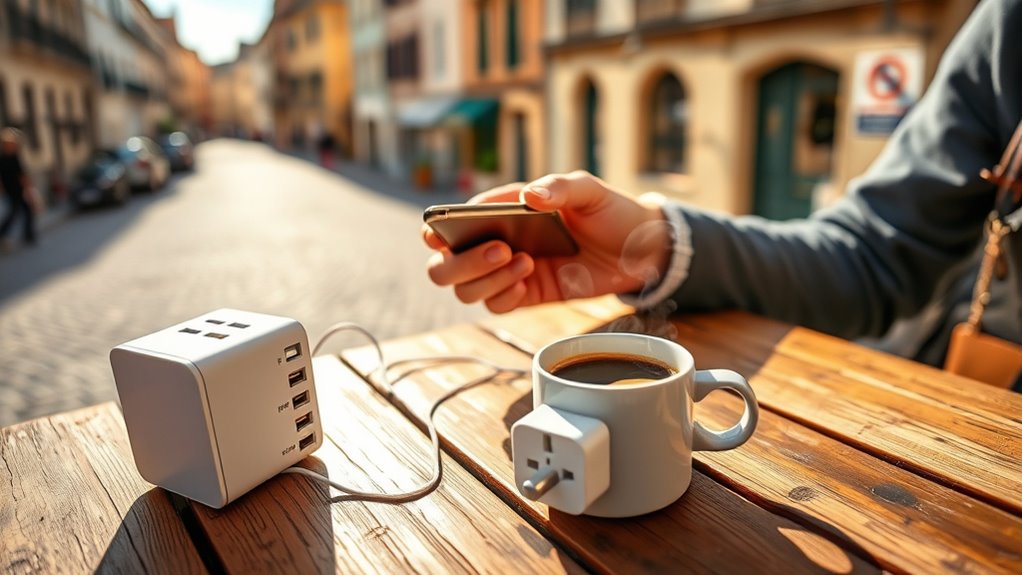

When charging your phone abroad, travel adapters are essential since they fit foreign outlets and guarantee safe connections, especially if your native charger’s plug doesn’t match local sockets. While many chargers support dual voltage, you’ll still need an adapter for the plug shape. Native chargers alone often won’t work without an appropriate adapter, risking damage or failure to charge. Keep exploring to learn how to safely and effectively power your device on your trip.
Key Takeaways
- Travel adapters ensure proper plug fit and safety when using native chargers in foreign outlets with different shapes.
- Native chargers may not work abroad without plug adapters due to incompatible outlet designs.
- Universal travel adapters often include voltage conversion, reducing the need for separate voltage converters.
- Relying solely on native chargers abroad can limit device charging if plug types or voltage standards differ.
- Combining native chargers with appropriate travel adapters offers a safe, versatile solution for international device charging.

Are travel adapters really necessary, or can you rely on native chargers when visiting a different country? The answer depends on a few key factors, primarily voltage compatibility and plug configurations. When you travel abroad, the electrical systems can vary markedly, which means your phone’s charger might not work as seamlessly as it does at home. Native chargers are designed specifically for the voltage and plug types of your country, but they may not fit into foreign outlets without some adjustments. That’s where understanding the importance of a travel adapter comes into play.
Voltage compatibility is vital when deciding whether you can use your native charger directly. Many chargers today are universal, capable of handling input voltages from 100V to 240V, but you should always check the label on your charger. If your charger isn’t compatible with the voltage of your destination, plugging it in could damage your device or cause safety hazards. Even if your charger supports dual voltage, the physical plug may still not fit into the foreign outlets, which brings us to plug configurations.
Plug configurations refer to the shape and size of the outlet and plug. Different countries have different standards—some use two flat pins, others round pins, and some have multiple holes or unique shapes. If your native charger’s plug doesn’t match the outlet, it won’t physically connect to power. Relying solely on native chargers without an appropriate plug adapter means you might be unable to charge your device at all. It’s tempting to think you can just use an extension cord or an outlet converter, but these often don’t solve the problem of incompatible plug shapes. Additionally, understanding electrical safety is crucial to prevent potential hazards when adapting to foreign electrical systems.
In many cases, travelers find that a universal travel adapter is the best solution. These devices can usually accommodate multiple plug types and often include USB ports, making them versatile for various destinations. They act as a bridge between your device’s plug and the foreign outlet, ensuring proper fit and safety. Some travel adapters also incorporate voltage conversion, but you should verify whether your device needs one and whether the adapter provides it. Relying solely on native chargers can work if you’re traveling within the same voltage and plug standards, but for international trips, a good travel adapter is often indispensable. It guarantees compatibility, safety, and convenience, so you won’t be caught without power just because your charger doesn’t match the local socket.
Frequently Asked Questions
Are Travel Adapters Compatible With All Phone Models?
Travel adapters are generally compatible with most phone models because they connect your device to different outlet types. However, charger compatibility depends on your phone’s charging port and voltage requirements. Be aware of adapter limitations—some don’t support fast charging or certain plug types. Always check your phone’s specifications and the adapter’s features to guarantee your device charges safely and efficiently abroad.
How Do I Identify the Correct Native Charger Voltage?
To hit the nail on the head, you need to check your native charger’s label for voltage compatibility, which is usually listed as volts (V). Look for the input voltage range—if it says 100-240V, it’s versatile worldwide. Also, verify the plug types to match the country’s outlets. This way, you prevent mishaps and assure your device charges safely and efficiently wherever you go.
Can Using a Travel Adapter Damage My Phone?
Using a travel adapter generally won’t damage your phone if it’s compatible with the local power supply. However, a power surge could occur if the adapter isn’t designed for your device, risking damage. Compatibility issues might prevent your phone from charging properly or cause irregular power flow. To avoid damage, verify your adapter matches the voltage and plug type, and consider using a surge protector for added safety.
Do Native Chargers Support Fast Charging Internationally?
Native chargers often support fast charging if they meet the appropriate native charger standards and are compatible with international voltage. You should check if your device’s native charger supports fast charging in your destination country, and confirm it’s compatible with the local voltage and plug type. Many modern chargers are designed for international use, but always verify these details to ensure your phone charges quickly and safely abroad.
Are Universal Travel Adapters Safe for Multiple Devices?
Think of universal adapters as a versatile key that opens many doors—so yes, they’re generally safe for multiple devices. They symbolize adaptability, but you need to verify device compatibility to avoid damage. Always choose high-quality models with built-in safeguards. By doing so, you ensure your gadgets stay protected, and you get the convenience of charging everything from smartphones to tablets with one reliable tool abroad.
Conclusion
When traveling abroad, choosing between a travel adapter and a native charger depends on your needs. Did you know that over 60% of travelers report facing charging issues due to incompatible outlets? By carrying a reliable travel adapter, you guarantee your devices stay powered without hassle. Remember, a small investment in the right gear can save you from the frustration of dead batteries in unfamiliar places. Stay connected and make your trip smoother!