Mistral’s sovereign AI strategy is likely about winning customers who care more about control, data residency, open weights, and enterprise deployment than about having the largest general model. The hard question is whether that makes Mistral a focused European AI winner or already lost in the global frontier race.
The most revealing thing about Mistral right now is not a leaderboard score. It is the kind of customer the Paris lab wants to win: banks with locked-down data, governments with nervous auditors, factories where latency feels like a machine stutter, and European buyers tired of renting their AI future from someone else’s cloud.
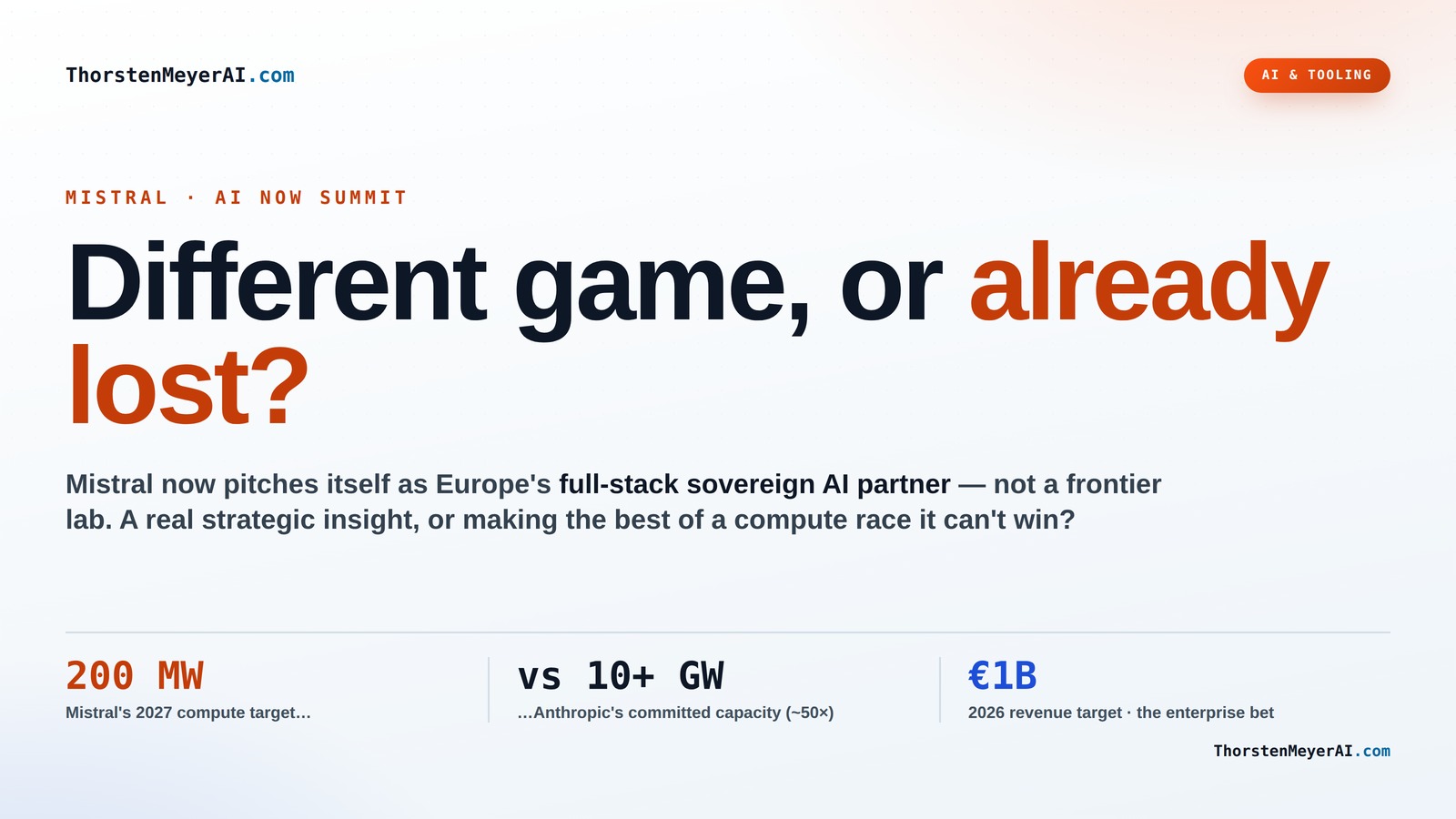
You are looking at a company trying to answer a sharp question: different game, or already lost? Mistral is positioning itself as the European, open-weight, enterprise-friendly alternative to closed US AI platforms, and that move is either a smart wedge or a polite retreat.[3][4]
This article gives you the practical read: what “sovereign” means, why open weights matter, where the strategy shines, where it creaks, and what a buyer should ask before signing the contract.
Different game, or already lost? Reading Mistral’s sovereignty bet — ThorstenMeyerAI.com
ThorstenMeyerAI.com
AI & Tooling · Field Note
Mistral · AI Now Summit, Paris
Different game, or already lost?
Mistral now pitches itself as Europe’s full-stack AI provider — compute, models, platform, consultancy — not a frontier-model lab. Is that a real strategic insight, or making the best of a race it can’t win? Both readings fit the same facts.
A genuinely two-sided question · held both ways
01The repositioning
From model lab to full-stack provider
The clearest signal from the summit wasn’t a model — it was a posture. Heavy on enterprise logos and partnerships (ASML, BNP Paribas, Alexa+), light on new-model announcements. That absence is exactly what skeptics seized on.
just a model company→the full AI stack
Compute
40MW Paris DC + Sweden build · 200MW target by 2027
Models
Open & custom · efficient · you own and run them
Platform
Forge for custom models · Vibe for Work agent
Consultancy
Sales teams, integrators, EU provenance & support
“To deploy AI in the enterprise, you actually need, as an AI provider, to own the full stack… transforming electrons into tokens and intelligence.”
— Arthur Mensch, CEO of Mistral
02The strategy debate · flip the metric
Small & focused, or large & general?
Mistral bets on specialized small models. The claim isn’t that they win a reasoning leaderboard — they don’t. It’s that on the metrics that matter in production agent systems, a purpose-built small model wins. Flip the metric to see the case reverse.
Small specialized vs large general — by what you measure
In token-heavy agentic apps making hundreds of calls, speed/energy/cost compound. Toggle the metric.
measuring: speed · energy · cost per token
large general modelsmall specialized model
03The proof points
Narrow models doing real work
Each is one model doing one thing efficiently — the tangible version of the strategy. Strong on their own terms; the open question is whether the bundle beats a free Chinese open-weight download.
🏦
On-prem KYC compliance
BNP Paribas · Belgium
Mistral models run inside the bank’s walls for know-your-customer checks. Sensitive financial data never leaves. (BNP was Mistral’s first customer, 2023.)
🗣️
Voxtral multilingual voice
Amazon Alexa+ · Europe
A focused voice model powering Alexa+ across Europe — speed and efficiency over raw size.
🤖
Robostral industrial robotics
ASML · manufacturing
Plus a “physics AI” push (via the Emmi acquisition) into aerospace, automotive & semiconductor design and simulation.
📄
Document AI / OCR at scale
European Patent Office
Large-scale text extraction — the unglamorous, high-volume enterprise work small models excel at.
📜
The standout: reading 2,000 years of ancient papyri
The Austrian Academy of Sciences fine-tuned Codestral into “Apollo” (with Sail Reply) to read tiny fragments of millennia-old discarded papyri — unlocking ~180,000 desert documents, a job estimated at 2,000+ years by hand. Over a million unread Greek papyri exist worldwide. The pitch that needs no spin.
04The reality nobody quite names
The strategy is downstream of the compute gap
Once you see the raw numbers, “why is Mistral behind?” answers itself — and the specialized-small-model strategy starts looking partly like a smart adaptation to a binding constraint, not a pure philosophical choice.
Compute & capital · Mistral vs a frontier leader, this same week
Not a knock — it’s the constraint that forces the efficiency-first, sovereignty-wedge strategy. Adapting intelligently to your position is what good strategy is.
⚡ Mistral · lifetime
~$3.9B
raised across 9 rounds, total history
200 MW
compute target by 2027
vs
⚡ Anthropic · this week
$65B
raised in a single round (Series H)
10+ GW
committed compute across deals
~50× / ~16×
50× the planned capacity, ~16× one round’s capital. You can’t train frontier-scale general models without frontier-scale compute. The “different game” is partly a game Mistral plays because it can’t win the frontier game on hardware.
05The question, held both ways
“I want them to win, but I’m worried”
That ambivalence is the most accurate read of where Mistral sits. The enterprise pivot gets read two opposite ways — and both deserve airing.
The optimist read
On-prem, real sales teams, the Koyeb deployment acquisition, EU provenance — exactly what regulated enterprises want, and stickier than consumer mindshare. Targeting €1B revenue in 2026 with 1,000 staff, up from 15 people and one customer in 2023. US closed-API labs structurally can’t match the sovereignty axis.
The skeptic read
“Software consultancy with a data center,” not a foundation-model moat. Enterprise B2B is where European startups go when they can’t win consumer or world-scale SaaS. Why pay Mistral on-prem when you could run Qwen free? One paying Le Chat Pro user said the quality gap with frontier labs is now hard to ignore.
Different game, or already lost?
The honest read: Mistral has likely lost the frontier game on compute — that race is realistically over for any European pure-play — and is betting there’s a large, durable, profitable game in being Europe’s sovereign full-stack AI partner. That second game is real. Whether it’s big enough, and holds against free Chinese open weights, is the thing none of us can yet answer. The summit was a company committing fully to the bet. The next two years test whether it was wisdom or consolation.
ThorstenMeyerAI.com
Sources: Koen van Gilst’s AI Now Summit notes & the Hacker News discussion · Mistral summit materials · VentureBeat · TechCrunch · Data Center Dynamics · Austrian Academy of Sciences. Figures current as of late May 2026 · independent commentary, not affiliated with Mistral.
Key Takeaways
Mistral’s sovereignty pitch is a product argument about control, data location, upgrade timing, and auditability, not just a European branding move.
Open weights matter because they let buyers self-host, fine-tune, and inspect models in ways closed API-only platforms often do not allow.
Mistral looks strongest for regulated buyers such as governments, banks, insurers, defense suppliers, and industrial companies.
The biggest weakness in the strategy is competition from other capable open-weight models that may be cheaper or free to run.
The right buying test is not “which model is biggest?” but “which model fits our risk, workflow, cost, and governance needs?”
Different Game, or Already Lost? Reading Mistral's Sovereign is likely about one thing above all: control. In Mistral’s world, sovereign AI means customers can choose where models run, who handles data, how updates happen, and whether core AI systems depend on closed foreign platforms.[3][4]
Think of a Belgian compliance team reviewing know-your-customer files at 8:10 on a gray Monday morning. The data includes passports, addresses, income records, and risk flags. Sending that material through a black-box API hosted elsewhere can feel less like innovation and more like handing the office keys to a stranger.
Mistral’s pitch speaks to that fear in plain business language. You can run capable models closer to your own systems. You can fine-tune them for your workflows. You can show auditors a cleaner story about where sensitive data went and who touched it.[3]
Sovereignty is not just a flag on a slide. For regulated buyers, it can mean fewer awkward questions from legal, risk, procurement, and public-sector oversight teams.
The phrase can sound political, and yes, it partly is. Europe has spent years worrying about digital dependence on non-EU infrastructure, and Mistral benefits from that mood.[3] But the product point is concrete: control feels different when the model can live inside your walls instead of behind someone else’s API meter.
Open weights let customers download, inspect, fine-tune, and self-host a model instead of only sending prompts to a hosted API. Mistral’s early credibility came from models such as Mistral 7B and Mixtral 8x7B, both released under the permissive Apache 2.0 license.[3]
That changes the meeting. A buyer can ask, “Can our team run this in our own environment?” and Mistral can say yes in a way API-only rivals often cannot. The room gets quieter. The lawyers stop tapping their pens.
For instance, a bank testing an internal research assistant may start with a harmless pilot: policy search, meeting notes, customer email drafts. Then someone asks whether the model can touch real client records. With closed APIs, the answer may trigger a month of risk reviews; with open weights, the bank has more deployment options from day one.
Fine-tuning: You can adapt the model to your legal language, product catalog, or call-center scripts.
Self-hosting: You can run the model on your own servers or a chosen cloud region.
Upgrade control: You decide when a new model version enters production.
Audit story: You can explain where data flows with fewer foggy patches.
Open weights do not make everything easy. Your team still needs infrastructure, security reviews, monitoring, and people who know what to do when a model starts giving confident nonsense. Freedom comes with a server-room hum.
Mistral differs from OpenAI and Anthropic by selling more deployment control, more openness, and a stronger sovereignty story, while the US labs lead with closed hosted products and frontier-model performance. The clean comparison is not “better or worse.” It is “which constraints matter most to you?”[3][4]
Buyer Question
Mistral’s Strongest Answer
OpenAI / Anthropic’s Strongest Answer
Can you self-host?
Often yes, especially with open-weight models and enterprise setups.[3]
Usually centered on hosted APIs and managed services.
Who controls upgrades?
The customer can have more say over timing and model changes.
The provider often controls the hosted model lifecycle.
What is the main promise?
Sovereignty, flexibility, cost control, and European fit.[3][4]
Startups, developers, enterprises wanting fast managed access.
Imagine two companies building the same claims-processing tool. A fast-moving startup may choose a hosted frontier API because it wants to ship by Friday. A national insurer may choose Mistral because every claim contains personal data, every deployment needs sign-off, and every vendor question lands in a thick binder.
This is where the friendly alternative to US platforms message has bite. Mistral does not need to beat every model on every benchmark to win that buyer. It needs to be good enough, controllable enough, and easier to defend in the procurement room.
Different Game, or Already Lost? Reading Mistral's Sovereign looks strongest when the buyer values control more than maximum general intelligence. Governments, banks, insurers, defense suppliers, and industrial companies often care about data residency, upgrade timing, and support as much as raw model scores.[3][4]
Picture a public health agency trying to summarize case notes. The documents may contain names, addresses, diagnoses, and messy human details typed at midnight under fluorescent light. A hosted chatbot might be easier, but “easy” can sour fast when privacy officers ask where every token traveled.
Mistral’s strategy fits these buyers because the pain is not imaginary. Regulated teams need AI that can sit close to sensitive systems, speak the language of compliance, and avoid surprise model changes on a Tuesday afternoon. That is not glamorous, but it is where budgets live.
There is also a European politics layer. According to the source material, Mistral’s sovereignty narrative has grown stronger as Europe keeps debating digital dependence on non-EU providers.[3] In that climate, “Paris-based AI lab” is not trivia; it is part of the sales deck.
The sharper wedge is not patriotism. It is procurement comfort: a buyer can tell risk teams, “We have more control over where this runs and how it changes.”
Where The Sovereignty Bet Looks Smart
Where The Strategy Starts To Wobble
The strategy wobbles when open-weight competition becomes too good and too cheap to ignore. If a company wants self-hosted AI, it can ask why it should pay Mistral instead of running another capable open model with internal engineers and commodity infrastructure.[2][3]
This is the hard, dry question under the glossy summit language. Mistral sells support, provenance, customization, enterprise tooling, and a European control story. But free or low-cost open models keep improving, and buyers do not pay extra for romance once the pilot becomes a budget line.
Take a mid-sized manufacturer with a small AI team. It wants a parts-search assistant for maintenance manuals. If an open model handles the job well enough on existing hardware, Mistral has to prove that its bundle saves time, reduces risk, or performs better in the dusty corners of production.
Price pressure: Open models can make paid model access feel expensive fast.
Talent pressure: Buyers with strong internal teams may prefer building directly on free weights.
Benchmark pressure: Frontier labs still shape expectations for reasoning, coding, and agent quality.
Support pressure: Mistral must turn “European control” into daily operational value.
The skeptic’s “or already lost” framing is not silly. If the best global models keep pulling away, sovereignty may become a narrower shelter rather than a broad platform advantage. Warm lights, locked doors, smaller room.
Where The Strategy Starts To Wobble
Why Smaller Models Can Win In Real Workflows
Smaller models can win when speed, cost, latency, and specialization matter more than one huge model’s peak reasoning score. In token-heavy agent workflows, a system may call models dozens or hundreds of times, so cheaper and faster calls can compound into a real operating advantage.
Imagine an insurance agent that reads a claim, extracts dates, checks policy language, drafts a response, searches old cases, and flags missing photos. That is not one magical prompt. It is a chain of small jobs, each clicking like a relay in a cabinet.
A giant model may be overkill for many of those steps. You do not need the world’s most powerful reasoning system to classify a document, extract an invoice number, or route a support ticket. A smaller tuned model can feel like a sharp kitchen knife: plain, fast, and good in the hand.
Use the largest model for judgment-heavy steps. Contract interpretation, unusual edge cases, and multi-step reasoning need more headroom.
Use smaller models for repeatable tasks. Extraction, routing, translation, OCR cleanup, and formatting can run cheaply at volume.
Measure the full workflow cost. Count every model call, retry, token, GPU hour, and human review.
Test latency where users feel it. A half-second delay in a back-office batch job is fine; a half-second pause in a voice assistant can feel broken.
This is where Mistral’s small, focused model story makes practical sense. The tradeoff is that buyers still want proof. “Fast and cheap” must show up in dashboards, not just in a smooth keynote line.
Why Smaller Models Can Win In Real Workflows
What Buyers Should Ask Before Choosing Mistral
Buyers should ask whether Mistral reduces real deployment risk, not whether the sovereignty story sounds appealing. The right questions cover data residency, model ownership, upgrade control, support, security, and total cost after the pilot stops being a neat demo.[3][4]
A pilot can smell like fresh paint: clean dashboards, friendly engineers, tidy sample data. Production smells different. It has old databases, angry users, missing fields, slow approvals, and a finance team asking why GPU costs doubled in March.
Where will the model run? Ask for exact regions, infrastructure choices, and failover plans.
Who controls updates? Make sure a model change cannot quietly alter regulated workflows.
What happens to prompts and outputs? Get retention, logging, and access rules in writing.
How do you measure TCO? Include compute, support, tuning, monitoring, staff time, and fallback processes.
Can you leave? Ask what happens if you move to another open-weight model later.
The angle is that sovereignty only matters if it changes your operating reality. If the contract still leaves you locked into opaque tooling, surprise costs, or weak support, the label does not save you. You bought the sticker, not the steering wheel.
What Buyers Should Ask Before Choosing Mistral
How To Read The Growth-Curve Argument
The growth-curve argument says Mistral should be judged by fit, adoption, and enterprise traction, not only by whether it owns the largest model. According to commentary in the source material, Mistral’s market opportunity sits with sovereign-conscious and regulated buyers more than universal dominance.[3][4]
This matters because AI coverage often turns into a scoreboard. Who has the biggest context window? Who won the coding benchmark? Who released the model with the most dramatic demo music? Those signals matter, but they can hide the quieter question: who gets paid by customers with repeatable problems?
For instance, a bank using Mistral for compliance workflows may be less visible than a viral consumer chatbot. But the bank has budget, urgency, and a clear reason to avoid sending sensitive data through a closed external stack. That kind of customer can build a sturdy business, even without internet fireworks.
The phrase first ai strategy sounds clumsy, but the point behind it is useful: Mistral’s first AI strategy is not to be everyone’s chatbot. It is to become the trusted AI layer for buyers who need control, customization, and a procurement story that survives contact with auditors.
How To Read The Growth-Curve Argument
Why The Answer Is Probably Both
Different Game, or Already Lost? Reading Mistral's Sovereign has a messy answer: Mistral is playing a different game, and that choice also reflects pressure from the frontier race. Sovereignty is a real wedge, but it may also be where the company can still win.
That is the bittersweet truth. A focused strategy can look brilliant from one angle and defensive from another. The same facts support both readings: open weights, European buyers, enterprise control, fewer headline-grabbing frontier breakthroughs, and a market full of larger rivals.[3][4]
Think of a restaurant on a street full of giant chains. It cannot outspend them on ads or offer every cuisine. So it serves one neighborhood beautifully: warm bread, familiar faces, the same corner table every Friday. Is that focus or limitation? Yes.
Mistral’s sovereign bet has the same organized chaos. It gives buyers a sharper choice than “use the biggest model.” It also asks the market to believe that control, openness, and fit can matter enough to offset raw scale.
Why The Answer Is Probably Both
What This Means If You Are Building With AI
If you are building with AI, treat Mistral as a serious option when control matters and a harder sell when maximum frontier performance matters most. Your decision should start with deployment constraints, not brand heat, conference clips, or social media noise.[3][4]
Suppose your team is building a customer-support copilot for a healthcare provider. You need tight privacy rules, predictable upgrades, and low latency for agents moving fast between calls. Mistral belongs on the shortlist because its strengths line up with the job.
Now suppose you are building a coding agent for a startup racing to ship a complex product. You may care more about peak reasoning, tool use, and the richest developer ecosystem. In that case, a closed frontier provider may win despite weaker sovereignty controls.
Pick the model strategy that matches the risk. If your biggest fear is weak reasoning, buy capability. If your biggest fear is loss of control, buy control.
The practical move is simple: run a bakeoff using your real documents, real security rules, and real workflow volume. A polished demo with sample data tells you almost nothing. The truth appears when the model meets your messy PDFs, your impatient users, and your monthly cloud bill.
Frequently Asked Questions
What does sovereign AI mean for Mistral?
Sovereign AI means customers get more control over where models run, how data moves, who manages upgrades, and how systems meet local governance needs. For Mistral, the phrase connects European AI independence with practical enterprise deployment choices.[3][4]
Is Mistral trying to beat OpenAI and Anthropic directly?
Mistral is not only trying to win the same race on raw model size. It is positioning itself as a stronger fit for buyers who want open weights, self-hosting, European provenance, and more control over deployment.[3][4]
Why do open-weight models matter to enterprises?
Open-weight models matter because enterprises can download, fine-tune, inspect, and self-host them. That helps with privacy, auditability, customization, and upgrade control, especially in regulated industries.[3]
What is the biggest risk in Mistral’s strategy?
The biggest risk is that other open-weight models become good enough at lower cost. If buyers can self-host a rival model for less money, Mistral must prove its support, tuning, governance fit, and European control story are worth paying for.[2][3]
Who should seriously evaluate Mistral?
Governments, banks, insurers, defense contractors, healthcare groups, and industrial companies should take Mistral seriously when data control matters. Teams that need the strongest general reasoning model for broad tasks may still prefer a leading closed frontier provider.
Conclusion
Mistral’s sovereign strategy is not a magic escape from the frontier race, and it is not empty theater either. You should read it as a focused bet: some buyers will pay for capable AI they can control, run close to home, and explain to auditors without sweating through their shirt.
The question is not whether Mistral becomes the biggest name in AI. The question is whether enough serious buyers decide that the future should not arrive as a locked box from someone else’s cloud.
Smartphone Launch Events: Losing Their Spark? (Are New Phones Too Incremental?)
Losing their spark, smartphone launch events now feel less exciting due to incremental updates, leaving us questioning if innovation is truly happening anymore.