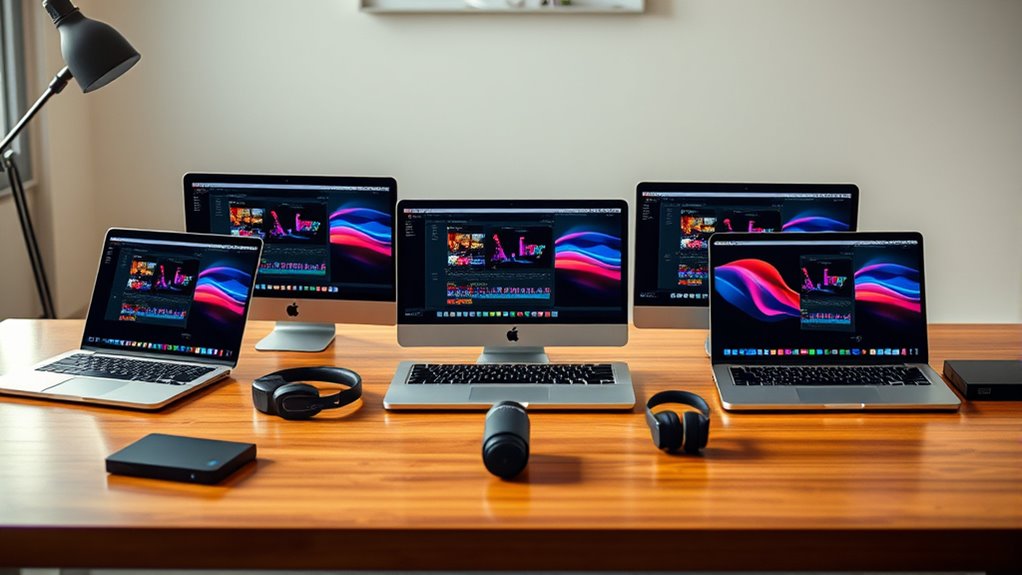

If you’re looking for the best MacBook Pro models for video editing in 2025, I recommend considering the Apple 2024 models with the M4 Pro and M4 Max chips, as well as the latest 2025 M5 variant. These laptops excel in processing power, stunning Liquid Retina XDR displays, and impressive battery life. Their robust storage options and seamless connectivity make them ideal for editors. Stick around to discover more about each model’s unique features and benefits!
Listen free for 30 days with Audible
Thousands of audiobooks and originals — cancel anytime.
As an affiliate, we earn on qualifying purchases.
Key Takeaways
- The M5 chip (2025) offers a powerful 10-core CPU and GPU for efficient 4K video editing and rendering.
- The 16.2-inch Liquid Retina XDR display provides exceptional clarity and color accuracy for professional video content creation.
- Models feature extended battery life, with up to 24 hours of usage, ideal for on-the-go editing.
- Storage options range from 512GB to 1TB SSD, accommodating large video files and projects efficiently.
- Enhanced connectivity with Thunderbolt 4/5, HDMI, and SDXC slots ensures seamless integration with external devices.

Apple 2024 MacBook Pro Laptop with M4 Pro, 12‑core CPU, 16‑core GPU: Built for Apple Intelligence 14.2-inch Liquid Retina XDR Display, 24GB Unified Memory, 512GB SSD Storage; Space Black
- Processor Options: M4 Pro or M4 Max chip
- Display: 14.2-inch Liquid Retina XDR
- Performance: Powerful for demanding tasks
As an affiliate, we earn on qualifying purchases.
Apple 2024 MacBook Pro Laptop with M4 Pro

The Apple 2024 MacBook Pro with the M4 Pro chip is ideal for video editors seeking high performance in a portable package. With its 14.2-inch Liquid Retina XDR display, I enjoy stunning visuals and vibrant colors that make my edits pop. The M4 Pro chip handles intensive tasks effortlessly, whether I’m rendering 4K footage or compiling complex projects. Plus, the all-day battery life keeps me productive without interruptions. I appreciate the 24GB unified memory for smooth multitasking and the 512GB SSD for quick data access. This MacBook Pro truly combines power and portability, making it a perfect choice for my editing needs.
Best For: Video editors and creative professionals seeking a high-performance laptop with exceptional display quality and portability.
Pros:
- Exceptional Performance: M4 Pro chip handles demanding tasks like rendering 4K footage effortlessly.
- Stunning Display: 14.2-inch Liquid Retina XDR display offers vibrant colors and high brightness for accurate visual editing.
- Portability: Lightweight and sleek design allows for easy transport without sacrificing power.
Cons:
- Price: Higher price point may not be accessible for all users.
- Limited Storage: 512GB SSD may be insufficient for extensive video projects or large media libraries.
- Compatibility: Some specialized software may not be optimized for macOS, potentially limiting functionality.

Apple 2025 MacBook Pro Laptop with Apple M5 chip with 10‑core CPU and 10‑core GPU: Built for AI, 14.2-inch Liquid Retina XDR Display, 24GB Unified Memory, 1TB SSD Storage; Space Black
- Processor: Apple M5 with 10-core CPU/GPU
- Display: 14.2-inch Liquid Retina XDR
- Memory: 24GB Unified Memory
As an affiliate, we earn on qualifying purchases.
Apple 2025 MacBook Pro Laptop with M5 Chip

For those who demand top-tier performance in video editing, the Apple 2025 MacBook Pro with the M5 chip stands out with its impressive 10-core CPU and GPU, ensuring smooth playback and rendering of high-resolution footage. With 24GB of unified memory and a 1TB SSD, I can work all day without worrying about storage or power. The 14.2-inch Liquid Retina XDR display provides stunning visuals, while advanced camera features and spatial audio elevate my video calls. Plus, seamless integration with my other Apple devices enhances my workflow. This MacBook Pro truly combines power, efficiency, and an exceptional user experience.
Best For: Professionals and creatives who need high performance for demanding tasks like video editing and multitasking.
Pros:
- Powerful Performance: Equipped with a 10-core CPU and GPU, ensuring fast processing and rendering.
- Stunning Display: The 14.2-inch Liquid Retina XDR display offers exceptional brightness and contrast for vivid visuals.
- Seamless Ecosystem Integration: Effortlessly connects with other Apple devices, enhancing productivity and workflow.
Cons:
- Pricey: Higher price point compared to non-Mac alternatives may not fit all budgets.
- Limited Gaming Capability: While powerful, it may not be optimized for high-end gaming experiences.
- Fewer Upgrade Options: Limited ability to upgrade hardware components compared to some Windows laptops.
Apple 2025 MacBook Pro Laptop with M5 chip

With its powerful M5 chip, the 2025 MacBook Pro is an excellent choice for video editors seeking top-tier performance and efficiency. The 10-core CPU and GPU deliver incredible speed, while hardware-accelerated media engine supports seamless ProRes and H.264 editing. I love the stunning 14.2-inch Liquid Retina XDR display, which brings my videos to life with vibrant colors and sharp details. Plus, with up to 24 hours of battery life, I can edit on the go without worrying about charging. Its range of ports, including Thunderbolt and HDMI, makes connecting external displays effortless. This laptop truly elevates my editing experience.
Best For: Video editors and creative professionals seeking high-performance laptops with outstanding display quality and long battery life.
Pros:
- Incredible performance with the Apple M5 chip, featuring a powerful 10-core CPU and GPU for seamless editing.
- Stunning display with a 14.2-inch Liquid Retina XDR screen offering vibrant colors and sharp details.
- Extended battery life of up to 24 hours, allowing for on-the-go editing without frequent recharging.
Cons:
- Higher price point compared to other laptops, which may not be suitable for budget-conscious buyers.
- Limited upgradability as components are typically not user-replaceable in Apple devices.
- Potential compatibility issues with some older software that may not be optimized for Apple Silicon.

Apple 2024 MacBook Pro Laptop with M4 Max, 16‑core CPU, 40‑core GPU: Built for Apple Intelligence, 16.2-inch Liquid Retina XDR Display, 48GB Unified Memory, 1TB SSD Storage; Space Black
- Processor Options: M4 Pro or M4 Max chip
- Display: 16.2-inch Liquid Retina XDR
- Performance: Powerful for demanding tasks
As an affiliate, we earn on qualifying purchases.
Apple 2024 MacBook Pro Laptop with M4 Max (16.2-inch, 48GB, 1TB SSD)

Designed for professional content creators, the Apple 2024 MacBook Pro with the M4 Max chip delivers exceptional performance and efficiency tailored for video editing. With a powerful 16-core CPU and 40-core GPU, it’s built for demanding tasks like 3D rendering and video editing. The stunning 16.2-inch Liquid Retina XDR display offers vibrant colors and 1600 nits peak brightness, making every frame pop. Plus, I love the battery life—up to 21 hours of video playback! With 48GB of memory and ample storage options, this MacBook is perfect for anyone serious about video production. It’s a game-changer.
Best For: Professionals and content creators seeking high-performance computing for video editing, 3D rendering, and demanding workflows.
Pros:
- Exceptional performance with a powerful 16-core CPU and 40-core GPU for intensive tasks.
- Stunning 16.2-inch Liquid Retina XDR display with vibrant colors and peak brightness of 1600 nits.
- Impressive battery life of up to 21 hours of video playback, ideal for on-the-go professionals.
Cons:
- Higher price point may not be suitable for casual users or students.
- Limited upgrade options for memory beyond 48GB at purchase.
- Heavier compared to other laptops, which may affect portability for some users.
Apple 2024 MacBook Pro Laptop with M4 Max, 14.2-inch Liquid Retina XDR Display

The 2024 MacBook Pro Laptop with the M4 Max chip is a game-changer for video editors who demand top-tier performance and stunning visuals. With its 14-core CPU and 32-core GPU, this model tackles complex tasks effortlessly, from 3D rendering to intense editing workflows. The 14.2-inch Liquid Retina XDR display, boasting impressive brightness and contrast, brings your footage to life with vibrant colors. Plus, it’s designed for all-day battery life, ensuring you stay productive wherever you are. With seamless integration in the Apple ecosystem, you’ll find this laptop not only powerful but also user-friendly for your creative projects.
Best For: Creative professionals and power users who require high performance and stunning visuals for demanding tasks.
Pros:
- Exceptional power with M4 Max chip for intensive workflows and 3D rendering.
- Stunning 14.2-inch Liquid Retina XDR display with high brightness and contrast, perfect for video editing.
- Long-lasting battery life that supports productivity on the go.
Cons:
- Higher price point may not be suitable for casual users or those with lighter workloads.
- Limited upgrade options for memory and storage after purchase.
- The weight and size may be less portable compared to ultrabooks.
Factors to Consider When Choosing a Macbook Pro for Video Editing

When I choose a MacBook Pro for video editing, I focus on several key factors. Performance and processing power are vital, but I also can’t overlook display quality and storage capacity. Plus, battery life and connectivity options play a big role in my decision-making process.
Performance and Processing Power
Choosing the right MacBook Pro for video editing hinges on performance and processing power, which are vital for handling demanding tasks. I recommend looking for a high-core-count CPU and GPU to guarantee smooth workflows, especially for 4K and 8K projects. Ample unified memory is essential too; I suggest at least 16GB, but 24GB or more is ideal for multitasking and dealing with large video files. Fast SSD storage with high read/write speeds will minimize lag during imports, exports, and rendering. Additionally, look for hardware-accelerated decoding and encoding engines like ProRes and HEVC support, as these will markedly speed up video processing. A robust chip with Neural Engines can further enhance real-time editing capabilities, making your workflow even more efficient.
Display Quality and Resolution
How can you guarantee that your video editing experience is visually striking and accurate? It all comes down to display quality and resolution. I’ve found that a high-resolution display with accurate color reproduction is essential for precise editing work. The Liquid Retina XDR displays are a game-changer, boasting a contrast ratio of 1,000,000:1, which brings vibrant visuals and deep blacks. With peak brightness levels reaching up to 1600 nits, HDR content becomes clearer and more engaging. Plus, the wide P3 color gamut allows for a broader range of colors, indispensable for color grading. Don’t forget the ProMotion technology, offering a smooth 120Hz refresh rate that enhances playback and editing responsiveness. It’s all about seeing your work in the best light!
Storage Capacity and Speed
While diving into video editing, I quickly realized that storage capacity and speed are essential elements that can make or break your workflow. I found that opting for a larger storage capacity, like 1TB or more, guarantees I have enough space for high-resolution videos and project assets without constant worry. Fast SSDs with high read/write speeds drastically reduce rendering times, letting me focus on creativity rather than waiting. I recommend NVMe-based SSDs for their superior data access, especially when handling large files. Additionally, having multiple external drives or high-speed ports makes transferring and backing up projects a breeze. Finally, considering expandability options helps future-proof my setup against ever-growing video file sizes.
Battery Life and Efficiency
When I’m deep into a video editing project, battery life and efficiency become essential for maintaining my workflow. Longer battery life means I can edit uninterrupted, especially during on-location shoots or long hours at my desk. Devices with larger battery capacities, like those with 100Wh or more, can support up to 21 hours of video playback, which markedly reduces downtime. I also appreciate the efficient power consumption in high-performance laptops, allowing me to render and edit without sacrificing processing power. Features like fast charging are a lifesaver, quickly replenishing my battery during intensive sessions. With optimized energy efficiency in newer MacBook Pro models, I can sustain performance while conserving battery life, making mobile video editing much more manageable.
Connectivity and Port Options
As I plunge into video editing, the importance of connectivity and port options becomes immediately clear. Multiple Thunderbolt ports, like Thunderbolt 4 or 5, are game changers, enabling high-speed data transfer and support for multiple external displays, which I find essential for my workflow. The convenience of HDMI ports can’t be overlooked, allowing me to connect directly to external monitors for seamless editing and previewing. Plus, having an SDXC card slot means I can quickly transfer footage from my professional camera without fumbling with adapters. I also appreciate the 3.5mm jack for high-impedance headphones, ensuring I monitor audio accurately. Overall, the variety of ports considerably enhances my efficiency, reducing the need for extra hubs or adapters.
Weight and Portability Factors
After considering connectivity and port options, the weight and portability of a MacBook Pro become significant factors in my decision-making process for video editing. I find that lighter models, typically weighing around 3 to 4 pounds, are much easier to carry during on-the-go editing sessions. Thinner designs, often under 0.7 inches thick, enhance portability without sacrificing performance. Features like MagSafe charging and a compact chassis contribute to the overall reduced weight, making these models more convenient. On the other hand, heavier models with larger screens and robust hardware can weigh over 4.5 pounds, impacting transport ease. Striking the right balance between weight, screen size, and hardware capabilities is vital for my editing needs while maintaining portability.
Software Compatibility and Support
Choosing the right MacBook Pro for video editing hinges on software compatibility and support, especially since I rely on tools like Adobe Premiere Pro and Final Cut Pro. I always guarantee my MacBook runs the latest macOS versions optimized for these applications. It’s vital to check that the hardware specifications meet or exceed the recommended requirements for smooth workflows. Compatibility with external peripherals, like high-resolution monitors and external drives, is also essential for my editing setup. I look for models that support hardware acceleration features necessary for efficient rendering and encoding, such as ProRes and HEVC. Ultimately, I appreciate having access to regular software updates to stay current with new formats and codecs in the ever-evolving video editing industry.
Audio and Camera Features
When it comes to video editing, audio and camera features play a critical role in enhancing the overall quality of my projects. I always look for high-quality microphones with studio-grade audio capture and noise reduction. This guarantees my audio is crystal clear, which is essential for professional edits. Support for Spatial Audio and Dolby Atmos takes the immersive experience to the next level.
A camera with at least 12MP resolution, alongside features like Center Stage and Desk View, is indispensable for clear recording and streaming. Multiple microphones with high signal-to-noise ratios greatly improve audio clarity, eliminating unwanted background noise. With advanced camera features and high-fidelity speakers, I can present on-camera confidently while receiving real-time audio feedback.
Frequently Asked Questions
What Software Is Recommended for Video Editing on Macbook Pro?
For video editing on my MacBook Pro, I recommend using Final Cut Pro or Adobe Premiere Pro. Final Cut Pro’s seamless integration with macOS really enhances my workflow, while Premiere Pro offers incredible versatility and features. I’ve found both programs user-friendly, but it depends on what you prefer. If you’re just starting out, iMovie is also a great option. It’s simple and perfect for basic editing before you move on to more advanced software.
How Do I Optimize My Macbook Pro for Video Editing Performance?
If I could make my MacBook Pro fly, I would! To optimize it for video editing performance, I always start by closing unnecessary applications and clearing background processes. I also make sure my software’s updated and consider using an external SSD for faster read/write speeds. Adjusting energy settings to prioritize performance over battery life makes a huge difference too. Trust me, these tweaks really elevate my editing experience to a whole new level!
Can I Upgrade the Storage on My Macbook Pro?
Yes, you can upgrade the storage on your MacBook Pro, but it depends on the model. If you have an older model, you might be able to replace the SSD easily. However, newer models, especially those with the M1 or M2 chips, have soldered storage, making upgrades impossible. I recommend checking your specific model’s specifications and considering external storage options if you can’t upgrade the internal storage.
What Are the Best Accessories for Video Editing With a Macbook Pro?
Did you know that using high-quality accessories can improve your editing efficiency by up to 30%? I’ve found that a solid external hard drive is essential for storing large video files, while a good pair of studio headphones helps me catch every detail in my audio. Additionally, a reliable USB-C hub expands my connectivity options. finally, consider a comfortable editing stand to keep your workflow ergonomic during those long editing sessions.
How Does Battery Life Affect Video Editing on Macbook Pro?
Battery life affects video editing on my MacBook Pro profoundly. When I’m in the zone, the last thing I want is to run out of power mid-project. A longer battery life allows me to work uninterrupted, especially when I’m away from an outlet. It also means I can focus on the creative process rather than constantly checking my battery percentage. Ultimately, good battery life enhances my overall editing experience and productivity.
Conclusion
When it comes to video editing, choosing the right MacBook Pro is like selecting the perfect canvas for a masterpiece. I remember the first time I exported a project on my M4 Pro—it was like watching a painter’s brush glide effortlessly across a pristine surface. With the powerful options available in 2025, you’ll find a model that not only meets your needs but elevates your creative process. So, pick your canvas and let your imagination run wild!
Flea & tick season Picks
flea and tick prevention
As an affiliate, we earn on qualifying purchases.