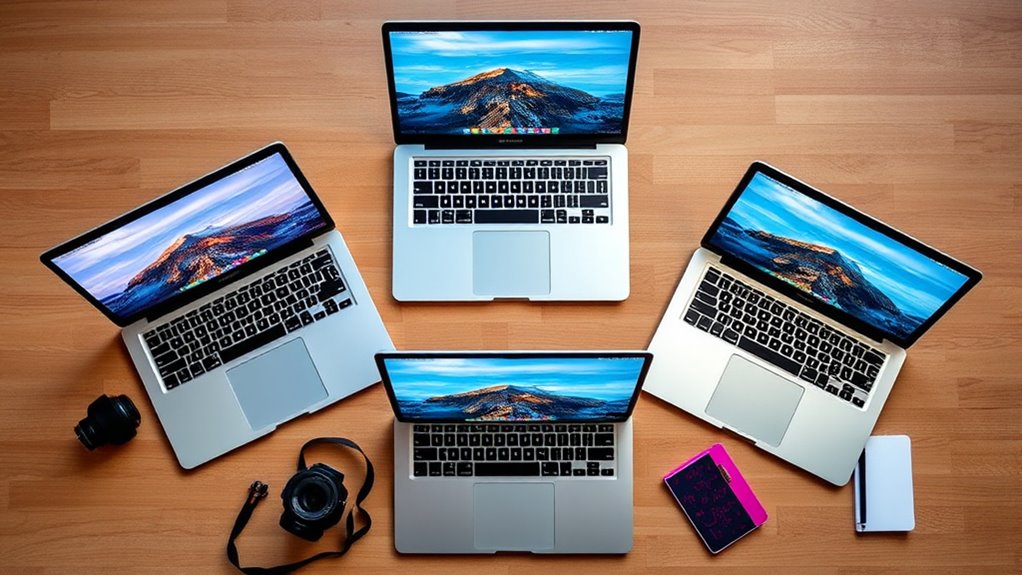

If you’re a photographer looking for the best MacBook Pro models for Lightroom editing, I recommend considering the Apple 2025 MacBook Pro with an M5 Chip and the Apple 2024 models with M4 Max chips. These options offer high core processors, exceptional displays, and ample storage, ensuring seamless multitasking and stunning image quality. Plus, their connectivity features support efficient workflows. Keep going to discover specific models that fit your needs perfectly!
Key Takeaways
- The latest MacBook Pro models feature high-core CPUs like the M5 and M4 Max, crucial for multitasking and efficient Lightroom editing.
- Equipped with Liquid Retina XDR displays, these models offer exceptional color fidelity and high resolution for detailed image work.
- With SSD options starting at 1TB, photographers can store large RAW files and extensive Lightroom catalogs without performance lag.
- Long battery life, enhanced by M5 and M4 Max chips, supports extended use during on-the-go photography and editing sessions.
- Multiple Thunderbolt ports and an SDXC card slot facilitate quick connections to cameras and external devices, optimizing workflow efficiency.
Apple 2025 MacBook Pro Laptop with M5 Chip
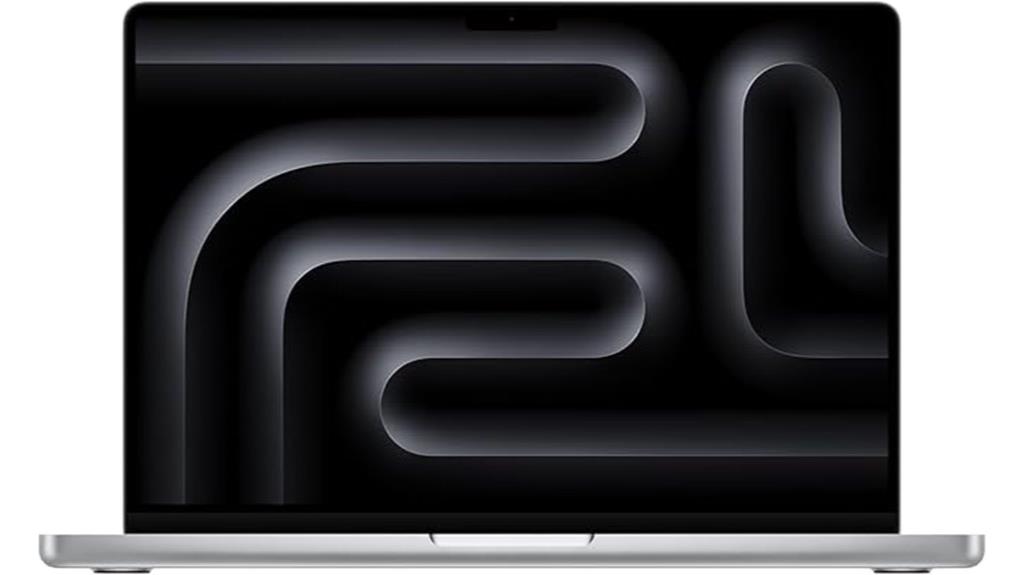
If you’re a photographer looking for exceptional performance, the Apple 2025 MacBook Pro with the M5 chip is a game changer. Its 10-core CPU and GPU handle demanding tasks effortlessly, making photo editing a breeze. The stunning 14.2-inch Liquid Retina XDR display reveals every detail of your images with vibrant colors and incredible contrast. Plus, the battery life keeps me going for up to 16 hours without a hitch. With ample ports for connectivity and a powerful media engine, this MacBook Pro elevates my editing workflow. Trust me, this laptop is a must-have for any serious photographer.
Best For: Photographers and creatives who require high-performance computing for demanding tasks like photo editing and video production.
Pros:
- Exceptional performance with the powerful 10-core CPU and GPU, making demanding tasks effortless.
- Stunning 14.2-inch Liquid Retina XDR display with vibrant colors and impressive contrast for detailed image editing.
- Long battery life of up to 16 hours, ensuring productivity without interruptions.
Cons:
- Higher price point compared to other laptops in the market, which may not be suitable for budget-conscious users.
- Limited upgradeability options, as the hardware is integrated into the Apple Silicon architecture.
- May have a learning curve for users transitioning from other operating systems to macOS.
Apple 2024 MacBook Pro Laptop with M4 Max
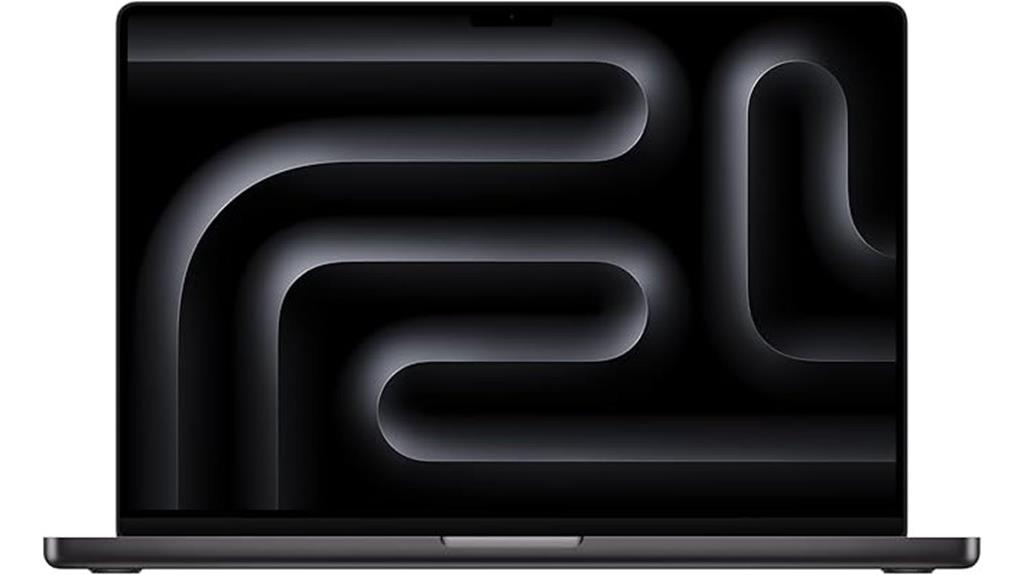
The Apple 2024 MacBook Pro with M4 Max is an exceptional choice for photographers who demand top-tier performance and stunning visuals. With its 16-core CPU and 40-core GPU, it effortlessly handles demanding tasks like 3D rendering and video editing. The 16.2-inch Liquid Retina XDR display showcases vibrant colors and incredible detail, perfect for editing photos. Plus, the battery life lasts up to 21 hours, ensuring I can work all day without interruptions. Connectivity options, including Thunderbolt 5 and HDMI, make it easy to integrate into my workflow. Overall, this MacBook Pro is an outstanding tool for any serious photographer.
Best For: Photographers and creative professionals seeking high-performance computing for demanding tasks like 3D rendering and video editing.
Pros:
- Exceptional performance with a powerful 16-core CPU and 40-core GPU for handling intensive creative workloads.
- Stunning 16.2-inch Liquid Retina XDR display with vibrant colors and high detail, ideal for photo editing.
- Long battery life of up to 21 hours, allowing for extended work sessions without needing to recharge.
Cons:
- Higher price point compared to other laptops, which may not be feasible for all users.
- Weight of 4.73 pounds may be less portable for those needing a lightweight device.
- Limited upgrade options post-purchase, as hardware configurations are chosen at the time of buying.
Apple 2024 MacBook Pro Laptop with M4 Max (14.2-inch Display, 1TB SSD)

For photographers seeking exceptional performance, the Apple 2024 MacBook Pro with the M4 Max chip stands out with its stunning 14.2-inch Liquid Retina XDR display. With a 14-core CPU and a 32-core GPU, it powers through demanding tasks like editing high-resolution images effortlessly. The 1TB SSD guarantees ample storage for your projects, while 36GB of unified memory keeps everything running smoothly. Plus, the stunning brightness and contrast make your photos pop. I love the seamless integration with my iPhone and the added peace of mind from AppleCare+. This laptop truly elevates my photography workflow to new heights.
Best For: Photographers and creative professionals who require high performance and exceptional display quality for image editing and multimedia tasks.
Pros:
- Outstanding performance with the M4 Max chip, ideal for demanding tasks like 3D rendering and video editing.
- Stunning 14.2-inch Liquid Retina XDR display with exceptional brightness and contrast for vibrant visuals.
- Seamless integration with Apple ecosystem, making it easy to connect and share content across devices.
Cons:
- Higher price point compared to other laptops, which may not fit all budgets.
- Limited upgradeability as components are often soldered and not user-replaceable.
- Heavier than some ultra-portable options, which may be a consideration for frequent travel.
Apple 2024 MacBook Pro Laptop with M4 Max

Designed with photographers in mind, the Apple 2024 MacBook Pro with M4 Max chip delivers unparalleled performance, making it an indispensable tool for anyone serious about their craft. With its 14-core CPU and 32-core GPU, I can tackle complex tasks like 3D rendering effortlessly. The 14.2-inch Liquid Retina XDR display boasts vibrant visuals, reaching up to 1600 nits brightness, perfect for editing my photos. Plus, the all-day battery life guarantees I can work without interruptions. Integrated seamlessly with macOS and other Apple devices, it’s a powerhouse that elevates my photography workflow to new heights.
Best For: Photographers and creative professionals seeking high performance and exceptional display quality for demanding tasks.
Pros:
- Exceptional Performance: Equipped with M4 Max chip, 14-core CPU, and 32-core GPU for handling intensive workflows and 3D rendering.
- Stunning Display: 14.2-inch Liquid Retina XDR display with up to 1600 nits peak brightness for vibrant visuals and precise color accuracy.
- All-Day Battery Life: Designed to maintain performance throughout the day, whether plugged in or on battery.
Cons:
- High Price Point: Premium features come with a higher cost, making it less accessible for budget-conscious users.
- Weight and Portability: While designed for professionals, it may be heavier compared to ultra-portable laptops, affecting mobility.
- Limited Upgrade Options: Unified memory and storage configurations may limit future upgrades, requiring careful initial selection.
Apple 2024 MacBook Pro Laptop with M4 Max

If you’re a photographer seeking unparalleled performance for demanding tasks, the Apple 2024 MacBook Pro with M4 Max is an ideal choice. With its 14-core CPU and 32-core GPU, it effortlessly handles complex workflows like 3D rendering and Lightroom editing. The stunning 16.2-inch Liquid Retina XDR display boasts incredible brightness and contrast, making your photos pop. Plus, the all-day battery life means you can work anywhere without interruption. Integrated seamlessly within the Apple ecosystem, it enhances your creative process with features like iPhone Mirroring. This sleek, powerful laptop truly redefines what a portable workstation can be for photographers.
Best For: Photographers and creative professionals seeking a powerful, portable workstation for demanding tasks.
Pros:
- Exceptional performance with M4 Max chip for complex workflows like 3D rendering and video editing.
- Stunning 16.2-inch Liquid Retina XDR display with high brightness and contrast for vibrant photo editing.
- Seamless integration within the Apple ecosystem, enhancing productivity and creativity.
Cons:
- Higher price point compared to standard laptops may not fit all budgets.
- Limited to Apple software and applications, which may not suit all users.
- Heavier than some other portable options, which may affect portability for some users.
Factors to Consider When Choosing a Macbook Pro for Photographers and Lightroom
When picking a MacBook Pro for photography and Lightroom, I always consider a few key factors. Processing power, display quality, and battery life are vital for handling large files and editing smoothly. Plus, having enough storage and strong graphics capabilities can really enhance my workflow.
Processing Power and Performance
As a photographer, I know that processing power and performance are critical when choosing a MacBook Pro, especially for handling demanding applications like Lightroom. I recommend opting for a high-core CPU, ideally a 10-core or 14-core processor, to guarantee smooth multitasking with large catalogs. A powerful GPU, such as a 32-core or 40-core graphics card, enhances rendering and speeds up editing features, making your workflow much more efficient. Don’t forget about RAM; having at least 36GB allows for seamless editing of high-resolution images. Fast storage is also key—1TB SSD or larger helps with quick imports and exports. Ultimately, look for hardware-accelerated decoding for formats like ProRes and HEVC to save time on RAW files and video exports.
Display Quality and Resolution
While selecting a MacBook Pro, one vital aspect I can’t overlook is the display quality and resolution, as it directly impacts my editing experience. A high-resolution display with at least 3000 pixels in width ensures I see sharp, detailed images for precise edits. The wide P3 color support is essential for accurate color representation, which I rely on heavily in photography. An HDR-capable screen with high peak brightness of around 1000 nits or more enhances the visibility of contrast-rich images, making my work easier. Additionally, True Tone technology adapts to ambient lighting, providing a natural viewing experience. Finally, ProMotion technology with adaptive refresh rates up to 120Hz offers smooth scrolling, reducing motion blur during my editing sessions.
Battery Life Considerations
Editing on a stunning display is only part of the equation; battery life is just as important for photographers like me. A MacBook Pro with a high-capacity battery, like the 72.4Wh or 100Wh options, can keep me going for up to 24 hours of video streaming or 21 hours of web browsing. This means I can shoot and edit remotely without worrying about frequent recharges. The latest M5 or M4 Max chips also help conserve battery during intensive editing tasks. Plus, with rapid charging capabilities from high-wattage adapters, I can quickly juice up between shoots. External power options and multi-port connectivity give me the flexibility I need to extend my working time, even away from power sources.
Storage Capacity and Options
When choosing a MacBook Pro for photography, storage capacity is vital. I recommend going for at least 1TB to comfortably store high-resolution RAW files and Lightroom catalogs without constantly relying on external drives. If you need more, look for models with configurable storage options that allow upgrades to 2TB, 4TB, or even higher. This future-proofs your setup for expanding photo storage needs. Don’t forget about the speed of the storage; SSD performance can considerably impact how quickly Lightroom loads, saves, and processes your images. Balancing your storage needs with your budget is key, as higher internal storage will typically increase the overall cost. Choose wisely to guarantee a smooth editing experience.
Graphics Capabilities for Editing
To guarantee your photography workflow is as seamless as possible, considering the graphics capabilities of a MacBook Pro is crucial. I find that choosing a model with a high-core GPU, like a 40-core or 32-core option, considerably boosts my editing and rendering tasks, especially with high-resolution photos. The hardware-accelerated ray tracing feature enhances real-time previews, making complex edits smoother. Large unified memory, around 36GB or 48GB, lets me handle large image files effortlessly while multitasking in Lightroom. Plus, the Liquid Retina XDR display offers accurate color grading and detailed image review. If you’re like me and value expansive workspaces, support for high-resolution external displays (6K or 8K) is a game-changer for detailed photo editing.
Connectivity and Port Availability
As I immerse myself in my photography projects, I quickly realize that connectivity and port availability are just as vital as performance. I always look for a MacBook Pro with multiple Thunderbolt ports, ideally Thunderbolt 4 or 5, to guarantee fast data transfers with my external drives and peripherals. It’s essential to have various ports like HDMI and SDXC card slots to connect directly to my cameras and monitors without fumbling with adapters. An SDXC card slot is especially necessary for importing photos straight from my camera’s memory cards. I also prefer models that support high-speed data transfer rates, as they make handling large Lightroom catalogs and RAW files a breeze while multitasking between displays and storage devices.
Integration With Apple Ecosystem
Integrating with the Apple ecosystem is essential for photographers like me who rely on a seamless workflow. With devices like the MacBook Pro, iPhone, and iPad working together, I can sync my photos and projects effortlessly. Features like AirDrop allow me to transfer high-resolution images quickly between devices without any cables, saving precious time. Thanks to Continuity and Handoff, I can start editing on my iPhone and instantly pick up where I left off on my MacBook. Plus, iCloud Photo Library automatically backs up my images, ensuring they’re always accessible and safe. This deep integration with macOS optimizes performance for Lightroom, making my editing process smoother and more efficient. It’s a game-changer for my photography work.
Frequently Asked Questions
What Is the Battery Life of These Macbook Pro Models?
The battery life of the latest MacBook Pro models typically ranges from 10 to 20 hours, depending on usage. I’ve found that for everyday tasks, it lasts me all day without needing a charge, which is fantastic for my workflow. However, intensive applications like video editing can drain it faster. Overall, I appreciate that I can rely on it during long sessions without constantly searching for a power outlet.
Can I Upgrade the RAM in These Macbook Pro Models?
No, you can’t upgrade the RAM in these MacBook Pro models. Apple has soldered the RAM to the motherboard, so it’s not user-replaceable. I learned this the hard way when I was considering upgrades for my own MacBook. If you’re looking for performance improvements, I’d recommend choosing a model with the highest RAM configuration you can afford upfront. It’s a vital factor for handling demanding tasks efficiently.
Are These Models Compatible With Older Software Versions?
Yes, these MacBook Pro models are generally compatible with older software versions. I’ve found that most applications run smoothly, even those that are a bit dated. However, it’s essential to check the specific system requirements for the software you want to use. Sometimes, updates might restrict older versions, but I’ve had success running legacy software on my MacBook Pro without any major issues. It’s worth testing before making a final decision.
What Type of Ports Do These Macbook Pro Models Have?
A good tool is only as good as its features. The newer MacBook Pro models come equipped with Thunderbolt 4/USB-C ports, which offer incredible versatility. You’ll find three of these ports, plus an HDMI port and an SD card slot, which is perfect for photographers like us. I love how these ports make transferring files and connecting my peripherals so easy. It’s all about efficiency, right?
Do These Models Support External Displays for Photo Editing?
Yes, these MacBook Pro models support external displays, which is fantastic for photo editing. I often connect mine to a larger screen for a better view of my images. You’ll appreciate the Retina display’s sharpness and color accuracy, making it easier to edit photos precisely. Plus, with multiple Thunderbolt 3 ports, I can easily hook up my external monitor and other devices without any hassle. It really enhances my editing workflow!
Conclusion
In the grand tapestry of photography, your MacBook Pro is the loom weaving your creative vision into reality. Each model, like a brushstroke on a canvas, adds depth and clarity to your editing experience. With the right choice, you’ll paint vibrant stories through your images, allowing your artistry to shine. So, as you set out on this journey, remember: the right tool can transform mere snapshots into masterpieces. Trust your instincts, and let your creativity flow freely.