
If you’re looking to enhance your astronomy experience, I recommend checking out the top five field flatteners for refractor telescopes. The Astromania 2″ Field Flattener is a fantastic option for sharp, flat images, while the SVBONY SV193 and SV209 models are great for reducing focal length and improving edge sharpness. Each flattener has unique features to correct field curvature and improve image quality. Stick around, and I’ll share more details about what to contemplate when choosing a field flattener.
Key Takeaways
- The Astromania 2″ Field Flattener corrects field curvature for sharp images, ideal for astrophotography with refractors f/4 to f/8 ratios.
- SVBONY SV193 0.8X Focal Reducer offers a wider field of view while minimizing distortion, compatible with full-frame cameras like SV305C Pro.
- SVBONY SV209 0.8X Focal Reducer & Flattener reduces focal length and enhances edge-to-edge sharpness, specifically designed for the SV550 122mm APO refractor.
- Key factors for choosing a field flattener include optical performance, compatibility, construction quality, and ease of mounting for optimal astrophotography results.
- Ensure your field flattener maintains precise optical alignment to minimize distortions and improve overall image quality across the entire field.
Astromania 2″ Field Flattener for Astronomy Photos

If you’re an astrophotographer looking to enhance your images, the Astromania 2″ Field Flattener could be just what you need. This tool guarantees perfect image flatness, especially for refractors with f/4 to f/8 ratios. With M48 threading, it provides full aperture illumination at 2“, allowing for wide-angle shots. I’ve noticed a significant improvement in my astrophotos, as it corrects field curvature and keeps stars sharp from the center to the edges. Weighing only 8.8 ounces, it’s lightweight and easy to use, making it a fantastic addition to my gear. Trust me, you won’t regret investing in this flattener!
Best For: Astrophotographers using refractor telescopes with f/4 to f/8 ratios who want to achieve sharp, flat images across the entire field.
Pros:
- Corrects field curvature to ensure sharp stars from center to edge.
- Lightweight design at only 8.8 ounces makes it easy to handle and use.
- Full aperture illumination with M48 threading allows for wide-angle astrophotography.
Cons:
- Limited compatibility with telescopes outside the f/4 to f/8 range.
- May require additional accessories for optimal performance, depending on your setup.
- Focus on astrophotography means it may not be as beneficial for visual observing.
Astromania 2″ Field Flattener for Astronomy Photos

The Astromania 2″ Field Flattener stands out as an essential tool for astrophotographers aiming to capture stunning images with their refractor telescopes. This flattener corrects field curvature, ensuring pin-sharp stars from center to edge, even with large image chips. It’s compatible with telescopes ranging from f4 to f8, offering a seamless M48 threading for easy attachment. I’ve found that its high-quality multi-coated lenses reduce glare and maximize light transmission, delivering crisp edge-to-edge images. With 109mm of back focus room, I can easily add accessories, making it a reliable choice for serious astronomy imaging.
Best For: Astrophotographers seeking to achieve sharp, distortion-free images from their refractor telescopes.
Pros:
- High-quality multi-coated lenses minimize reflections and maximize light transmission for optimal image clarity.
- Corrects field curvature, ensuring sharp stars from the center to the edges of the image.
- Offers 109mm of back focus room for easy integration of additional accessories.
Cons:
- Limited compatibility with telescopes outside the f4 to f8 aperture range.
- May require additional adjustments for optimal performance with specific camera setups.
- Some users may find the price point to be on the higher side for a field flattener.
SVBONY SV193 Focal Reducer 0.8X Field Flattener

Looking for a way to enhance your astrophotography experience? The SVBONY SV193 Focal Reducer 0.8X Field Flattener is your go-to solution. This 2-inch reducer not only lowers your focal length by 0.8x but also flattens field curvature, giving you wide, sharp images of celestial wonders. I love how it connects easily to my main lenses and is compatible with full-frame cameras like the SV305C Pro. With minimal distortion at the edges, I capture stunning details of planets, even in low light. The low readout noise guarantees my images are clean and sharp—perfect for those breathtaking astrophotography moments!
Best For: Amateur and professional astrophotographers looking to improve image quality and field curvature in their refractor telescopes.
Pros:
- Reduces focal length by 0.8x, allowing for wider field views of celestial objects.
- Minimizes distortion at image edges, resulting in sharper, high-quality astrophotos.
- Compatible with full-frame cameras, including the SV305C Pro, enhancing versatility for different imaging setups.
Cons:
- Limited to refractor telescopes, which may not suit users with other types of telescopes.
- Requires additional adapters for some camera connections, which could complicate setup for beginners.
- May not perform optimally in extremely low light conditions, affecting image clarity.
SVBONY SV209 Field Flattener and Focal Reducer for Telescopes

For astrophotographers seeking to enhance their imaging experience, the SVBONY SV209 Field Flattener and Focal Reducer stands out as an exceptional choice. This 0.8X focal reducer not only reduces the focal length from 854mm to 683.2mm, but it also corrects field curvature, ensuring sharp focus across the entire image. I’ve found that it improves edge-to-edge sharpness, markedly enhancing the quality of my images. Installing it on my SV550 122mm APO refractor is a breeze, thanks to the secure metric 63×1 thread. Whether you’re a novice or pro, this flattener makes capturing expansive celestial scenes effortless and rewarding.
Best For: Astrophotographers seeking to improve image quality and expand their field of view when using the SV550 122mm APO refractor.
Pros:
- Enhances edge-to-edge image sharpness, reducing distortions for higher-quality results.
- Reduces focal length to capture wider scenes, increasing photographic speed.
- Easy installation with a secure metric 63×1 thread, ensuring stable connection during imaging.
Cons:
- Specifically designed for the SV550 122mm APO refractor, limiting compatibility with other telescopes.
- May require additional adjustments for optimal performance depending on the camera used.
- The reduction in focal length may not suit all astrophotography styles or preferences.
SVBONY Focal Reducer and Field Flattener for SV503 102mm ED Telescope
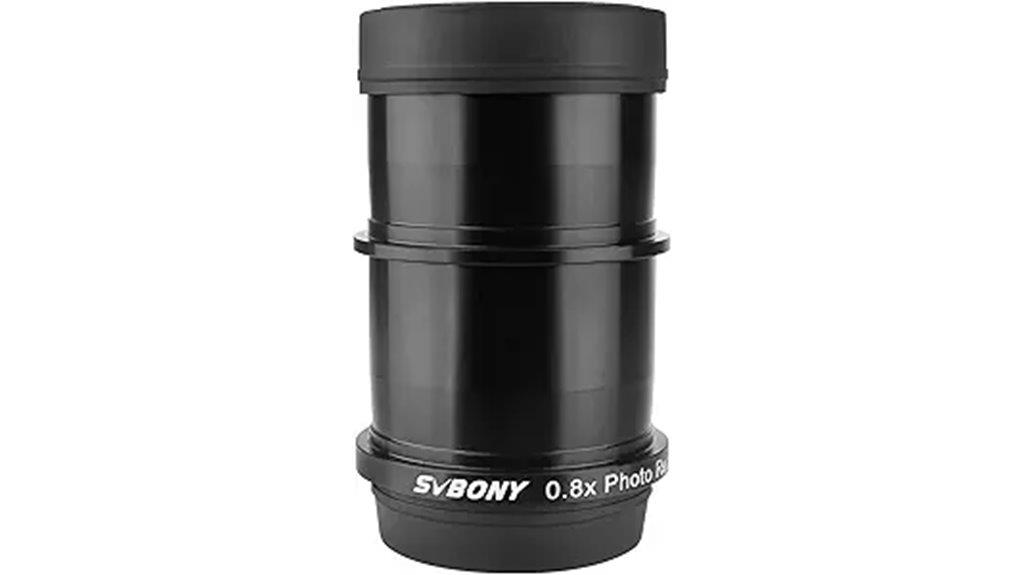
If you’re an astrophotographer seeking to enhance your SV503 102mm ED refractor telescope, the SVBONY Focal Reducer and Field Flattener is a game changer. With its 0.8x reduction factor, it provides a wider field of view and sharpens star points, making your celestial images pop. The multi-coated optics ensure bright, clear images with minimal distortion, and the hard anodized aluminum construction guarantees durability. Plus, it offers easy connectivity for filters, enhancing your astrophotography setup. I’ve found that it considerably reduces focal length while improving detail and brightness, making it an essential tool for capturing stunning astrophotos.
Best For: Astrophotographers looking to enhance image quality and field coverage with their SV503 102mm ED refractor telescope.
Pros:
- Wider field of view with a 0.8x reduction factor, allowing for more expansive celestial photography.
- High-quality multi-coated optics provide clear, bright images with minimal distortion and improved signal-to-noise ratio.
- Durable construction with hard anodized aluminum ensures longevity and reliability in various conditions.
Cons:
- Compatibility limited to SV503 102mm ED telescopes, which may restrict use for other telescope models.
- Additional cost for filters and accessories may be required to maximize its capabilities.
- Learning curve for optimal setup and usage in astrophotography may be challenging for beginners.
Factors to Consider When Choosing Field Flatteners for Refractor Telescopes

When I’m choosing a field flattener for my refractor telescope, I focus on a few key factors. Optical performance, compatibility with my specific model, and the quality of construction materials are vital for getting the best results. It’s also important to take into account how easy it is to mount and attach the flattener to my setup.
Optical Performance Requirements
Choosing the right field flattener for your refractor telescope is essential, as it directly impacts the quality of your astrophotography. You want a flattener that effectively corrects field curvature, ensuring sharp images across the entire sensor or film plane. Look for models with multi-coated lenses to minimize reflections and maximize light transmission, giving you brighter, clearer images. It’s also critical that the flattener supports your telescope’s focal ratio, ideally between f/4 to f/8, for ideal correction. Additionally, make sure it provides full aperture illumination without vignetting or light loss at the edges. Finally, precise optical alignment and high-quality construction are vital for maintaining consistent performance and preventing distortions, which can ruin your astrophotography experience.
Compatibility With Telescopes
Compatibility with your refractor telescope is vital for achieving the best results in astrophotography. First, verify that the field flattener matches your telescope’s focal ratio, ideally between f/4 to f/8, for ideal image correction. Next, confirm that the threading and connection type, such as M48 or 2-inch, align with your telescope’s focuser or camera accessories for a secure fit. It’s also fundamental to confirm that the flattener supports the required back focus distance, typically around 109mm, to achieve full illumination. Additionally, check if it’s designed for your specific aperture size, as some models are optimized for certain diameters. Finally, consider the optical coatings and construction to reduce reflections and enhance light transmission.
Focal Length Reduction
Understanding the impact of focal length reduction can substantially enhance your astrophotography experience with refractor telescopes. By using a focal reducer, you can decrease your telescope’s effective focal length, which opens up wider fields of view for your images. For instance, a 0.8x focal reducer cuts the original focal length by 20%, markedly expanding your coverage area. This reduction also increases imaging speed by lowering the f-ratio, allowing you to capture images faster with shorter exposure times. Plus, it can improve the overall brightness and contrast of your photos, especially when photographing large celestial objects. Just ensure the field flattener you choose is compatible with your telescope‘s focal ratio to maintain ideal image quality.
Construction Material Quality
When selecting a field flattener for your refractor telescope, the quality of construction materials plays a critical role in ensuring peak performance. I always look for high-quality materials like anodized aluminum and durable multi-coated lenses, as they promise longevity and resistance to environmental factors. Using premium materials considerably reduces the risk of optical misalignments, ensuring consistent image quality over time. Lightweight yet sturdy options make handling and installation a breeze without compromising structural integrity. Additionally, corrosion-resistant materials are essential in humid or harsh conditions, preserving the accessory’s performance. Ultimately, the material quality directly affects the flatness and optical precision of the field flattener, which is essential for achieving sharp and clear images during my stargazing sessions.
Mounting and Attachment Ease
Choosing a field flattener that’s easy to mount and attach can make a significant difference in your stargazing experience. First, I recommend ensuring the flattener has compatible threading or connection types with your refractor telescope’s focuser. This compatibility streamlines attachment and minimizes hassle. Next, check if the mounting mechanism provides a secure fit to prevent misalignment during astrophotography. I also find it helpful if the flattener supports additional adapters or extension tubes for seamless integration with my setup. A straightforward attachment process is essential, ideally requiring minimal tools for quick setup and removal. finally, considering the weight and size of the flattener helps maintain proper balance and prevents stress on your telescope’s focuser during use.
Image Sharpness Across Field
To achieve stunning astrophotography, I pay close attention to how a field flattener affects image sharpness across the entire field. A good flattener ensures that the image remains sharp from the center to the edges, minimizing optical distortions that can ruin a shot. Correcting field curvature is vital for uniformly sharp stars throughout the field of view, preventing any noticeable drop in quality. I also consider how well the flattener’s specifications match my telescope’s focal ratio, as this compatibility is essential for maintaining sharpness. An effective field flattener preserves focus across the image, eliminating star elongation and ensuring high-resolution results. Ultimately, achieving sharpness across the entire field greatly enhances my astrophotography experience.
Multi-Coating Benefits
While exploring the best field flatteners for my refractor telescope, I quickly realized the importance of multi-coating in enhancing image quality. Multi-coatings considerably reduce reflections, glare, and ghosting, which means I get clearer images during my observations. I found that high-quality multi-coatings maximize light transmission, ensuring my astrophotographs turn out brighter and more detailed. These coatings also help minimize chromatic aberrations and other optical distortions at the edges of the field, which is vital for sharpness. Plus, proper multi-coating decreases internal lens reflections, boosting contrast and overall image quality. I appreciate that multi-coated optics are more durable, as they resist environmental factors better, maintaining their performance over time. This durability is a game changer for long-term use in the field.
Price and Value Consideration
When I consider the price and value of field flatteners for my refractor telescope, it’s clear that investing wisely can substantially enhance my astrophotography experience. Higher-priced flatteners often feature premium multi-coated optics, which guarantee better image quality and durability. I’ve learned that the value of a flattener also lies in its compatibility with various refractors and camera systems. By choosing a well-reviewed, mid-range to high-end option, I can enjoy long-term benefits like consistent performance and fewer optical distortions. On the flip side, cheaper flatteners might skimp on advanced coatings and precise construction, resulting in reduced sharpness and increased reflections. Balancing cost with essential features ensures I get the best worth for my specific setup.
Frequently Asked Questions
How Do Field Flatteners Improve Image Quality in Refractor Telescopes?
Field flatteners improve image quality in refractor telescopes by correcting spherical aberrations and reducing distortion at the edges of the field of view. When I use one, I notice sharper stars and clearer details across the entire image. It minimizes the curvature that often blurs the view, allowing me to enjoy crisp, consistent visual experiences. This enhancement makes my stargazing sessions much more satisfying, letting me appreciate celestial wonders in their full glory.
Are Field Flatteners Compatible With All Refractor Telescope Brands?
Not every field flattener plays nice with all refractor brands, which is shocking, right? I mean, you’d think they’d just get along! When I choose a flattener, I always check compatibility with my specific telescope model. Some brands design their flatteners for particular optics, while others might work universally. So, double-checking specs prevents me from potential headaches and ensures I get the best views of the cosmos without any distortion.
Can Field Flatteners Be Used for Visual Observations?
Yes, I’ve used field flatteners for visual observations, and they definitely enhance the experience. They correct distortion at the edges of the field of view, making stars and celestial objects appear sharper and clearer. I’ve noticed a significant difference, especially when viewing expansive star fields or deep-sky objects. If you’re into serious stargazing, I’d recommend trying one out; you might be surprised at how much it improves your observations!
Do Field Flatteners Affect the Telescope’s Focal Length?
Oh sure, let’s just throw a field flattener into the mix and expect our telescope to magically transform into a perfect instrument! But seriously, field flatteners don’t change the focal length; they just correct the image. You still get to enjoy the beauty of the cosmos without the annoying distortion. So, if you’re excited about crisp images, go ahead and give it a try—it won’t mess with your focal length!
How Do I Attach a Field Flattener to My Telescope?
Attaching a field flattener to my telescope is pretty straightforward. First, I make sure my telescope is off and stable. Then, I unscrew the existing eyepiece or camera adapter from the focuser. Next, I screw the field flattener directly onto the focuser, ensuring it’s secure. After that, I attach my camera or eyepiece to the other end of the flattener. Finally, I check for any adjustments needed to achieve the perfect focus.
Conclusion
In the vast universe of astrophotography, finding the right field flattener is like discovering a hidden gem in the night sky. Each of these top picks can transform your refractor telescope into a powerful tool, bringing celestial wonders into sharper focus. So, whether you’re capturing distant galaxies or observing the moon’s craters, these flatteners will elevate your stargazing experience. Equip yourself wisely, and let the stars unfold their beauty like a well-written story waiting to be explored!