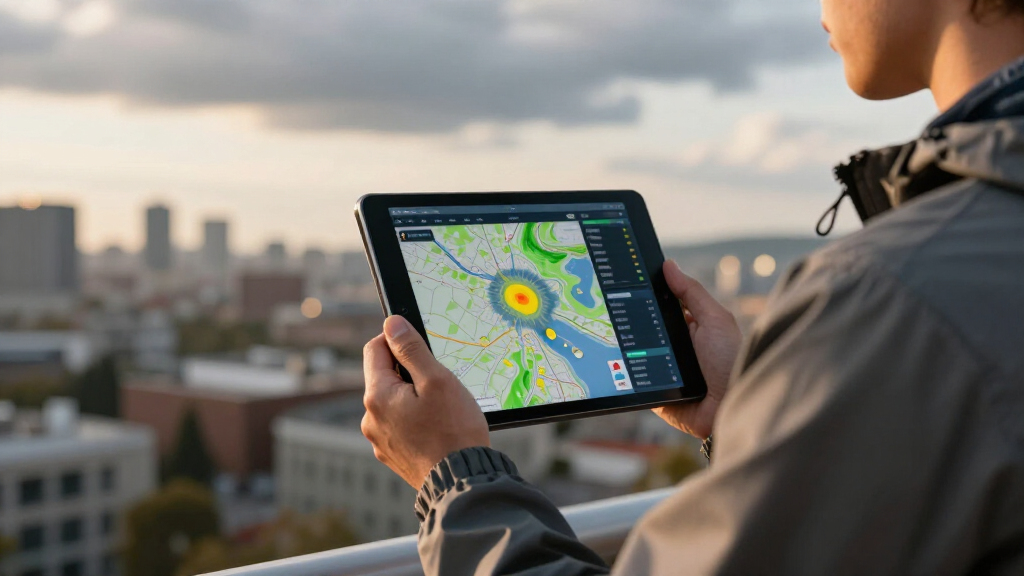

📊 Full opportunity report: AI And Weather Forecasting: Navigating A World Of Increasing Climate Extremes on ThorstenMeyerAI.com — validation score, market gap, and execution plan.

Get the latest gadgets delivered free — and shop member deals
- Fast, free delivery on millions of items
- Access to Prime Big Deal Days deals on October 6–7
- Prime Video, Amazon Music and more included
TL;DR
A report attributed to Huawei Pangu suggests AI is significantly changing weather forecasting amid increasing climate extremes. However, key technical details and performance metrics are absent, leaving the actual impact unverified. The development could influence emergency preparedness and climate resilience strategies.
A report attributed to Huawei Pangu states that AI-based weather forecasting is transforming predictions as societies face increasing climate extremes. While the claim highlights potential for faster and more useful forecasts, it provides no technical details, performance metrics, or independent validation, leaving the actual impact unconfirmed.
The report suggests that AI systems could enable meteorological agencies to generate forecasts more rapidly, potentially allowing earlier warnings for extreme weather events such as floods, heatwaves, and storms. However, it does not specify the AI model version, training datasets, geographic coverage, or benchmark results. No evidence is provided to demonstrate improved accuracy or reliability compared to existing numerical weather prediction models.
Currently, AI weather systems typically learn from historical atmospheric data and can complement traditional physics-based models. The report does not clarify whether the AI system is a new development, a commercial service, or an existing system, nor does it include independent testing or validation results. The absence of such information makes it impossible to assess whether the AI forecasts are more accurate, faster, or better at predicting extreme events.
Potential Impact of AI on Weather Emergency Response
If AI-based forecasting can reliably produce faster predictions, it could provide emergency services, transportation, energy providers, and communities with critical additional time to prepare for severe weather events. This capability could reduce damages, save lives, and improve resilience. However, the public benefit depends on the accuracy, stability, and communication of forecast uncertainty, which the current report does not address.
As an affiliate, we earn on qualifying purchases.
Current State of AI in Weather Forecasting and Climate Challenges
AI has been increasingly integrated into weather prediction workflows, often used alongside traditional models to enhance pattern recognition and reduce computational demands. The rise in climate extremes—such as intense heatwaves, hurricanes, and flooding—has heightened the need for faster, more reliable forecasts. Despite growing interest, there is no publicly available, independently validated evidence confirming that AI systems outperform established models in predicting these high-impact events.
The Huawei Pangu report appears to be a broad claim of progress, but without detailed technical documentation or benchmarking data, its actual significance remains uncertain. Historically, improvements in weather prediction have depended on advances in satellite data, observation networks, and computational physics, with AI serving as a supplementary tool rather than a replacement.
“The report suggests AI could enable faster forecasts, but without validation, it’s difficult to assess the true impact on accuracy or reliability.”
— an anonymous researcher
As an affiliate, we earn on qualifying purchases.
Unverified Claims and Lack of Technical Validation
It is not yet clear whether the AI system referenced has undergone independent testing, what datasets it uses, or how it compares to existing models in predicting extreme weather events. The absence of published benchmarks, model details, and performance metrics means the claimed improvements cannot be confirmed.
As an affiliate, we earn on qualifying purchases.
Need for Transparent Benchmarking and Independent Testing
Future steps should include publishing detailed model documentation, benchmark results, and independent evaluations. Validation across different regions and weather conditions, especially for high-impact extremes, is essential before any operational deployment. Clarification on whether this represents a new model or system is also needed to assess its real-world utility.
As an affiliate, we earn on qualifying purchases.
Key Questions
Does the report prove that AI improves weather forecast accuracy?
No, the report does not provide accuracy metrics, validation methodology, or direct comparisons with existing models. Its claims remain unverified without supporting technical data.
Could faster AI forecasts help communities better prepare for extreme weather?
Potentially, yes. Faster forecasts could give emergency services and the public more time to respond, but only if the predictions are reliable and communicate uncertainty effectively.
What technical information is missing from the report?
Details such as model version, training datasets, geographic coverage, benchmark results, and independent validation are absent, making it impossible to evaluate the system’s performance.
Is this a new AI weather prediction system?
The report does not specify whether it describes a new model, a commercial product, or an existing system, leaving this question open.
What should be the next step for verifying these claims?
Publishing detailed technical documentation, benchmark results, and conducting independent testing are necessary to verify the reported advances.
Source: ThorstenMeyerAI.com
Evergreen bestsellers Picks
bestsellers
As an affiliate, we earn on qualifying purchases.