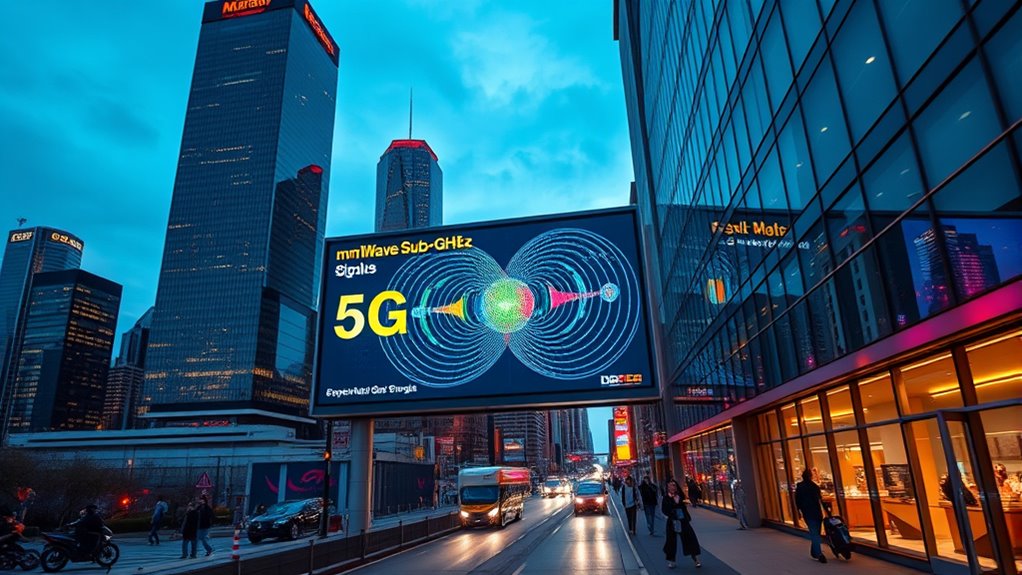

mmWave 5G operates at very high frequencies above 24 GHz, offering ultra-fast speeds and low latency, but it has limited coverage and poor wall penetration. Sub-6GHz, below 6 GHz, provides broader coverage and better signal propagation, making it more practical for everyday use. Devices may only support one or the other, affecting where you can enjoy the fastest speeds. To discover how these differences impact your experience, keep exploring these technologies further.
Key Takeaways
- mmWave offers ultra-fast speeds and low latency but has limited coverage and poor wall penetration.
- Sub-6GHz provides broader coverage and better signal penetration with moderate speeds.
- mmWave requires dense small-cell infrastructure, making deployment more complex and costly.
- Sub-6GHz supports wider device compatibility and is suitable for suburban and rural areas.
- mmWave is ideal for high-capacity urban zones, while Sub-6GHz ensures reliable everyday connectivity.
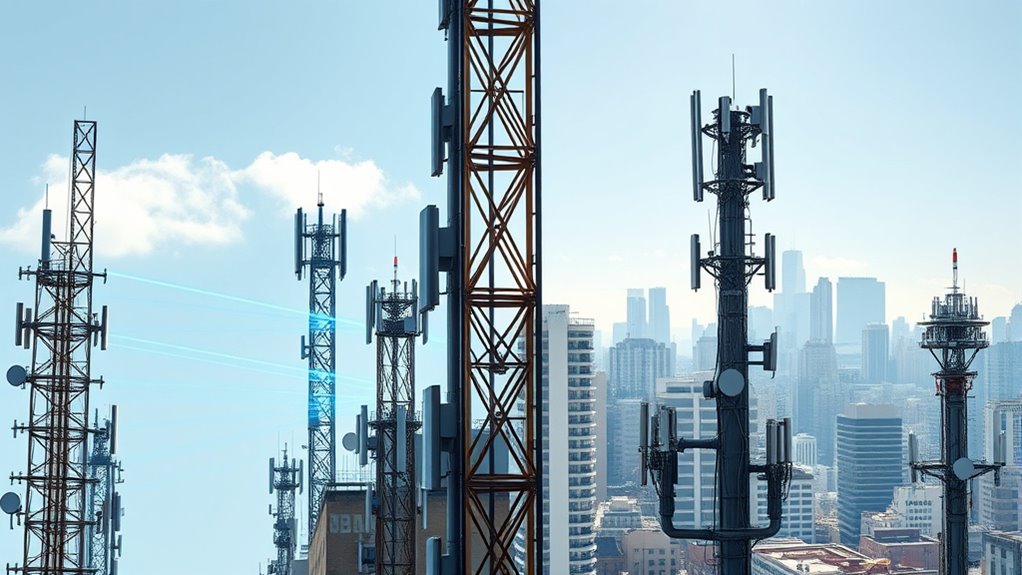
When choosing between mmWave and Sub-6GHz 5G, understanding their fundamental differences is essential. These two frequency bands shape how 5G networks are built and how they perform, impacting everything from network deployment to device compatibility. mmWave operates at extremely high frequencies, typically above 24 GHz, which allows it to deliver blisteringly fast speeds and ultra-low latency. However, these high frequencies have limited range and poor wall penetration, meaning that deploying mmWave networks requires a dense infrastructure of small cells to ensure reliable coverage. This dense network setup can be costly and complex, but it’s necessary to harness the full potential of mmWave’s speed and capacity. On the other hand, Sub-6GHz frequencies—below 6 GHz—offer broader coverage and better signal propagation. This makes them more practical for widespread network deployment, especially in rural or sprawling urban areas, because fewer cell towers are needed to cover the same area. If you’re considering device compatibility, it’s important to recognize that not all 5G devices support both bands. Many smartphones and gadgets are designed to be compatible with Sub-6GHz 5G to ensure they work across a wider range of networks, especially since Sub-6GHz is already more common. Devices supporting mmWave are often more expensive and might only work in specific locations where mmWave infrastructure is available, such as dense city centers. This creates a gap in device compatibility, affecting how and where you can access the fastest 5G speeds. When choosing a device, consider whether you need the ultra-fast speeds of mmWave or if reliable coverage with Sub-6GHz suits your daily needs. For network deployment, providers often prioritize Sub-6GHz for broad coverage and mmWave for targeted, high-capacity zones. Your location and usage patterns influence which band is more suitable; urban areas with dense infrastructure benefit from mmWave’s speed, while suburban or rural areas may rely more on Sub-6GHz to ensure consistent connectivity. Ultimately, understanding these differences helps you decide which 5G network best fits your lifestyle. If you’re in a city and need cutting-edge performance for streaming or gaming, mmWave can be a game-changer—assuming your device supports it. If you want reliable, widespread coverage without needing the absolute fastest speeds, then Sub-6GHz is likely your best bet. Recognizing the interplay between network deployment and device compatibility guarantees you make informed choices, maximizing the benefits of 5G technology tailored to your needs. Additionally, network infrastructure plays a crucial role in determining the availability and effectiveness of each band, influencing coverage and performance.

Samsung Galaxy S23 Ultra 5G, US Version, 512GB, Green – Unlocked (Renewed)
6.8" Dynamic AMOLED 2X Infinity-O QHD+, Edge Screen, 120Hz Refresh Rate, 500ppi, 1750nit (Outdoor Peak), 1440 x 3088…
As an affiliate, we earn on qualifying purchases.
As an affiliate, we earn on qualifying purchases.
Frequently Asked Questions
How Does Signal Range Differ Between Mmwave and Sub-6ghz?
You’ll notice that sub-6GHz signals have a longer range because they operate at lower frequency bands, allowing signals to penetrate obstacles better. In contrast, mmWave signals, which use higher frequency bands, have a much shorter range due to higher attenuation and limited penetration. Antenna design also plays a role; sub-6GHz antennas are simpler, while mmWave antennas require more precise, advanced designs to optimize coverage and signal strength.
What Are the Typical Use Cases for Each 5G Spectrum?
You’ll find mmwave spectrum allocation used for high-capacity, low-latency applications like stadiums and urban hotspots, requiring dense network infrastructure. Sub-6GHz is ideal for broader coverage, providing reliable service in rural areas and for general mobile use. Its network infrastructure supports everyday activities like browsing, streaming, and calls. Each spectrum serves different needs, with mmwave focusing on high-density environments and sub-6GHz ensuring wider, consistent coverage.
How Do Environmental Factors Impact Mmwave and Sub-6ghz Signals?
Ironically, your shiny mmwave signals might struggle more with urban interference and weather issues, despite their speed. Sub-6ghz signals, on the other hand, excel in weather resilience and penetrate buildings better. Environmental factors like rain, fog, and dense city landscapes can weaken mmwave signals, making them less reliable outdoors. So, while mmwave offers blazing speed, don’t forget that sub-6ghz’s robustness makes it more dependable in everyday environments.
What Are the Costs Associated With Deploying Each 5G Technology?
You’ll find that the cost comparison for deploying mmwave and sub-6GHz 5G varies considerably. Deploying mmwave requires higher infrastructure expenses due to the need for dense small cells and advanced equipment, making it more costly upfront. In contrast, sub-6GHz deployment involves lower infrastructure expenses because it covers larger areas with fewer towers. Your decision depends on balancing initial costs against coverage needs and performance goals.
How Does Device Compatibility Vary Between Mmwave and Sub-6ghz Networks?
You might worry about device compatibility across 5G networks, but most modern devices now support both mmwave and sub-6GHz. Device interoperability depends on spectrum allocation and the hardware’s ability to handle different frequency bands. While mmwave requires specialized antennas and chips, sub-6GHz is more widely supported. Check your device specs to verify it’s compatible with the spectrum used in your area for seamless connectivity.

TP-Link AC1200 WiFi Extender – 1.2Gbps Home Signal Booster, Dual Band 5GHz/2.4GHz, Up to 1600 Sq.ft and 32 Devices, EasyMesh Compatible, One Ethernet Port (RE315)
𝐒𝐭𝐫𝐨𝐧𝐠𝐞𝐫 𝐖𝐢-𝐅𝐢 𝐢𝐧 𝐄𝐯𝐞𝐫𝐲 𝐂𝐨𝐫𝐧𝐞𝐫 – Enjoy extended coverage with strong performance powered by Adaptive Path Selection and…
As an affiliate, we earn on qualifying purchases.
As an affiliate, we earn on qualifying purchases.
Conclusion
In the battle between mmWave and sub-6GHz 5G, think of mmWave as the lightning bolt—fast and powerful but with a limited reach—while sub-6GHz is the steady, reliable rain spreading broadly. Your choice depends on whether you need blazing speed for short bursts or consistent coverage for everyday use. Ultimately, they’re like a dynamic duo, each shining in their own way, working together to create a more connected world.

2026 WiFi Extender Signal Booster, 10X Faster WiFi 6 Extender, 18899 sq.ft. Internet Repeater for Home, Dual-Band Network Extender, Wireless Router Signal Amplifier w/Gigabit Ethernet Port, Easy Setup
Wide-Scale Coverage up to 18,899 Sq.Ft.: The wifi extender features 4 high-gain directional antennas with beamforming technology to…
As an affiliate, we earn on qualifying purchases.
As an affiliate, we earn on qualifying purchases.
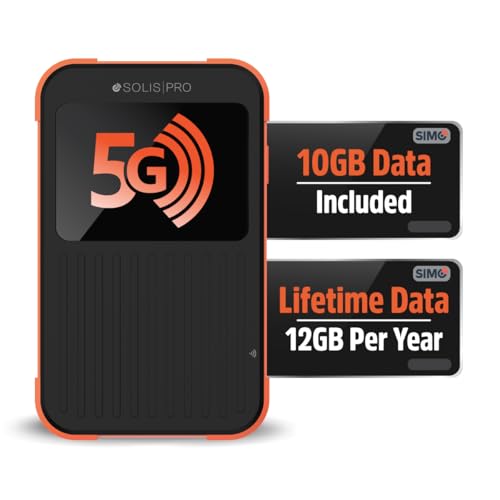
SIMO Solis Pro 5G Mobile Hotspot WiFi Power Bank Touchscreen Display for Travel in 140+ Countries, No SIM Card or Contract, Multi-Carrier Network, 20 Devices, 1GB/Month Lifetime + 10GB Global Data
2-in-1 Solution: The SIMO Pro features a next gen 5G hotspot device (Wi-Fi 6E) along with a 8000mAH…
As an affiliate, we earn on qualifying purchases.
As an affiliate, we earn on qualifying purchases.