
LiDAR in smartphones uses laser pulses to measure distances by bouncing off objects and returning to a sensor. This creates precise 3D maps of your environment, which improves features like AR, faster autofocus, and better low-light photos. It helps your device understand surroundings more accurately. While currently in select models like iPhone and iPad Pro, ongoing advancements mean you’ll see even more innovative uses soon—there’s much more to discover behind this exciting technology.
Key Takeaways
- LiDAR in smartphones emits laser pulses to measure distances and create detailed 3D maps of the environment.
- It enhances augmented reality by accurately detecting surfaces and spatial features for virtual object placement.
- LiDAR improves photo quality by enabling faster autofocus and better depth sensing for portrait effects.
- Currently available in select Apple devices like iPhone 12 Pro/Max and iPad Pro, with growing industry interest.
- Limitations include a short range of about 5 meters and sensitivity to environmental factors like sunlight and reflective surfaces.
What Is LiDAR Technology and How Does It Work

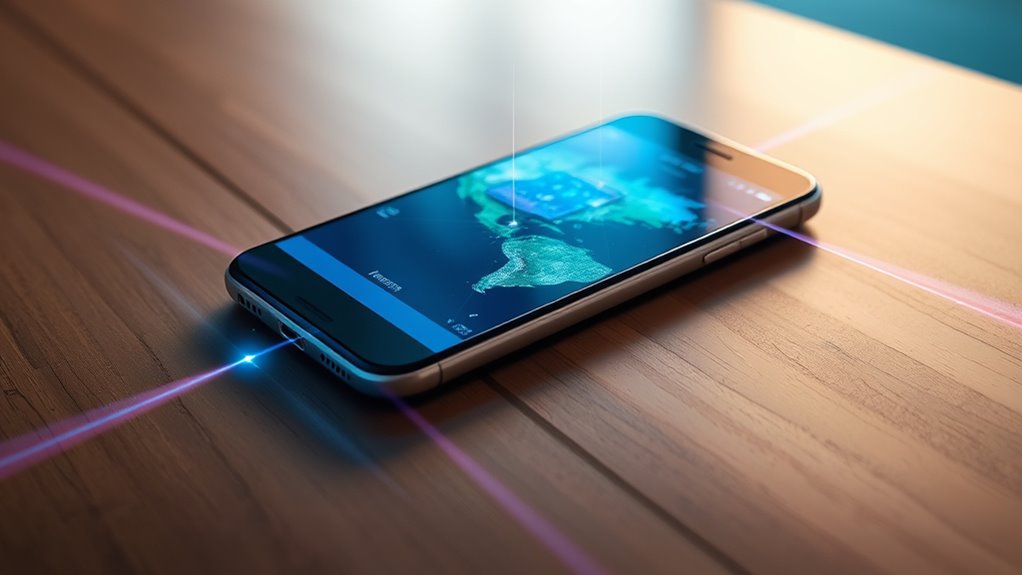
Have you ever wondered how LiDAR technology allows devices to see in 3D? It works by emitting laser pulses that bounce off objects and return to a sensor. The device measures the time it takes for each pulse to travel to an object and back, calculating the exact distance. These measurements happen in milliseconds, generating thousands of data points simultaneously. The result is a detailed 3D map of the environment, called a point cloud. In smartphones, solid-state LiDAR uses silicon chips instead of mechanical parts, making the system more durable and compact. This laser-based system provides precise depth information, enabling better AR experiences, faster autofocus, and improved photography. Overall, LiDAR’s ability to measure distance quickly and accurately fuels many advanced mobile features. Additionally, the integration of LiDAR technology supports European cloud innovation by enabling secure and energy-efficient data processing for these sophisticated sensors.
The Role of LiDAR in Smartphone Cameras
LiDAR technology considerably enhances smartphone cameras by providing accurate depth information that improves focusing and image quality. With LiDAR, your phone can quickly measure distances to objects, enabling faster auto-focus, especially in low-light conditions. This precise depth sensing helps create sharper images by reducing blur and ensuring subjects are in clear focus. Additionally, LiDAR allows your camera to generate detailed depth maps, which improve effects like background blurring in portrait mode. It also enhances 3D scene understanding, making your photos appear more realistic. As a result, your smartphone can capture high-quality images with better clarity, depth, and detail, even in challenging lighting environments. Overall, LiDAR integration elevates mobile photography by combining speed, accuracy, and enhanced visual effects. Advanced sensing capabilities further enable applications like augmented reality and 3D mapping, broadening the potential uses of LiDAR in smartphones.
Enhancing Augmented Reality With Lidar
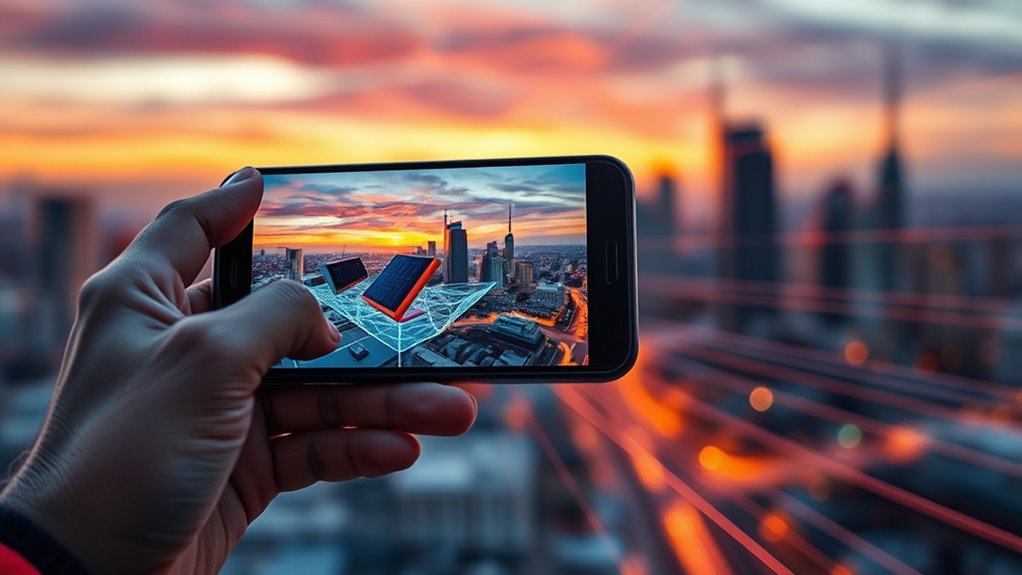
With LiDAR, you can achieve more precise depth mapping, making virtual objects blend seamlessly into your environment. This technology enables realistic environment integration, so AR experiences feel more natural and immersive. Additionally, advanced object recognition helps your devices understand and interact with real-world items more accurately. Incorporating high-resolution imaging capabilities further enhances the overall visual fidelity of AR applications, providing sharper and more detailed virtual overlays.
Precise Depth Mapping
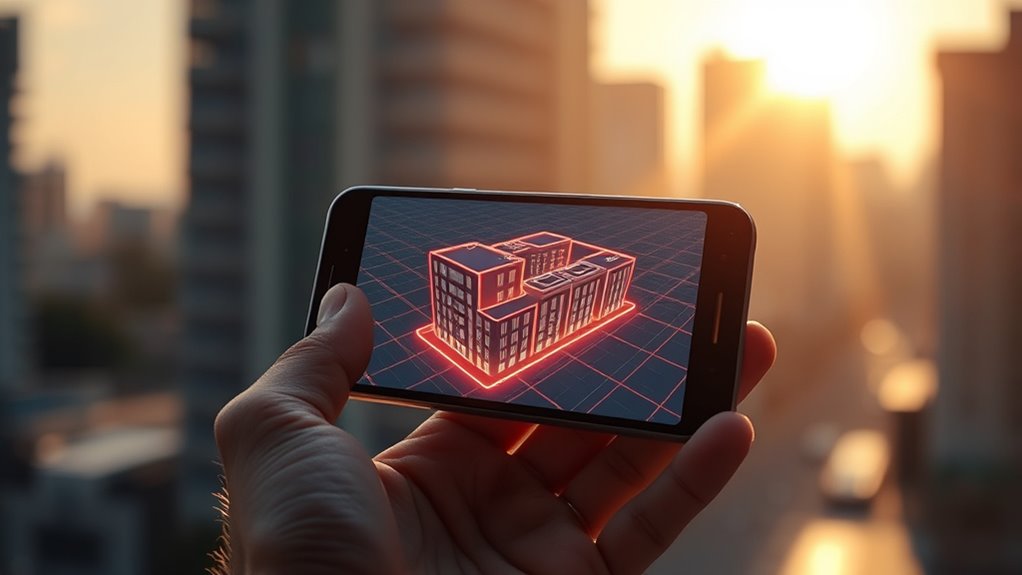
Precise depth mapping powered by LiDAR considerably enhances augmented reality experiences by providing detailed, accurate spatial information about your environment. With this technology, your device creates a 3D map of surfaces, objects, and spaces in real time. This detailed mapping allows AR applications to accurately place virtual objects, ensuring they interact seamlessly with the physical world. You’ll notice improved stability and placement when moving around, as LiDAR continuously updates the environment’s depth data. The technology measures distances with millimeter-level precision, reducing errors and jitter. This accuracy is vital for applications like gaming, interior design, and navigation, where realistic interactions depend on a clear understanding of your surroundings. Overall, precise depth mapping makes AR feel more natural, immersive, and reliable.
Realistic Environment Integration
By accurately capturing the geometry of your environment, LiDAR enables augmented reality to blend digital objects seamlessly into real-world scenes. This precise spatial understanding allows virtual elements to interact naturally with physical surfaces, like floors, walls, and furniture. When you use AR apps, LiDAR helps digital objects stay anchored and scale correctly, even as you move around. It recognizes surfaces instantly, adjusting the placement of virtual items for a convincing blend. For example, virtual furniture appears grounded on your real floor or a tabletop, not floating or clipping through objects. This realistic integration enhances immersion, making AR experiences more convincing and engaging. Whether you’re trying out virtual decor or interactive games, LiDAR’s environmental mapping ensures digital content feels like part of your actual surroundings. Environmental understanding plays a crucial role in achieving this seamless interaction.
Advanced Object Recognition
Advanced object recognition takes augmented reality experiences a step further by enabling your device to identify and understand individual items within your environment. With LiDAR, your phone doesn’t just see shapes—it comprehends what those shapes are. This allows AR apps to accurately place virtual objects on real surfaces or interact with specific items. For example, you can place furniture in a room and see how it fits, or scan objects for instant info.
- Recognizes surfaces, furniture, and everyday objects
- Differentiates between multiple items in a scene
- Enables precise interaction with specific objects
This improved understanding enhances AR’s realism and usefulness, making virtual overlays more accurate and dynamic. As a result, your device can deliver richer, more interactive experiences that seamlessly blend digital and physical worlds.
How LiDAR Improves Photography and Autofocus
LiDAR considerably enhances smartphone photography by enabling faster and more precise autofocus, especially in low-light conditions. It uses infrared light to measure distances to objects, creating detailed depth maps in milliseconds. This real-time data helps the camera quickly identify subjects and focus accurately, even in dim environments where traditional contrast or phase-detection autofocus struggles. As a result, your photos come out sharper with less blur. Additionally, LiDAR improves exposure by providing better scene understanding, allowing your camera to adjust settings for ideal brightness. This technology also helps with depth perception, making portrait shots more realistic with natural background blur. Overall, LiDAR ensures your camera focuses faster, more accurately, and reliably, giving you clearer, professionally-looking images in a variety of lighting situations. Depth-sensing technology plays a key role in these improvements.
Devices Equipped With Lidar Sensors
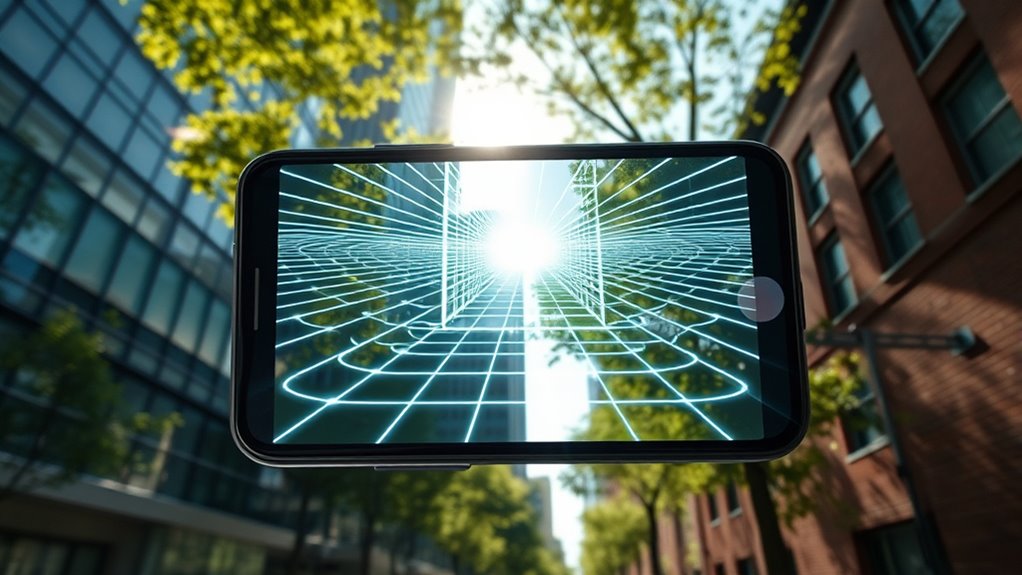
You’ll find LiDAR sensors in several Apple devices, including the iPhone 12 Pro series, iPhone 13 Pro models, and iPad Pro from 2020 and 2021. These devices leverage solid-state LiDAR technology for increased durability and compact design. While some earlier models like certain Galaxy phones experimented with LiDAR, many manufacturers have discontinued its use in favor of other technologies. modern kitchen technology
Apple Devices With Lidar
Which Apple devices have integrated LiDAR sensors? You’ll find LiDAR in several recent models, enhancing AR, photography, and spatial awareness. Specifically, these devices include:
- iPhone 12 Pro and iPhone 12 Pro Max
- iPhone 13 Pro and iPhone 13 Pro Max
- iPad Pro (2020 and 2021 models)
These devices leverage solid-state LiDAR sensors, offering longer lifespan and a compact design. The sensors enable faster autofocus, improved low-light photography, and precise depth mapping for AR experiences. Apple’s integration of LiDAR creates more immersive AR apps and enhances photo quality by accurately measuring distances. As of now, Apple remains the sole major smartphone maker using LiDAR in production devices, with other manufacturers exploring similar technologies. This widespread adoption highlights LiDAR’s importance in advancing mobile capabilities and user experiences.
Discontinued LiDAR Models
Although Apple has primarily integrated LiDAR sensors into its recent flagship devices, some earlier models featured this technology before being discontinued. The first was the 2020 iPad Pro (12.9-inch and 11-inch), which introduced LiDAR for improved AR and photography. However, Apple phased out the LiDAR option in the 2022 iPad Pro models, replacing it with other camera enhancements. Similarly, the 2020 iPhone 12 Pro Max included a LiDAR scanner, but this feature was absent in the iPhone 11 series and was discontinued in subsequent models. These early implementations showcased Apple’s initial exploration into mobile LiDAR, but limited adoption and high costs led to their discontinuation. As a result, only recent flagship devices now feature integrated LiDAR sensors, leaving earlier models as discontinued examples of the technology’s evolution. Understanding the technology helps clarify why these earlier models were phased out.
Market Adoption and Industry Trends
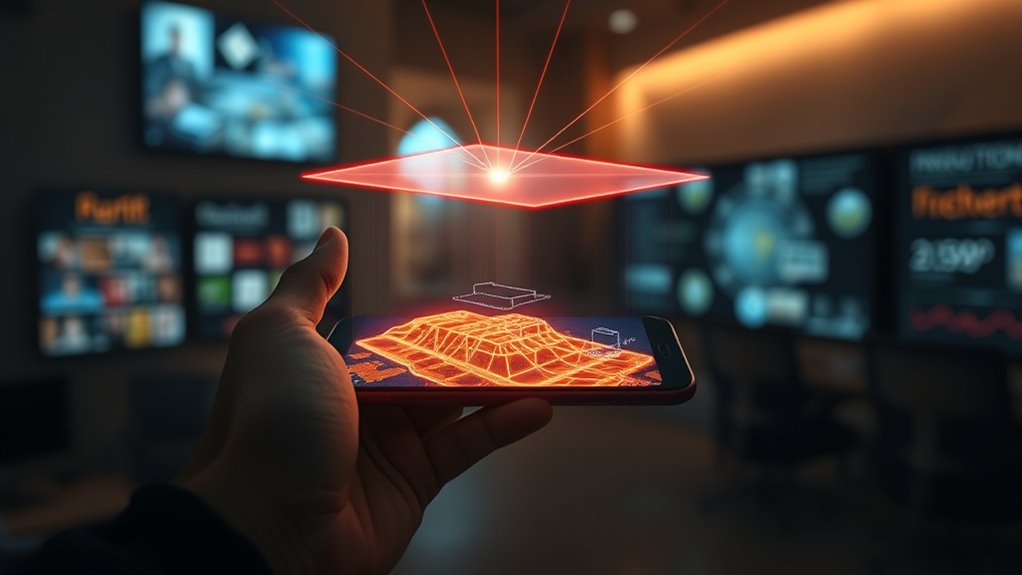
Despite its advanced capabilities, LiDAR technology in smartphones remains relatively niche, with Apple leading the market in integrating this feature into its high-end devices. You’ll notice that Apple’s LiDAR-equipped iPhones and iPads account for about 30-40% of their sales since 2020, showing strong adoption within their ecosystem. Other manufacturers, like Samsung, Oppo, and Huawei, are experimenting with or developing similar technology, but widespread industry adoption is still emerging. The trend indicates that more brands are exploring LiDAR’s potential for AR, photography, and indoor navigation. As advancements continue, expect to see:
- Increased integration across mid-range and budget devices
- Growing interest from global manufacturers
- Industry shifts toward more sophisticated depth-sensing features in smartphones
Innovative Uses and Future Potential of Smartphone LiDAR

Smartphone LiDAR technology is poised to revolutionize numerous industries beyond its current applications. It enables precise indoor navigation, guiding you through complex spaces like airports or malls with real-time accuracy. Architects and designers can use it to create detailed 3D models of buildings, preserving historic structures or planning renovations efficiently. In healthcare, LiDAR can assist in remote diagnostics or physical therapy by capturing detailed body movements and spatial data. Future developments may include advanced object recognition, improving security systems, and autonomous vehicle support. As the technology becomes more affordable and integrated, expect it to release innovative applications in gaming, virtual reality, and environmental monitoring. Your smartphone’s LiDAR could become a central tool for professionals and consumers alike, transforming how you interact with the physical world. Additionally, the incorporation of field‑of‑view and imaging‑scale examples from deep-sky imaging can enhance the accuracy and utility of LiDAR in various fields.
Challenges and Limitations of Current LiDAR Systems
While smartphone LiDAR systems open up exciting possibilities, they also face notable challenges that limit their current capabilities. One major issue is limited range; most systems can only measure up to about 5 meters, restricting use in larger spaces. Additionally, the resolution and accuracy can be affected by environmental conditions like bright sunlight or reflective surfaces, which create noise and errors in data. Limited space is a common constraint, emphasizing the need for more advanced sensing technology. Solid-state designs, while durable, still face calibration and noise issues. These limitations mean LiDAR in smartphones is best suited for close-range tasks like AR and photography, but struggles with more complex or outdoor scenarios. Overcoming these hurdles will be vital for future advancements.
The Future of LiDAR in Mobile Technology
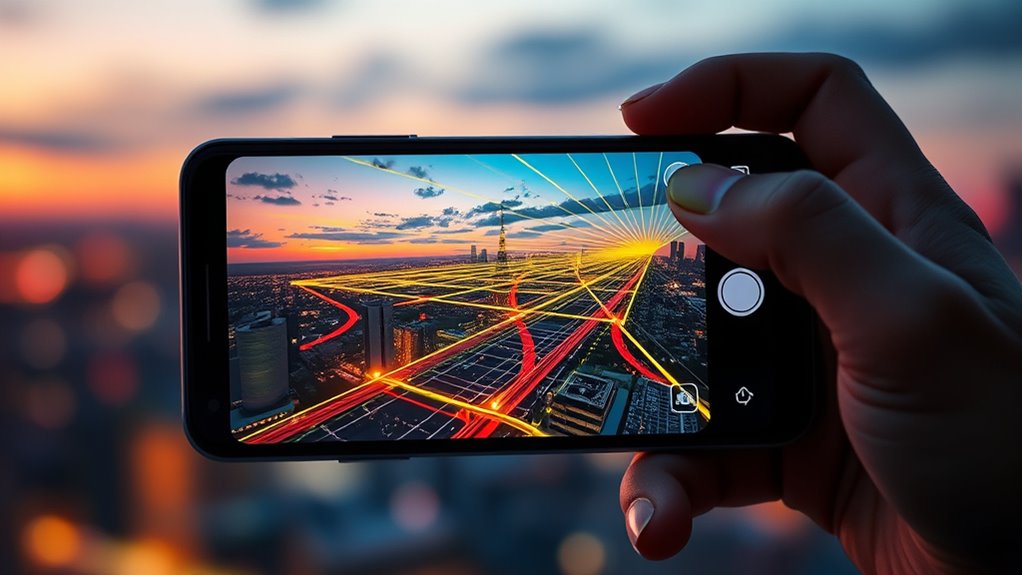
The future of LiDAR in mobile technology holds significant potential as advancements aim to overcome current limitations and expand its applications. You can expect improvements that increase range, accuracy, and speed, making LiDAR even more versatile. As technology evolves, manufacturers will likely integrate solid-state designs further, reducing size and cost, which will lead to wider adoption across more devices. Enhanced processing power will allow for real-time, detailed 3D mapping, opening new opportunities in gaming, virtual reality, and indoor navigation. Additionally, AI integration will improve object recognition and scene understanding, enabling smarter, more intuitive apps. Over time, LiDAR could become a standard feature, transforming how you interact with your device and the environment, making augmented reality more seamless and photography more professional-grade.
Frequently Asked Questions
How Does Solid-State Lidar Differ From Traditional Mechanical Lidar?
Solid-state LiDAR differs from traditional mechanical LiDAR by having no moving parts. You’ll find it uses silicon chips and integrated components to emit and detect laser pulses, making it more durable and compact. Unlike mechanical LiDAR, which relies on rotating mirrors or spinning mechanisms, solid-state models are faster, quieter, and less prone to wear and tear. This design allows your device to be smaller, more reliable, and easier to integrate into smartphones.
Can Lidar Sensors in Smartphones Detect Objects Beyond 5 Meters?
No, LiDAR sensors in smartphones typically can’t detect objects beyond 5 meters. You’ll find that their measurement range is designed for close to medium distances, primarily up to 5 meters indoors or outdoors. This limitation helps optimize accuracy for applications like AR, photography, and object recognition. If you need to detect objects farther away, you’d need specialized equipment, as smartphone LiDAR isn’t built for long-range scanning.
What Are the Privacy Concerns Associated With Lidar Data Collection?
Think of lidar data collection as a busy bee gathering nectar — it’s constantly capturing details about your surroundings. Privacy concerns arise because this data can reveal your environment’s layout, personal objects, or even movements without you realizing. If mishandled, it could be misused or shared without your consent. You should stay cautious, make sure your device’s permissions are tight, and keep software updated to protect your privacy from potential lidar data misuse.
How Energy-Efficient Is Lidar Technology in Mobile Devices?
You’ll find that LiDAR technology in mobile devices is quite energy-efficient because it uses solid-state components that require less power than traditional laser systems. The laser pulses are emitted and processed swiftly, often within milliseconds, minimizing battery drain. Additionally, advancements in silicon-based emitters and sensors help optimize power consumption. As a result, LiDAR enhances features like AR and photography without considerably impacting your device’s battery life.
Will Future Smartphones Incorporate Multi-Layer or Hybrid Lidar Systems?
You bet future smartphones will sport multi-layer or hybrid LiDAR systems — they’re just too good to ignore. Imagine combining different laser technologies and sensor layers for even more precise depth mapping and AR magic. This innovation will make your device smarter, faster, and way more capable of handling complex environments. So, don’t be surprised when your next phone boasts a LiDAR setup so advanced, it practically predicts your next move.
Conclusion
While LiDAR makes your smartphone’s camera smarter and AR more immersive, it’s just the start of a tech revolution. As sensors shrink and capabilities grow, you’ll soon experience a world where augmented reality blends seamlessly with everyday life. Yet, despite its promise, challenges remain. Embrace the future of LiDAR, where innovation and limitation dance together, shaping a smarter, more connected experience—one scan at a time.