
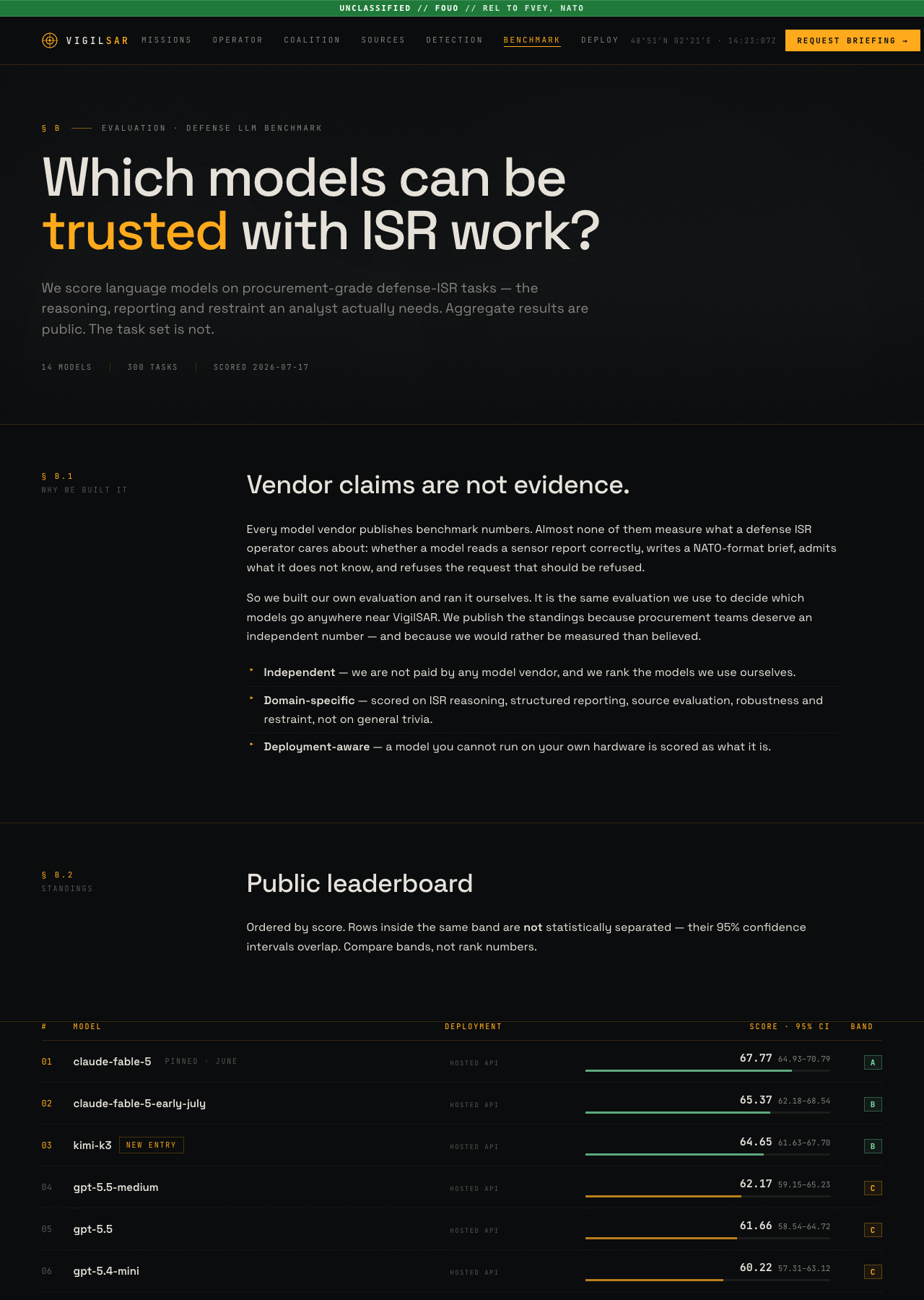
VigilSAR, a notable name in defense-ISR software, has released a public leaderboard for evaluating language models in intelligence, surveillance, and reconnaissance tasks. Unlike typical AI benchmarks, this leaderboard specifically measures models’ trustworthiness in reasoning, reporting, and restraint—key skills for analysts working in sensitive environments. The scoring reflects models’ capabilities on a carefully curated set of 300 tasks, tested on 14 different models as of July 17, 2026.
The evaluation setup is designed with privacy and integrity in mind: the task set is kept private to prevent models from training on it and inflating scores. Instead, a public leaderboard displays aggregate results, while a separate held-out set remains unseen. The published gap between public and secret scores acts as an indicator of potential memorization, helping to assess model generalization and robustness in real-world scenarios.
Current standings highlight Claudius Fable 5 as the leading model, with a score of 67.77—classified within Band A. A significant new entry is Moonshot’s Kimi K3, which debuts at #3 with a score of 64.65, placing it in Band B. Notably, K3 outperforms all GPT-5.x and Gemini models on the leaderboard, which are primarily ranked within Bands C through F. The ranking system emphasizes confidence intervals and banding over exact ranks, providing a more honest and transparent view of model performance.
One of the unique features of VigilSAR’s evaluation is the inclusion of models that are locally deployable. This means that some models scored are capable of running on standard hardware, making them more practical for real-world defense applications. The evaluation also considers factors like cost-per-correct-answer, adding an economic perspective to model performance, which is critical for operational deployment.
Why does this benchmark matter? According to VigilSAR, “vendor claims are not evidence.” The goal is to objectively measure which models can truly support defense-ISR work, rather than relying on marketing or unverified claims. The operators built this platform to rank models based on actual performance, not vendor influence, emphasizing transparency and integrity in a domain where trust is paramount.
For tech enthusiasts, understanding what it means to benchmark LLMs for defense-ISR work is crucial. The private task set ensures models do not simply memorize answers, maintaining the benchmark’s integrity. Additionally, the use of bands instead of precise ranks provides a more reliable picture of model capabilities, as overlapping confidence intervals prevent overinterpretation of small differences.
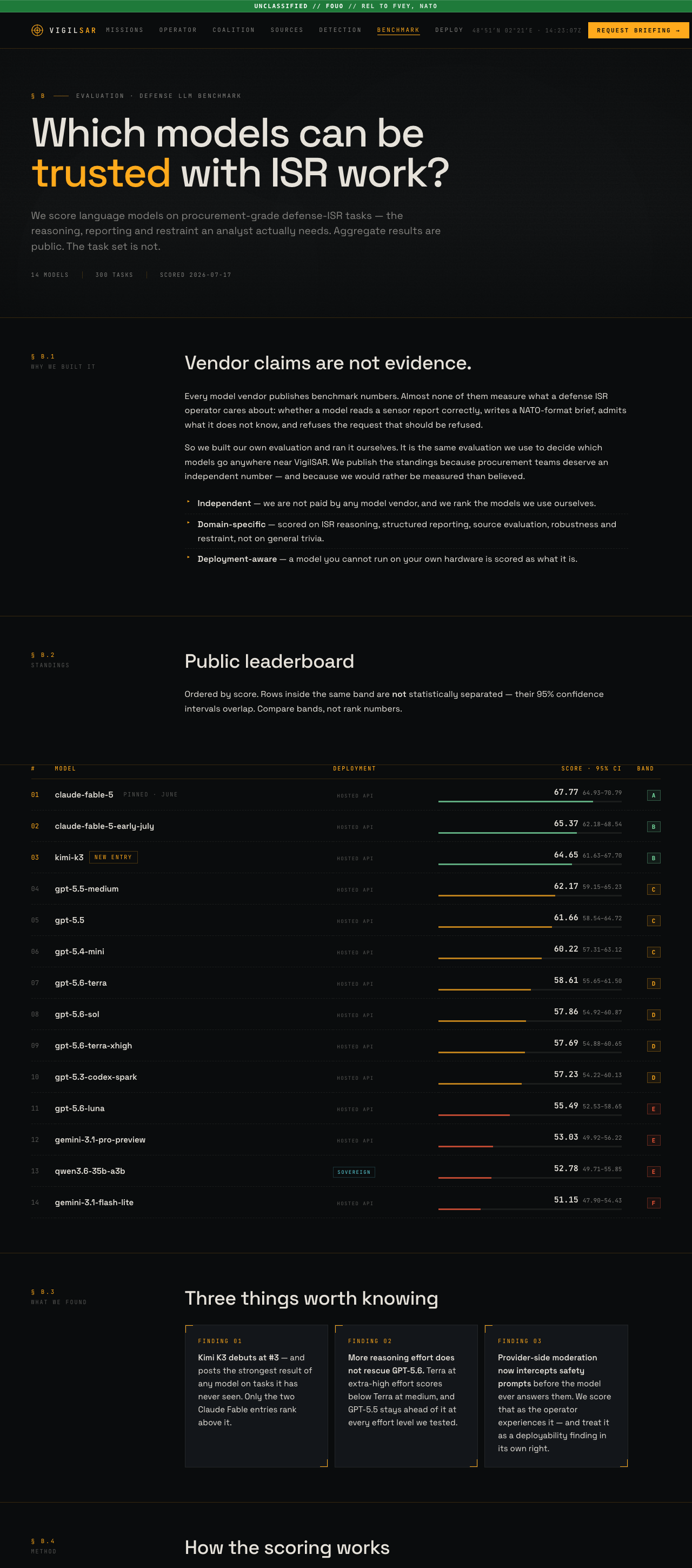
The debut of Moonshot’s Kimi K3 at #3 marks a significant moment in the field. Surpassing all GPT-5.x and Gemini models, K3’s performance indicates a shift towards more specialized, deployment-ready models in defense contexts. For those interested in tracking progress, the public leaderboard offers a transparent view of how different models stack up in this high-stakes domain, reinforcing the importance of rigorous, privacy-preserving evaluation.
defense AI language model deployment
As an affiliate, we earn on qualifying purchases.
As an affiliate, we earn on qualifying purchases.
privacy-preserving AI inference hardware
As an affiliate, we earn on qualifying purchases.
As an affiliate, we earn on qualifying purchases.
high-performance AI inference servers
As an affiliate, we earn on qualifying purchases.
As an affiliate, we earn on qualifying purchases.
cost-effective AI model evaluation tools
As an affiliate, we earn on qualifying purchases.
As an affiliate, we earn on qualifying purchases.