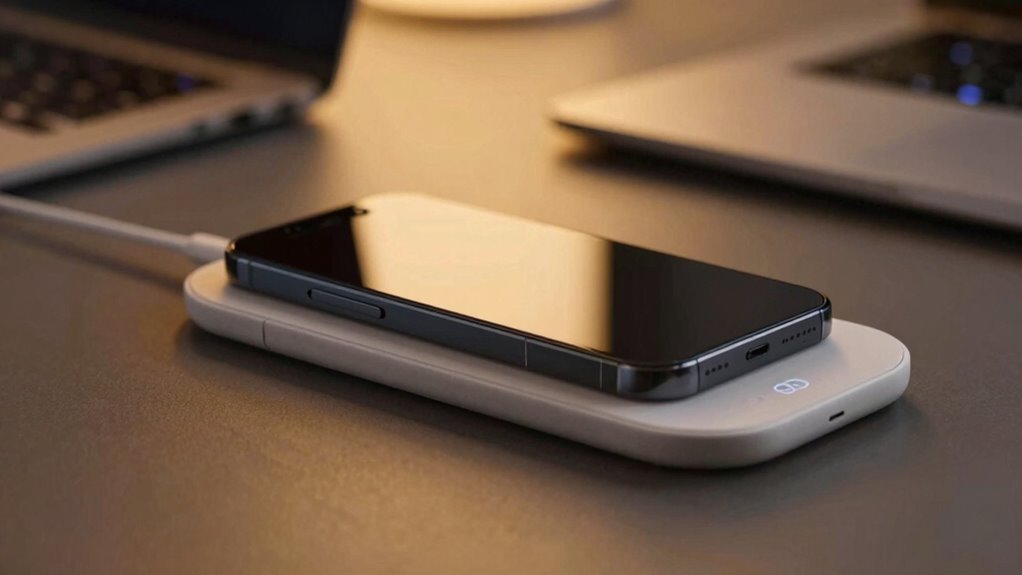

Wireless charging feels slower because safety measures limit the power transfer to prevent overheating and protect your battery’s health. It relies on electromagnetic fields, which are less efficient than wired connections, especially if your device isn’t perfectly aligned with the charging pad. Additionally, most wireless chargers use lower wattages, so they naturally take longer to charge your device. If you’re curious about how technology keeps improving this process, you’ll find more details ahead.

Get the latest gadgets delivered free — and shop member deals
- Fast, free delivery on millions of items
- Access to Prime Big Deal Days deals on October 6–7
- Prime Video, Amazon Music and more included
Key Takeaways
- Wireless chargers generate heat, prompting safety features that slow down charging to protect the battery.
- Energy transfer inefficiencies and misalignment reduce actual power delivery, extending charging times.
- Lower wattage wireless chargers prioritize safety, resulting in slower charging compared to wired fast chargers.
- Advances in technology aim to improve speed but current standards still favor safety and battery health.
- Wireless charging is designed for safety and convenience, often making it slower than wired alternatives.
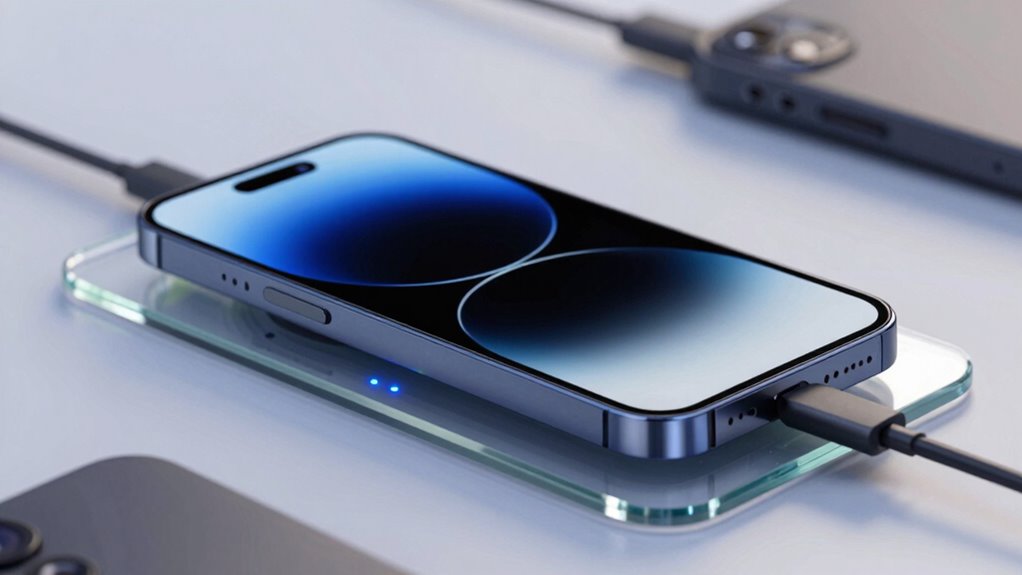
Many users expect wireless charging to be as quick and efficient as wired methods, but in reality, it often feels slower than anticipated. This discrepancy can be frustrating, especially when you’re used to the rapid pace of traditional charging cables. One reason for this perception is the way wireless charging prioritizes battery safety over raw speed. Wireless chargers generate heat during the transfer process, and excessive heat can compromise your device’s battery safety. To prevent overheating, many chargers and devices automatically slow down the power transfer once they detect rising temperatures. This built-in safeguard, while vital for long-term battery health, naturally results in slower charging speeds compared to wired options.
Charging efficiency also plays a significant role here. Wireless charging relies on electromagnetic fields to transfer energy, which introduces some inherent inefficiencies. Unlike wired connections, where electricity flows directly through a cable, wireless charging involves a transfer through air gaps and coils. These gaps can cause energy loss, meaning that a portion of the power you’re sending to your device doesn’t actually reach the battery. As a result, it takes longer to achieve full charge, especially if your device or charger isn’t optimized for high power transfer. Additionally, any misalignment between the device and the charging pad can further decrease efficiency, forcing the charger to work harder and extend charging times. Proper alignment and device compatibility are crucial for maximizing charging efficiency.
Another factor to contemplate is the charging technology itself. Many wireless chargers operate at lower wattages compared to fast wired chargers. While wired fast chargers can deliver 30W, 50W, or even higher, many wireless chargers max out at 10W or 15W. This difference means your device receives power more slowly, even if you’re using the same device and battery capacity. The slower power transfer isn’t necessarily a flaw; it’s a trade-off for a safer, more convenient charging experience that minimizes heat buildup and prolongs battery life. Furthermore, the design of wireless charging pads often emphasizes landscape compatibility and aesthetics over maximum wattage, which can influence charging speed. Innovations in wireless charging technology are ongoing, aiming to bridge the gap between safety and speed. An additional consideration is that newer standards are being developed to enhance transfer rates, which could improve charging times in future devices.
In addition, the technology behind wireless charging continues to evolve, with newer standards aiming to improve transfer rates and efficiency over time. While it might be frustrating to wait longer, this balance between speed and safety reflects thoughtful engineering designed to protect your device’s longevity. In the end, your perception of slower wireless charging isn’t just about speed. It’s about the delicate balance between charging efficiency and battery safety. Wireless charging might feel slower, but it’s designed to protect your device’s battery health and ensure safer use over time. While it might not match the speed of wired charging, the convenience and safety benefits often outweigh the waiting time, especially for overnight or passive charging scenarios.
wireless charging pad with fast charging
As an affiliate, we earn on qualifying purchases.
As an affiliate, we earn on qualifying purchases.
Frequently Asked Questions
Does the Type of Phone Affect Wireless Charging Speed?
Yes, your phone type influences wireless charging speed. Different models have varying battery health and charging ergonomics, which affect how efficiently they charge wirelessly. Older phones or those with degraded batteries may charge slower, and some phones are designed with better alignment features for faster charging. To optimize speed, make sure your device’s battery health is good and that you position it correctly on the charger, enhancing overall charging performance.
Can Using a Phone While Charging Slow Down Wireless Charging?
Using your phone while wireless charging is like trying to juggle while riding a bike—it slows things down. When you do, your device uses power actively, which can interfere with efficient charging, making it feel slower. Poor charging habits and declining battery health can compound this issue, preventing your phone from reaching full speed. To optimize charging, avoid using your phone during wireless charging sessions whenever possible.
What Is the Maximum Safe Wireless Charging Wattage?
The maximum safe wireless charging wattage typically ranges from 10 to 15 watts for most smartphones, which helps preserve your battery health. Higher wattages can accelerate power transfer but may generate more heat, risking battery degradation over time. To keep your device’s battery healthy, stick to the recommended wattage. Using chargers with proper cooling and avoiding high wattage transfers during intensive use can help maintain ideal battery health.
Do Wireless Chargers Lose Efficiency Over Time?
Wireless chargers do lose efficiency over time, much like a car engine becomes less smooth with use. As your device’s battery degrades, power transfer becomes less effective, causing slower charging speeds. Dust, dirt, or misalignment can also reduce efficiency. Regularly cleaning the charging pad and ensuring proper placement helps maintain performance. Ultimately, gradual wear and tear from regular use cause wireless chargers to become less efficient over time.
How Does Temperature Impact Wireless Charging Speed?
Battery temperature greatly impacts wireless charging speed. When your device gets too hot, heat dissipation becomes less efficient, causing the charging process to slow down to prevent damage. If your phone overheats, it may temporarily reduce charging speed or stop altogether. To improve speed, keep your device in a cool environment, and avoid blocking ventilation areas, ensuring ideal heat dissipation and maintaining steady wireless charging performance.
As an affiliate, we earn on qualifying purchases.
Conclusion
Remember, patience is a virtue. Wireless charging might feel slower, but it’s a trade-off for convenience and safety. Don’t let the wait frustrate you—sometimes good things take time. As the saying goes, “All good things come to those who wait.” Embrace the process, knowing that your device will be ready when it’s truly charged. In the end, a little patience will always power you through.
magnetic alignment wireless charger
As an affiliate, we earn on qualifying purchases.
As an affiliate, we earn on qualifying purchases.
wireless charging stand for Samsung
As an affiliate, we earn on qualifying purchases.
As an affiliate, we earn on qualifying purchases.
Fall Picks
fall essentials
As an affiliate, we earn on qualifying purchases.