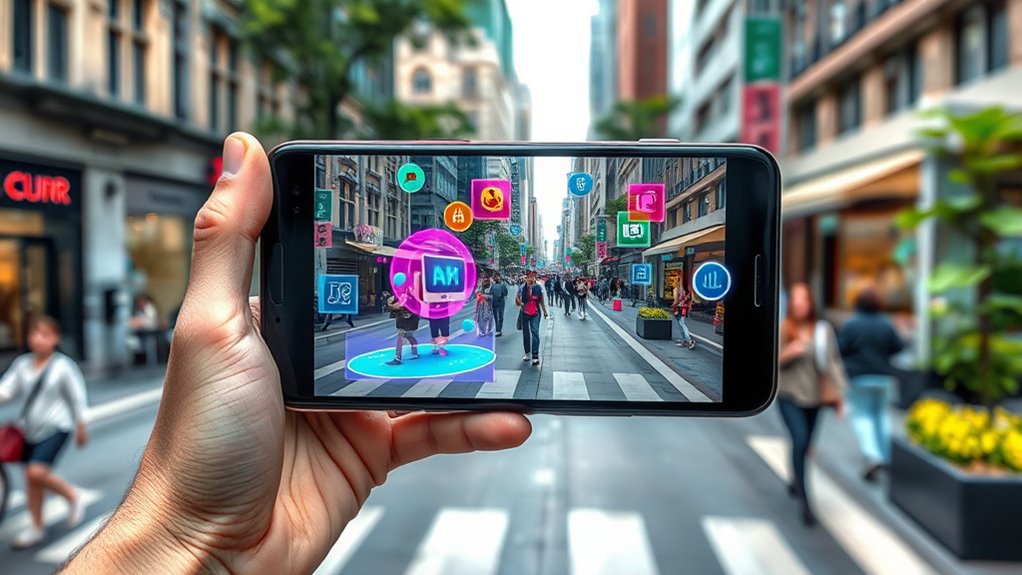

Augmented reality (AR) on phones blends virtual content with the real world through your device’s camera, creating immersive experiences. You can visualize products like clothes, glasses, or furniture without physically trying them on or buying first. AR also brings games to life and enhances daily activities such as navigation, education, and interior design. As this technology evolves, it offers even more engaging ways to interact with your surroundings—so keep exploring to learn more about how AR transforms your everyday life.
Key Takeaways
- AR on phones overlays virtual objects onto the real world, creating immersive and interactive experiences without additional equipment.
- It enables virtual try-ons for shopping, such as clothes, glasses, and makeup, enhancing online purchasing.
- AR gaming integrates digital characters into physical spaces, like Pokémon GO, encouraging outdoor activity and social interaction.
- Daily activities like navigation, education, and interior design benefit from AR overlays that simplify tasks and visualize ideas.
- Most smartphones support AR with ongoing advancements improving performance, realism, and new applications for enhanced user engagement.

Augmented reality (AR) on phones has become an exciting way to blend digital content with the real world, transforming how you interact with your environment. With just a few taps on your device, you can overlay virtual objects onto your surroundings, making experiences more immersive and engaging. One of the most popular uses of AR is virtual try-ons, where you can see how clothes, accessories, or makeup look on you without stepping into a store. For instance, many fashion and beauty apps let you hold up your phone and instantly see how a new pair of glasses or lipstick shade will appear on your face. This technology saves you time and helps you make better purchasing decisions because you can try before you buy, all from the comfort of your home.
AR gaming is another thrilling application that capitalizes on your phone’s capabilities. Instead of traditional screen-based games, AR gaming brings characters and environments into your real-world space. Games like Pokémon GO became a sensation because they encouraged players to explore outdoor environments while capturing virtual creatures that appeared through their phone screens. This blend of physical movement and digital interaction makes gaming more active and social. You can walk around your neighborhood, hunt for hidden treasures, or compete with friends, all while engaging with augmented elements seamlessly integrated into your surroundings.
AR gaming brings characters into your real-world space, making play active, social, and immersive.
Beyond shopping and gaming, AR on phones enhances everyday activities. Educational apps use AR to bring textbooks and museum exhibits to life, making learning more interactive and memorable. Navigation apps now incorporate AR to guide you through unfamiliar streets, overlaying arrows and street names directly onto the real-world view on your phone. This makes finding your way easier and more intuitive. Similarly, interior design apps allow you to visualize furniture and decor in your own space before making any purchases, reducing guesswork and helping you create the look you want.
The beauty of AR on phones is how accessible it is. You don’t need specialized equipment—most modern smartphones are capable of supporting AR features. As technology advances, you’ll see even more innovative uses, from virtual fitting rooms to immersive AR experiences that transform your daily routines. High refresh rates and low input lag in certain devices further enhance the responsiveness of AR applications, making interactions smoother and more realistic. Whether you’re trying on clothes virtually, exploring new games, or simply navigating your city, AR on phones opens up a world of possibilities right at your fingertips. It’s an exciting time to see how digital and physical worlds continue to merge, making everyday interactions more engaging, efficient, and fun.

RayNeo Air 3s AR/XR Glasses, 201" at 6m, 120Hz FHD HueView Display, Portable AR Video Eyewear Gaming Glasses for iPhone 17/16/15, Android, Mac, Switch, PS5, Steam Deck – 3S-Silver
[Quantum Leap in Image Quality]:RayNeo's latest HueView empowers vision with 98% DCI-P3, ΔE <2 color accuracy, 200,000:1 infinite…
As an affiliate, we earn on qualifying purchases.
As an affiliate, we earn on qualifying purchases.
Frequently Asked Questions
How Accurate Is AR on Different Phone Models?
AR accuracy varies across phone models due to differences in sensor calibration and device compatibility. Higher-end phones with advanced sensors and better calibration tend to deliver more precise AR experiences. Cheaper models may struggle with accuracy because of less sophisticated hardware. Always verify your device’s sensors are well-calibrated and check compatibility with AR apps for the best results. Upgrading your phone or updating software can also improve AR performance.
What ARe the Privacy Concerns With AR Apps?
You should be aware that AR apps pose privacy risks because they often collect data like your location, camera feeds, and usage habits. This data collection can be exploited or shared without your consent, raising concerns about your personal privacy. Always review permissions carefully, limit what data you share, and use trusted apps to reduce these privacy risks and protect your information while enjoying AR experiences.
Can AR Be Used Offline Effectively?
Yes, AR can be used offline effectively, especially for apps with robust offline functionality. You’ll find that many AR apps allow you to access certain features without an internet connection, improving app accessibility when you’re in areas with limited or no connectivity. Keep in mind, though, some advanced features or real-time updates might require online access, but core AR experiences often work seamlessly offline.
How Does AR Impact Battery Life?
AR substantially impacts your phone’s battery life through increased power consumption. When you use AR apps, your device’s camera, sensors, and graphics processor work harder, draining the battery faster. To minimize this, you can enable battery optimization features, reduce screen brightness, and limit AR app usage. These steps help conserve power, ensuring your device lasts longer while enjoying augmented reality experiences.
What Future Developments ARe Expected in Mobile AR Technology?
The future of mobile AR is bright, and it’s clear you’ll soon see more wearable integration and augmented reality gaming. As technology advances, expect lighter, more seamless devices that blend AR into your daily life, making experiences more immersive. You’ll find smarter interactions, richer graphics, and better battery efficiency. This evolution will turn your smartphone into a super-powered tool, opening doors to endless possibilities—so stay tuned, because the best is yet to come.
AR furniture visualization app
As an affiliate, we earn on qualifying purchases.
As an affiliate, we earn on qualifying purchases.
Conclusion
As you explore augmented reality on your phone, you’ll notice how it transforms everyday experiences. Did you know that by 2025, over 3.5 billion AR-enabled devices are expected worldwide? This rapid growth shows just how integral AR has become in gaming, shopping, and education. So, next time you use AR, remember you’re part of a trend that’s reshaping how we see and interact with the world around us. It’s an exciting time to be tech-savvy!

SUNCHI Universal Mobile Game Joystick Spiral Mini Joystick Game Handle Grip Controller Rocker Joypad Foldable Stand Holder for Cellphones (Handle Holder)
✔ it is not a electronic product ,Compatible with all touch-screen smartphones ,all iPhone and Android phone. It…
As an affiliate, we earn on qualifying purchases.
As an affiliate, we earn on qualifying purchases.

VITURE Luma Pro XR Glasses — 152” 1200p 120Hz Ultra Sharp Display, 52° FOV, Electrochromic Film,Myopia Adjustments, Harman Audio, AR Glasses for iPhone 17/16/15, Android, Mac, PC, Steam Deck, Switch 2
【A 1200P ULTRA SHARP DISPLAY YOU’LL NEVER FORGET — EVEN SHARPER THAN VITURE PRO】Step into a jaw-dropping 152”…
As an affiliate, we earn on qualifying purchases.
As an affiliate, we earn on qualifying purchases.